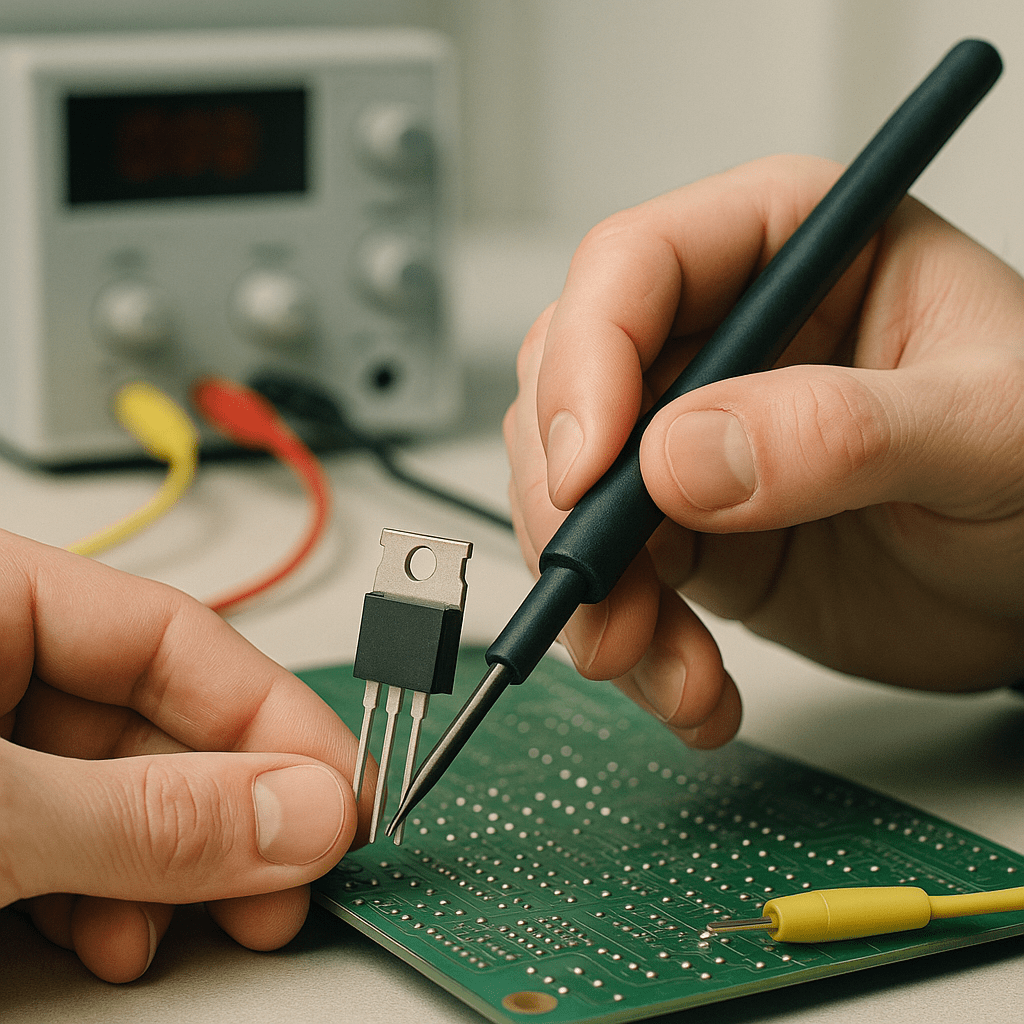
The source‑series resistance (Rₛ) and drain‑series resistance (Rᴅ) are the parasitic resistances that appear in series with the source and drain terminals of a MOSFET.
They arise from the silicon substrate, metallization layers, and package leads that connect the internal transistor to the external pins.
When the device is turned on, the total on‑resistance (Rₒₙ) measured between drain and source consists of three components: the intrinsic channel resistance (Rᴅₛ(on)), plus Rₛ and Rᴅ.
Accurately determining Rₛ and Rᴅ is important for predicting voltage drops, calculating power dissipation, and creating realistic circuit simulations.
When a MOSFET conducts, the current does not travel through a perfect conductor; instead, it encounters small but measurable resistances associated with the source and drain connections. These parasitic elements—known as the source‑series resistance (Rₛ) and the drain‑series resistance (Rᴅ)—are introduced by the silicon substrate, the metal interconnects, and the external package leads that link the transistor’s internal structure to its pins.
In practice, the total on‑resistance (Rₒₙ) observed across the drain‑source terminals is the sum of three contributions: the intrinsic channel resistance (Rᴅₛ(on)), which is governed by the gate bias and device geometry, plus the two series resistances Rₛ and Rᴅ.
Determining these series resistances typically involves biasing the MOSFET fully on, applying a known current, measuring the resulting voltage drop, and subtracting the datasheet‑specified Rᴅₛ(on) from the measured total. The remaining value represents the combined source‑and‑drain resistance, which can be split into individual Rₛ and Rᴅ values by assuming symmetry, swapping source and drain in a second measurement, or using a four‑wire (Kelvin) technique.
Knowing Rₛ and Rᴅ enables designers to accurately predict voltage losses, compute power dissipation, and build precise simulation models, ultimately leading to more reliable and efficient electronic designs.
BitcoinVersus.Tech Editor’s Note:
We volunteer daily to ensure the credibility of the information on this platform is Verifiably True.
If you would like to support to help further secure the integrity of our research initiatives, please donate here: bc1qrved9tfquym6u3age7xhmnkjs2lq8j9aulperagkuhtuk5w5c35ssfpge8
BitcoinVersus.tech is not a financial advisor. This media platform reports on financial subjects purely for informational purposes.
 Bitcoin Versus
Leave a comment