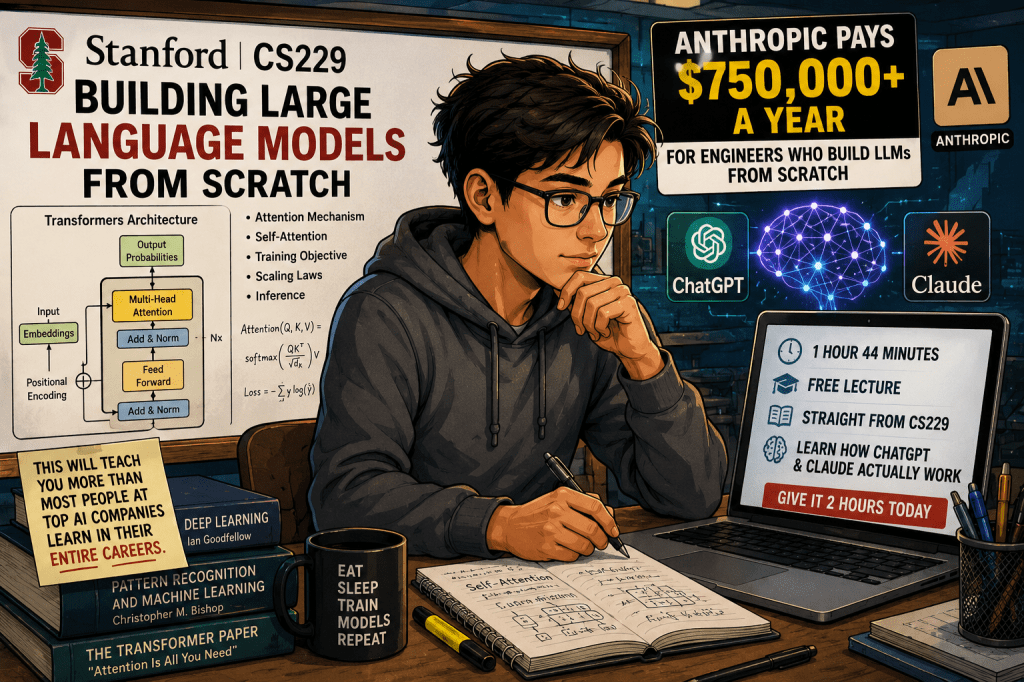
Artificial intelligence education is becoming increasingly accessible after reports surfaced that Anthropic is paying more than $750,000 annually for elite engineers capable of building large language models from scratch, while Stanford University released a free CS229 lecture breaking down the core mathematics and engineering behind systems like ChatGPT and Claude.
The lecture reportedly runs 1 hour and 44 minutes and focuses on the foundations of machine learning architectures powering modern generative AI systems.
Large language models, commonly referred to as LLMs, rely on neural network architectures trained on enormous datasets using advanced GPU infrastructure and distributed computing systems.
The release of educational material from Stanford arrives as AI companies aggressively compete for top engineering talent capable of designing transformer architectures, optimizing training pipelines, improving inference efficiency, and scaling foundation models across massive data center clusters.
The growing demand for elite AI engineers reflects the broader economic race surrounding artificial intelligence infrastructure. Companies including OpenAI, Google DeepMind, Meta AI, and Anthropic continue investing billions into advanced compute systems, GPU deployments, and AI research talent.
Universities and open educational platforms are increasingly responding by releasing advanced coursework publicly, allowing engineers, students, and independent researchers to study concepts previously limited to elite academic and corporate environments.
The lecture has also renewed interest in open source AI education as developers seek deeper understanding of transformers, attention mechanisms, gradient descent, tokenization, embeddings, and reinforcement learning systems used in modern conversational AI.
Industry observers note that practical understanding of these systems has become one of the highest value technical skills in the global software economy as enterprises accelerate adoption of generative AI technologies.
BitcoinVersus.Tech Editor’s Note:
We volunteer daily to ensure the credibility of the information on this platform is Verifiably True. If you would like to support to help further secure the integrity of our research initiatives, please donate here: 3C9o19EH5HSiwEPyCTmEKzxhNCbo2X6TTb
BitcoinVersus.tech is not a financial advisor. This media platform reports on financial subjects purely for informational purposes.


Leave a Reply