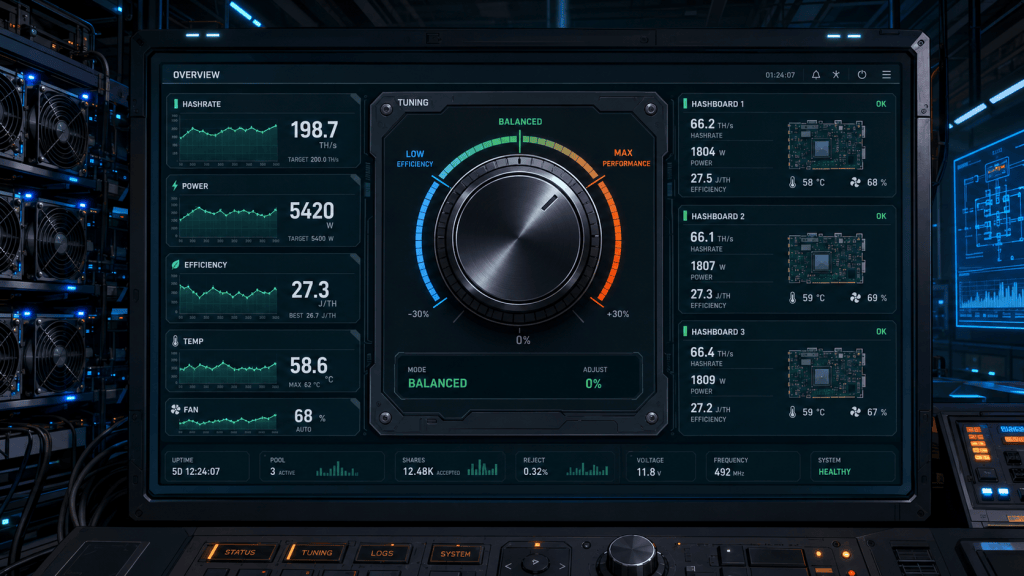
ChatGPT’s new reasoning-effort slider may look like a fresh artificial-intelligence interface, but the basic design philosophy has existed in Bitcoin ASIC mining for more than a decade.
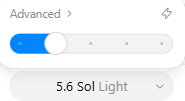
The control allows a user to move between lighter, faster processing and deeper, slower reasoning. OpenAI explains that higher reasoning effort can improve complex results but generally takes longer and consumes more tokens. It is essentially a user-facing compute profile—not a literal adjustment to processor voltage or clock frequency.
Custom solutions built on or replacing early CGMiner-based software (dating to ~2011) enabled overclocking, underclocking, and domain- or chip-level adjustments for better efficiency and hashrate.
Enterprise level Bitcoin mining firmware began implementing performance controls during the first generation of Antminer hardware.
In late 2013, Antminer S1 operators were already changing ASIC clock frequency through firmware to increase output from approximately 180 GH/s to 200 GH/s.
A November 2013 support thread also documents an official overclocking firmware update. By 2014, the Antminer S3 manual explicitly displayed the ASIC operating frequency through its browser-based management interface, and stock S3 firmware contained selectable frequency values. 2013 Antminer S1 documentation, 2014 Antminer S3 manual
However, early frequency controls should not be confused with modern ASIC autotuning. Advanced firmware capable of optimizing both voltage and frequency became established later. Antminer S9 firmware with voltage, fan and frequency controls was publicly documented in 2018.
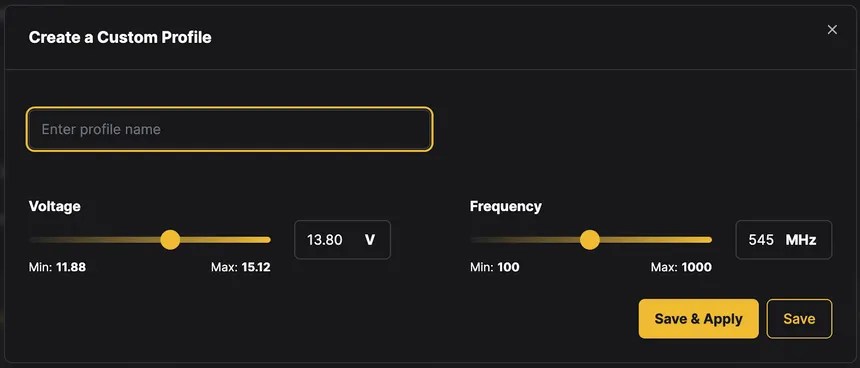
Asic.to, associated with the VNish firmware ecosystem, says its autotuning technology was developed in 2017 and released publicly in 2018. Modern systems such as VNish, LuxOS, Braiins OS, Hashcore and AxeOS can apply performance profiles or test chips and hashboards to find more efficient operating points.
The most accurate historical answer
- 2013: Firmware-based ASIC frequency changing and overclocking were already available on the Antminer S1.
- 2014: Browser-based miner interfaces visibly reported or exposed ASIC-frequency settings.
- 2017–2018: Automated voltage-and-frequency tuning began appearing in aftermarket Antminer S9 firmware.
- 2019–2020: Advanced per-chip autotuning became more polished and commercially established through platforms such as Braiins OS+ and competing firmware.
- Today: ASIC firmware can tune individual chips, hashboards, power targets, fan behavior and efficiency profiles.
Is ChatGPT borrowing from ASIC firmware?
Conceptually, the comparison is valid. Both interfaces reduce a complicated resource-management system to a simple user control:
The stronger claim—that OpenAI directly copied mining firmware—is not supported by available evidence. Sliders, performance modes and “power versus efficiency” controls have also existed in CPUs, GPUs, operating systems and industrial-control interfaces for decades.

The more defensible angle is that AI companies are adopting a familiar systems-engineering interface pattern: giving the user a simplified control over performance, resource consumption and response time.
Mining firmware has long offered accessible voltage/frequency profiles and auto-tuners precisely because silicon variation and operating conditions demand them, and modern AI interfaces are adopting analogous “effort” or model-tier selectors for the same reason of giving users controllable trade-offs.
The mining tools predate the ChatGPT feature by years, so the resemblance highlights how practical control surfaces evolve across industries once hardware or models become tunable at scale.
In short, the GUI concept has proven effective in ASIC firmware for nearly a decade and now appears in consumer AI products for analogous reasons of optimization and user agency.
BitcoinVersus.Tech Editor’s Note:
We volunteer daily to ensure the credibility of the information on this platform is Verifiably True. If you would like to support to help further secure the integrity of our research initiatives, please donate here: 3C9o19EH5HSiwEPyCTmEKzxhNCbo2X6TTb
BitcoinVersus.tech is not a financial advisor. This media platform reports on financial subjects purely for informational purposes.


Leave a Reply