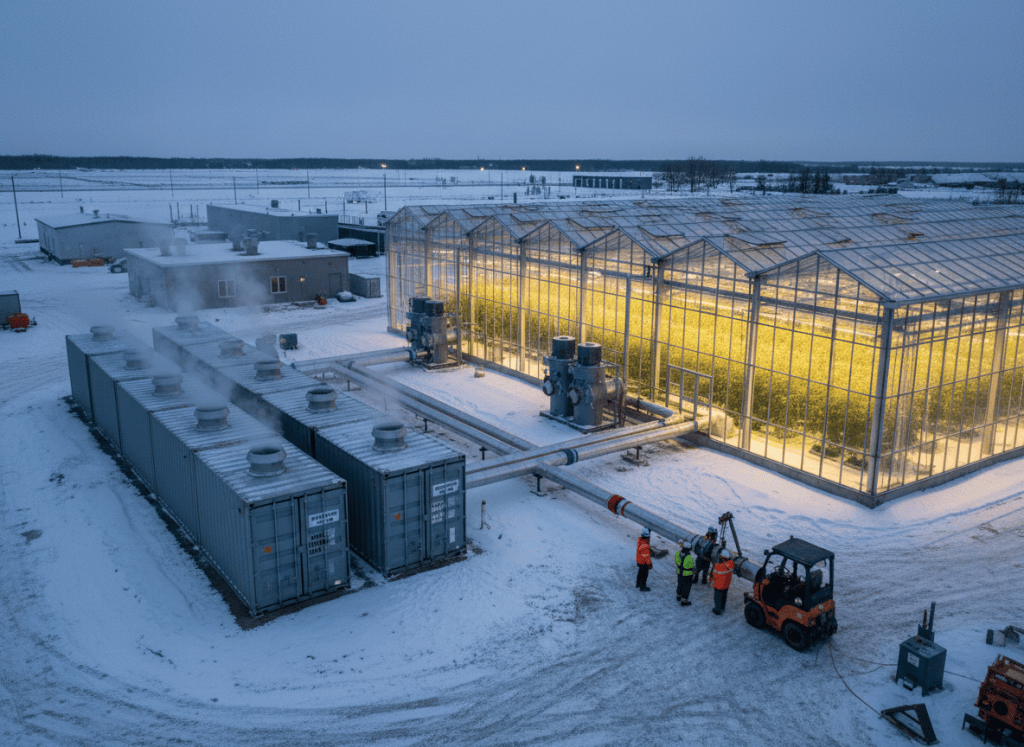
Canaan says installation is now underway on a 3-megawatt Bitcoin mining heat-recovery project in Manitoba, Canada, moving the company’s greenhouse pilot from planning toward real-world operation ahead of the winter heating season.
In its September 14 mining update, Canaan reported that the computing equipment had arrived at the site and installation was underway. The project was first announced in January as a 24-month proof of concept with Bitforest Investment Ltd. designed to test whether heat produced by high-density computing can be reused as a practical input for commercial agriculture.
360 Liquid-Cooled Avalon Miners
The system is planned around 360 Avalon A1566HA-460T liquid-cooled computing servers housed in four liquid-cooling container modules. Rather than rejecting the miners’ thermal output through conventional cooling infrastructure, the design routes recovered heat through a closed-loop heat exchanger that preheats intake water for the greenhouse’s electric boilers.
Canaan estimates that approximately 90% of the electricity consumed by the computing servers could ultimately be captured and transferred to the heating system, although the company has emphasized that the actual efficiency will need to be confirmed under operating conditions. The host is targeting 95% uptime for the equipment.
The thermal design connects directly with a broader shift in data-center cooling: heat increasingly is being treated as something that can be transported and reused rather than simply removed. Liquid cooling is especially important for this approach because it can move heat into a controlled fluid loop that is easier to integrate with boilers, district heating systems, industrial processes, or agricultural infrastructure.
Bitcoin Mining as a Thermal System
From an engineering perspective, the project is a useful reminder that a Bitcoin miner is not only a computing device. Nearly all of the electrical energy entering an ASIC mining system ultimately becomes heat. The practical question is whether operators can capture that thermal output at a useful temperature and move it somewhere that already needs heat.
Canaan’s Avalon platform is part of the specialized SHA-256 hardware ecosystem covered in BitcoinVersus.tech’s Bitcoin ASIC architecture overview. In this greenhouse project, the mining hardware’s electrical efficiency still matters for Bitcoin production, but the thermal characteristics of the system become equally important because the heat itself has a second intended use.
If the Manitoba pilot performs close to Canaan’s estimates, the project could provide operating data on heat-transfer efficiency, equipment stability, maintenance intensity and the economics of eliminating some conventional heat-rejection equipment. Canaan has said the design may also reduce capital requirements by removing the industrial cooling towers that otherwise could be needed in a liquid-cooled data-center deployment.
The installation does not prove that mining heat reuse will work economically in every climate or facility. Its value is that it turns the idea into a measurable operating system. Cold-weather regions with simultaneous demand for computing and heat are among the most logical places to test whether the same megawatts can produce both SHA-256 computation and useful thermal energy.
BitcoinVersus.Tech Editor’s Note:
BitcoinVersus.tech is not a financial advisor. This media platform reports on financial and technology subjects purely for informational purposes.


Leave a Reply