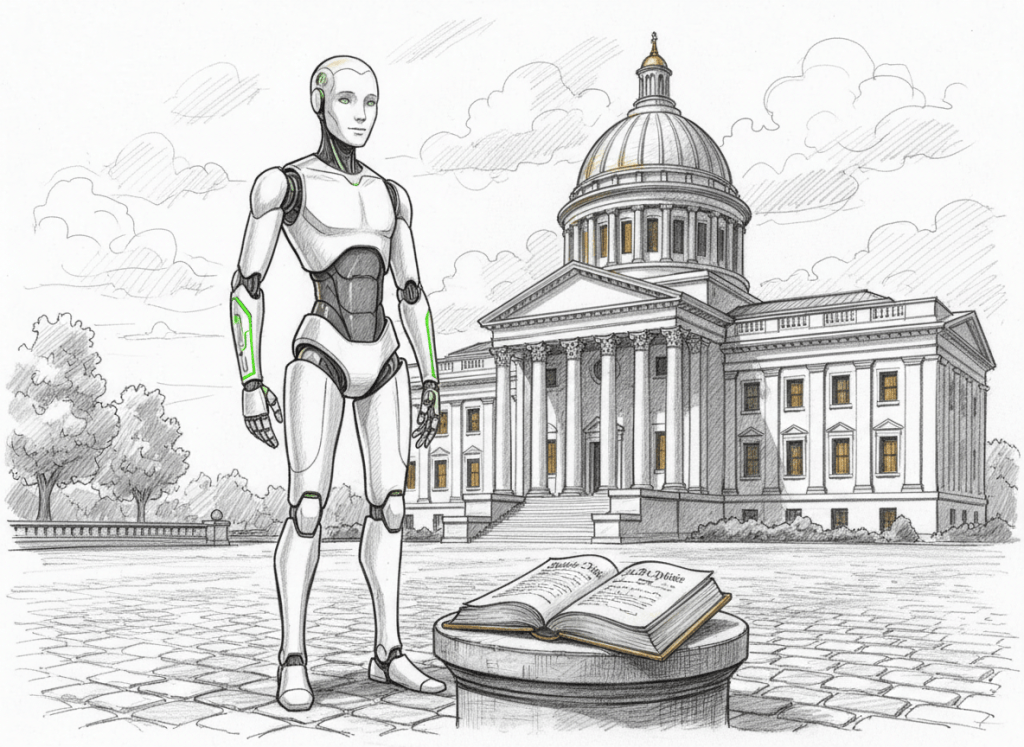
Humanoid robots are moving out of science fiction and into factories, laboratories and increasingly human spaces. That raises a question that sounds futuristic but is already becoming a serious legal thought experiment: if a robot eventually behaves enough like a person, will the law continue to treat it exactly like a refrigerator or a car?
Today, the straightforward answer is that robots are machines, not citizens. They do not possess human constitutional rights simply because they can walk, talk or make decisions. But American law already has several examples showing that legal protection does not always stop at the boundary of a biological human being.
The Law Already Protects Nonhuman Entities
A useful starting point is the concept of a legal person. Cornell Law School’s Legal Information Institute explains that legal persons can include nonhuman legal entities such as corporations. Those entities can own property, enter contracts, sue and be sued, and corporations receive some constitutional protections. That does not make a corporation a human citizen. It demonstrates something narrower but important: American law can assign selected rights and duties to something other than a natural person.
Animals provide another comparison. Animals generally do not possess the constitutional status of humans, yet legislatures can prohibit cruelty and create protections specifically for them. A 2025 Cornell Law Review analysis of animal rights before legal personhood examines whether certain rights can exist before full legal personhood. That distinction could eventually matter enormously for robots.
A future legislature would not necessarily have to choose between “ordinary property” and “full human citizen.” It could create an intermediate legal category.
Robots Are Already Getting Their Own Rules
Some of the first robot-specific laws are much more practical than questions about consciousness. Washington state, for example, has a dedicated legal framework for personal delivery devices. The rules address where the machines may travel, human monitoring, insurance, identification, braking equipment and accident reporting.
Washington traffic law even places personal delivery devices alongside pedestrians and bicycles for specific right-of-way rules. This does not give a sidewalk robot a civil right. It does show the law creating a distinct operational status for machines when ordinary property rules are no longer enough.
That may be an early preview of how robot law develops: not through one dramatic declaration of “robot citizenship,” but through hundreds of narrower rules defining what increasingly autonomous machines may do, what humans may do with them, and who is responsible when something goes wrong.
The Robots Are Becoming More Human-Like
The legal question becomes more interesting as the machines become more capable. Figure’s Helix 2.5, announced in September 2026, is designed to let humanoid robots generalize learned behavior across unfamiliar homes rather than learning only one fixed environment. Earlier Helix systems demonstrated whole-body autonomous tasks such as moving through rooms and manipulating household objects.
Boston Dynamics and other robotics companies have already publicly called for policymakers to address misuse of advanced mobile robots, including weaponization. Boston Dynamics has also supported proposed state legislation concerning responsible robot use.
None of these machines is legally a person. None of these developments proves that a robot is conscious or sentient. But the gap between a passive machine and an autonomous agent operating continuously around people is becoming much more important to AI, theory and public policy.
Could the Constitution Ever Apply?
Legal scholars have already asked the question directly. Indiana University professor R. George Wright’s Arkansas Law Review article, “The Constitutional Rights of Advanced Robots (and of Human Beings)”, examines circumstances under which advanced robots might qualify for constitutional rights and why granting any particular constitutional right would require justification.
Another major problem comes before rights can even be discussed: what counts as a robot? Stanford scholars Bryan Casey and Mark Lemley argued in the Cornell Law Review that lawmakers have struggled to define robots and AI cleanly and suggested that regulation should often focus on behavior rather than trying to create one permanent technological definition.
That could become crucial. A warehouse arm, autonomous delivery cart, conversational AI and humanoid household assistant may all contain sophisticated software, but treating all four as the same legal entity would make little sense.
Rights Do Not Have to Mean Citizenship
This is where the future may be less dramatic—and more interesting—than science fiction.
A robot would not need the right to vote, hold public office or obtain a passport for lawmakers to give it a legally protected status. A future legal framework could theoretically prohibit certain destruction, abuse or unauthorized modification of sufficiently advanced autonomous machines while still assigning their ownership, liability and economic responsibilities to humans or companies.
One possible progression is property → regulated autonomous machine → protected artificial entity → limited legal personhood. A later society could invent something resembling artificial or robotic citizenship, but that is speculation—not current law and not an inevitable outcome.
The animal-law comparison is useful precisely because it shows that protection and personhood are separate questions. Society can decide that damaging something is more serious than ordinary property damage without simultaneously giving that entity every right held by a human being.
The Hardest Question May Be Sentience
The debate would change dramatically if scientists ever developed credible evidence that an artificial system experiences consciousness, suffering or a persistent subjective identity. Current humanoid capability should not be confused with proof of any of those things.
Still, the law routinely has to classify new technologies before every philosophical question is resolved. If millions of humanoids eventually work beside people, live inside homes, remember years of interactions and make increasingly independent decisions, courts and legislatures may face pressure to determine whether destroying one is merely destruction of property—or something legally different.
Robot Rights May Arrive One Rule at a Time
The most plausible near-term future is probably not a robot walking into city hall and receiving citizenship papers.
It is a patchwork: traffic rules for delivery robots, liability rules for autonomous machines, restrictions on weaponization, privacy rules for robots inside homes, standards governing human-robot relationships and eventually court cases testing whether a particularly advanced system fits an older legal category.
At some point, the question could stop being whether robots are human. They are not. The more useful question may become whether some robots are sufficiently different from ordinary property that the law needs a new category for them.
If that happens, robot “rights” may begin not with equality to humans, but with something much smaller and more tangible: a legally recognized boundary around what humans are allowed to do to an autonomous artificial entity.
BitcoinVersus.Tech Editor’s Note:
We volunteer daily to ensure the credibility of the information on this platform is Verifiably True. If you would like to support to help further secure the integrity of our research initiatives, please donate here: 3C9o19EH5HSiwEPyCTmEKzxhNCbo2X6TTb
BitcoinVersus.tech is not a financial advisor. This media platform reports on financial subjects purely for informational purposes.


Leave a Reply