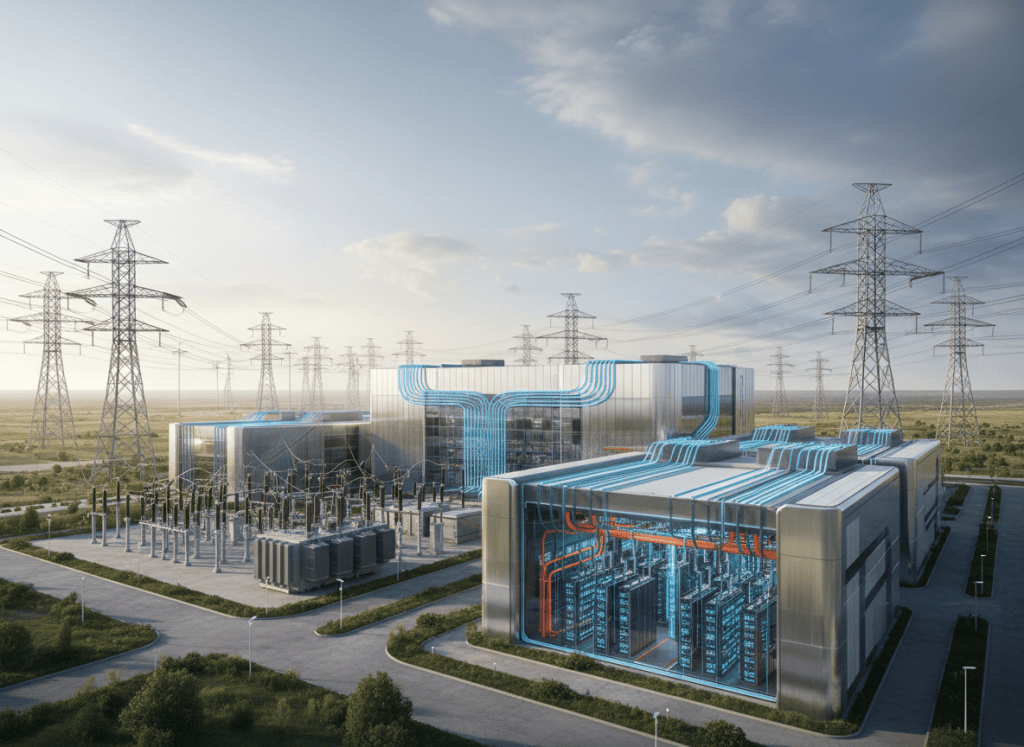
Huawei Digital Power has unveiled Grid-Interactive AIDC 1.0, an AI data-center architecture designed to make hyperscale computing facilities active participants in the power system instead of rigid electrical loads.
The system was presented at HUAWEI CONNECT 2026 in Shanghai. Huawei says rapidly fluctuating AI workloads and growing renewable generation require tighter coordination between computing equipment, power distribution, energy storage and cooling.
800 VDC-ready power architecture
Huawei’s new Hengshan DC UPS supports 270 V, 400 V and 800 V DC architectures on a software-defined hardware platform. SmartLi 5.0 battery storage is also designed to evolve toward 800 V HVDC infrastructure.
The Taishan UPS reaches 1,280 kVA in a single cabinet with claimed dual-conversion efficiency up to 98%. PowerPOD 5.0 reduces footprint by 40% and Huawei says its productized construction approach cuts lead time from seven days to three days for that system.
Energy storage smooths AI loads
Grid-Interactive AIDC 1.0 combines grid-friendly UPS equipment, intelligent lithium batteries and grid-forming energy storage. Huawei says the layered storage system can respond to AI workload changes across timescales ranging from microseconds to hours.
The LUNA2000 grid-forming energy storage system is designed to support weak grids, smooth AI loads and coordinate multiple energy sources at campus scale. The broader architecture treats generation, grid supply, facility load and storage as a coordinated system.
Liquid cooling becomes an active control system
Huawei is also moving from conventional coolant distribution units toward what it calls thermal management units. Its AI-powered TMU can detect small leaks, monitor coolant health and support predictive maintenance while coordinating cooling response with changes in compute workload.
The direction parallels the power-centric infrastructure BitcoinVersus.tech tracks across data centers and Bitcoin mining. As compute density rises, the electrical and thermal systems surrounding the machines become as important as the processors themselves.
From hundreds of megawatts toward gigawatts
Huawei says AI data centers are moving from hundreds of megawatts toward gigawatt scale. Its proposed operating metric, tokens per watt, connects energy consumption directly to AI compute output rather than relying only on traditional facility-level PUE.
Sources: Huawei Digital Power and Data Centre Magazine.
BitcoinVersus.Tech Editor’s Note:
We volunteer daily to ensure the credibility of the information on this platform is Verifiably True. If you would like to support to help further secure the integrity of our research initiatives, please donate here: 3C9o19EH5HSiwEPyCTmEKzxhNCbo2X6TTb


Leave a comment