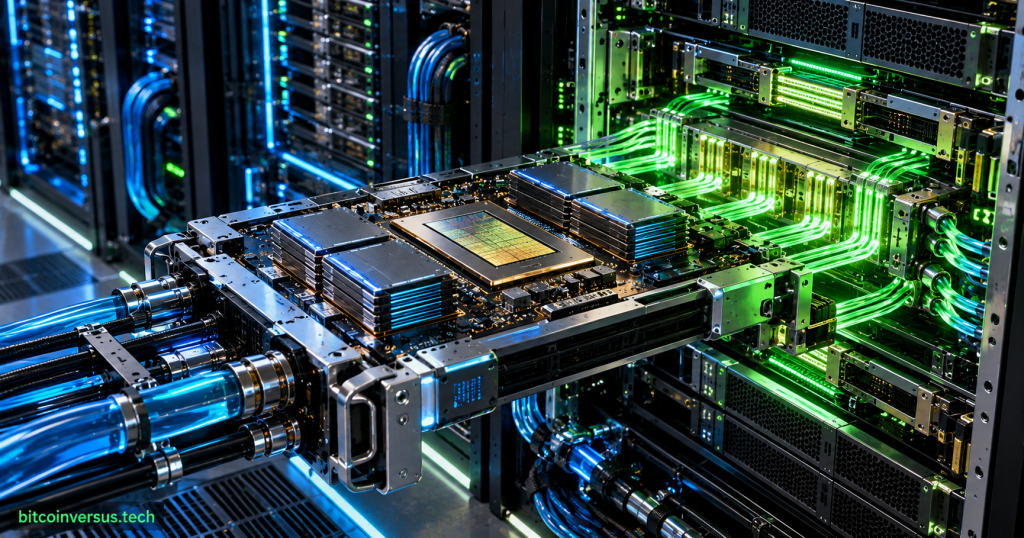
NVIDIA’s next AI infrastructure battle may be less about selling every accelerator and more about making sure custom accelerators still plug into NVIDIA’s rack.
MediaTek and NVIDIA announced an expanded collaboration on August 31 that will bring MediaTek-designed custom XPUs into the NVIDIA NVLink Fusion ecosystem. In NVIDIA’s official announcement, the companies said MediaTek will use NVLink Fusion as a foundation for customers building custom AI accelerators that need a path from silicon design to rack-scale deployment.
The shift was summarized directly by NVIDIA in an August 31 X post: AI factories will increasingly contain differentiated compute, but custom silicon still needs a way to connect into production-scale systems.
Custom Chips Are No Longer the Whole System
Designing a custom accelerator is only the first layer of an AI platform. The chip still has to connect to memory, CPUs, other accelerators, networking, power delivery, cooling, software, and a physical rack architecture that can be manufactured at scale.
NVLink Fusion is NVIDIA’s attempt to package more of that surrounding infrastructure into a reusable design foundation. The platform includes NVLink connectivity for scale-up communication, NVLink-C2C for chip-to-chip links, and NVIDIA’s NVHBM memory approach for custom XPU designs.
That makes MediaTek’s role important. The company brings custom silicon design, high-speed SerDes, advanced packaging, memory integration, and connectivity expertise into a platform that can be carried forward across future NVIDIA rack architectures.
The strategy has already appeared elsewhere. BitcoinVersus.Tech recently covered d-Matrix connecting its Raptor XPU to NVIDIA NVLink Fusion, showing that NVIDIA is building an ecosystem in which non-NVIDIA accelerators can still depend on NVIDIA interconnect and rack infrastructure.
The Moat Moves From the Chip to the Rack
The strategic implication is bigger than one MediaTek design program. Hyperscalers and AI companies increasingly want custom accelerators because specialized silicon can improve efficiency or optimize a workload that does not need a general-purpose GPU for every task.
If those custom chips use NVIDIA’s scale-up fabric, chip-to-chip interfaces, memory technology, networking, and MGX rack architecture, NVIDIA can remain embedded in the AI factory even when the accelerator itself comes from another supplier.
Independent coverage from Tom’s Hardware makes the same point from the custom-silicon side: MediaTek’s adoption gives customers a path to build their own accelerators while relying on NVIDIA for the surrounding connectivity and system infrastructure.
That model resembles the direction BitcoinVersus.Tech covered when Qualcomm and AWS paired custom AI silicon with 1.6T optical connectivity. The value is increasingly in the entire compute fabric, not simply the processor die.
NVLink Fusion Turns Packaging Into Infrastructure
Modern AI accelerators are multi-die systems. Compute tiles, memory, I/O, CPU connectivity, and interconnect chiplets all have to fit inside tight power, signal-integrity, thermal, and manufacturing limits.
That means a custom XPU program can fail even if the compute architecture is good. High-speed interfaces can miss timing. Packaging can run into yield problems. HBM placement can constrain power and routing. A rack-scale system can hit cooling or serviceability limits after the chip is already designed.
MediaTek’s role is therefore not just to draw a custom accelerator. It can help customers integrate the pieces around that accelerator so the device has a realistic route into production hardware.
Rack-Scale Validation Is Becoming Part of Chip Design
The industry is moving toward designing AI hardware from the rack backward. Power distribution, cooling, optics, memory, firmware, serviceability, and switch architecture increasingly shape the chip before final silicon exists.
That is visible in BitcoinVersus.Tech’s coverage of Supermicro shipping NVIDIA Vera Rubin NVL72 racks. Rack-scale systems are no longer just enclosures for processors. They are engineered compute platforms where electrical, thermal, optical, and mechanical decisions have to work together.
NVLink Fusion lets NVIDIA extend that systems approach to companies that want differentiated accelerators. MediaTek can help build the custom silicon, while NVIDIA supplies the rack-scale environment those chips are expected to inhabit.
Custom AI Silicon Could Strengthen NVIDIA’s Ecosystem
At first glance, the rise of custom accelerators looks like a threat to NVIDIA. If cloud providers build more of their own silicon, they need fewer off-the-shelf GPUs for some workloads.
NVLink Fusion gives NVIDIA another way to participate. Instead of requiring every customer to buy an NVIDIA accelerator, the company can provide the fabric, memory interfaces, chip-to-chip links, networking, rack architecture, and software environment around a third-party XPU.
That changes the competitive question. The fight is no longer only over whose accelerator wins a benchmark. It is also over whose infrastructure becomes the default place where every accelerator has to connect.
MediaTek adopting NVLink Fusion is another step toward that model. If custom AI chips continue to proliferate, the most powerful platform may be the one that can connect all of them.
BitcoinVersus.Tech
Advertisement
Editor’s Note:
We volunteer daily to ensure the credibility of the information on this platform is Verifiably True. If you would like to support our research initiatives, please donate here: 3C9o19EH5HSiwEPyCTmEKzxhNCbo2X6TTb
BitcoinVersus.tech is not a financial advisor. This media platform reports on financial subjects purely for informational purposes.


Leave a Reply