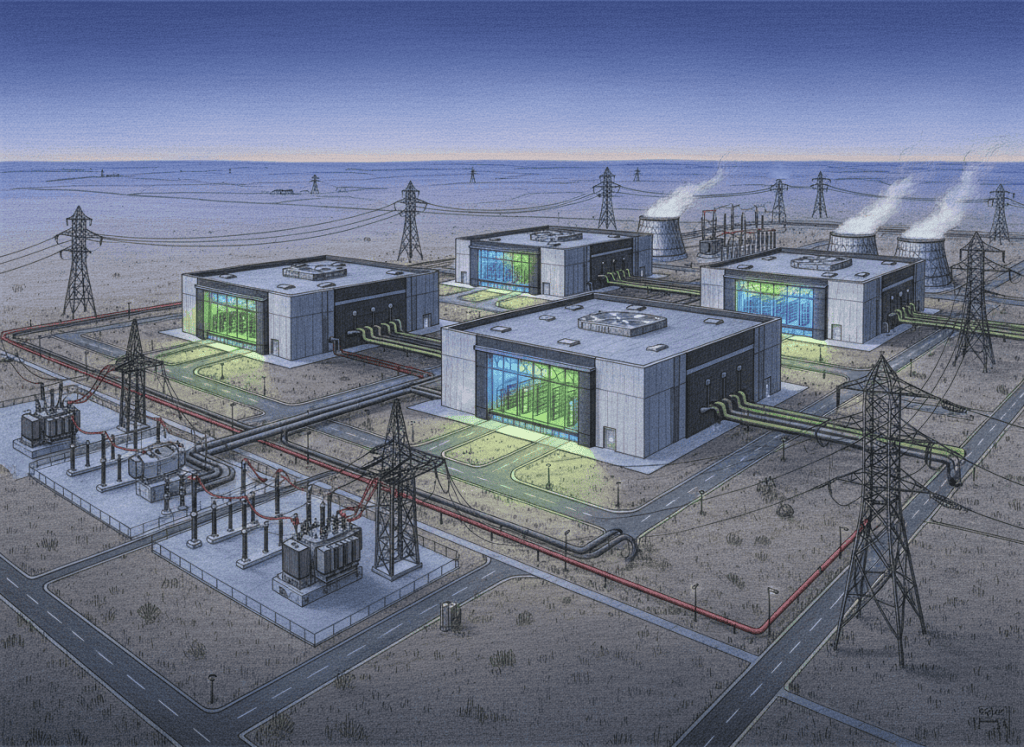
Applied Digital has brought another 75 MW of critical IT capacity to Ready for Service at Polaris Forge 1 in Ellendale, North Dakota, pushing the AI campus to 250 MW of fully operational critical IT load.
According to Applied Digital’s October 2 announcement, the delivery covers three new 25 MW data halls in the second phase of Building 2. The milestone completes that building at 150 MW.
A useful distinction matters here: “Ready for Service” means the data-center infrastructure has reached an operating handoff milestone. It does not automatically mean every rack is populated, every accelerator is installed, or all 75 MW is being continuously consumed by customer hardware.
Polaris Forge 1 now has 250 MW operational
The campus progression is straightforward: Applied Digital first brought a 100 MW building online, then delivered the first 75 MW phase of Building 2, and has now delivered its second 75 MW phase. Those stages total 250 MW of operational critical IT load.
The company says Polaris Forge 1 is fully leased and contracted for 400 MW at full buildout. That means another 150 MW remains outside the currently operational total. Independent infrastructure coverage from Grid & Silicon makes the same distinction between commissioned capacity and the future 400 MW buildout.
This is the part of AI infrastructure development that often gets lost behind enormous power announcements. Secured megawatts are not the same thing as usable compute capacity. Electrical distribution, cooling, networking, controls, fire systems, commissioning and customer acceptance all stand between a power agreement and a functioning data hall.
That execution theme connects directly with BitcoinVersus.Tech’s earlier coverage of Applied Digital’s planned Alabama AI data-center campus. The company is trying to replicate a model it has already moved from construction into operations in North Dakota.
Applied Digital’s recent X update on its expanding AI Factory footprint provides a broader look at the company’s buildout strategy.
Why 75 MW of commissioned capacity matters
For field operations, three separate 25 MW halls represent more than a headline power number. Phased halls allow construction, commissioning and customer deployment to move in blocks while preserving separation between electrical and mechanical systems. That can make testing, handoff and fault isolation more manageable than treating the campus as one giant undifferentiated load.
Critical IT load is also the right number to watch. It refers to the capacity available to computing equipment rather than the entire facility draw. Pumps, cooling equipment, power conversion and other building systems consume additional energy, so a 250 MW critical-load campus requires more total infrastructure than 250 MW of servers alone.
The distinction is especially relevant as former Bitcoin-mining infrastructure companies move deeper into AI and HPC. BitcoinVersus.Tech recently examined how miners are leaving substantial ASIC investment behind while redirecting power toward AI. AI tenants generally demand denser networking, tighter environmental control and much stronger uptime expectations than interruptible mining loads.
Power rights are only the beginning
Applied Digital CEO Wes Cummins framed the milestone around exactly that operational gap: securing power starts the project, but design, construction, commissioning and operation turn those megawatts into capacity a customer can actually use.
That is also why the final 150 MW at Polaris Forge 1 should not be counted as operating yet. It is contracted future capacity until it reaches the same commissioning threshold as the 250 MW now described as operational.
The broader data-center buildout is creating the same pressure on supporting electrical infrastructure. Our coverage of Renesas’ 650 V GaN power hardware for megawatt-scale AI systems shows how the industry is simultaneously reworking power conversion inside the facility as campuses scale outside it.
What comes next
The next useful evidence will be customer hardware deployment, sustained utilization, measured facility efficiency, uptime and the commissioning of the remaining 150 MW. Those operating metrics will show how quickly the physical capacity translates into productive AI infrastructure.
For now, the clean number is 250 MW operational at Polaris Forge 1—not 400 MW. The October milestone adds 75 MW to the live total and completes Building 2 at 150 MW, while the larger campus buildout continues.
BitcoinVersus.Tech
Advertisement
Editor’s Note:
We volunteer daily to ensure the credibility of the information on this platform is Verifiably True. If you would like to support our research initiatives, please donate here: 3C9o19EH5HSiwEPyCTmEKzxhNCbo2X6TTb
BitcoinVersus.tech is not a financial advisor. This media platform reports on financial subjects purely for informational purposes.


Leave a Reply