
- Lumentum says some AI optical components are completely sold out through early 2029.
- CEO Michael Hurlston says the company cannot meet roughly 70% of demand for some products through next year.
- Other product lines may still face about a 30% demand shortfall through 2028.
- The bottleneck centers on lasers and optical components used to move data through AI clusters, not on GPUs alone.
- NVIDIA invested $2 billion in Lumentum earlier this year and secured multiyear purchase commitments and future capacity access.
The AI infrastructure shortage is spreading beyond GPUs, HBM and power. Lumentum says demand for the lasers and optical components that move data through modern AI data centers has now outrun available manufacturing capacity into 2029.
In a Tokyo interview reported by Barron’s, Lumentum CEO Michael Hurlston said the company is effectively sold out through early 2029. He said Lumentum is unable to satisfy roughly 70% of demand for some products through next year, while other products could remain about 30% undersupplied through 2028.
That is a sharp extension from only months ago, when Lumentum was talking about capacity being committed through 2028. The change suggests AI networking demand is accelerating faster than the company can add indium-phosphide laser and optical-component output.
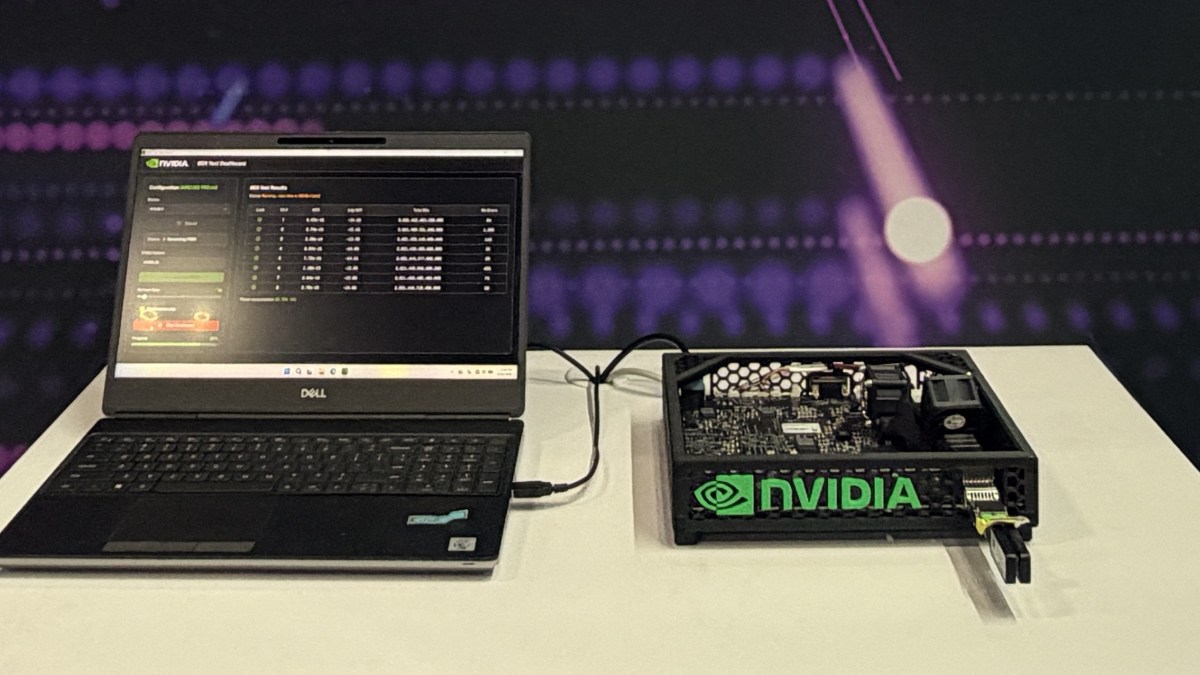
AI Clusters Are Turning Optics Into Critical Infrastructure
Large AI systems move enormous amounts of data between accelerators, switches, racks and increasingly between separate buildings or campuses. Electrical links can handle short distances, but bandwidth density, signal integrity and power consumption become harder problems as systems scale.
That pushes more traffic onto fiber and optical transceivers. BitcoinVersus.Tech recently covered Broadcom’s 102.4 Tb/s Ethernet and co-packaged optics push and Astera Labs extending PCIe 7 over optical links. Lumentum sits underneath many of these architectures by supplying the lasers and photonic components that generate and carry the light.
The Bottleneck Is Manufacturing, Not Just Design
Lumentum’s most important AI products rely heavily on indium phosphide, a compound semiconductor used for high-performance lasers and electro-absorption modulated lasers. These devices are not interchangeable with ordinary silicon logic chips, and capacity cannot be expanded overnight by simply booking more wafers at a standard CMOS foundry.
Lumentum has been adding capacity aggressively. In March, the company announced a new 240,000-square-foot manufacturing facility in Greensboro, North Carolina for advanced indium-phosphide optical devices. The site is intended to produce continuous-wave and ultra-high-power lasers used in the largest AI data centers.
Even with that expansion, Hurlston’s latest comments indicate the demand curve is moving faster than the manufacturing ramp.
NVIDIA Already Treated Optical Capacity as Strategic
NVIDIA saw the constraint early. In March, it announced a $2 billion investment in Lumentum tied to multiyear purchase commitments, R&D collaboration and future capacity access for advanced laser components.
The agreement shows why optics are no longer a secondary networking component. If an AI system has GPUs but cannot move data between them efficiently, accelerator utilization falls and expensive silicon spends more time waiting on communication.
BitcoinVersus.Tech has also covered NVIDIA-backed Ayar Labs, another example of capital flowing toward optical interconnect as electrical links become harder to scale.
1.6T Is Here, and 3.2T Is Already the Next Target
Lumentum’s own 2026 roadmap shows how quickly bandwidth requirements are moving. At OFC, the company demonstrated 1.6T optical modules using 200G-per-lane technology and showed 400G-per-lane components as a path toward future 3.2T pluggable optics.
The company is also working across co-packaged optics, external laser sources, VCSEL-based scale-up links and optical circuit switching. Those architectures attack different parts of the same problem: moving more bits with less electrical power as AI clusters grow.
That direction aligns with BitcoinVersus.Tech’s recent Ciena 6.4T optics coverage, where the network itself becomes a major part of the AI system’s power and performance budget.
Optical Shortages Can Slow Complete AI Deployments
AI infrastructure is assembled from a chain of constrained components: accelerators, HBM, substrates, advanced packaging, NICs, switches, power equipment, cooling systems, fiber and optical transceivers. A shortage in any one layer can delay deployment of the complete rack or cluster.
Optics are especially important because new AI designs use more high-speed links per accelerator generation. Higher GPU counts do not reduce optical demand; they usually increase it because the processors need to exchange more data across increasingly large fabrics.
What to Watch Next
- Greensboro ramp: how quickly Lumentum can bring additional U.S. indium-phosphide laser capacity online.
- Japan expansion: whether added manufacturing there materially reduces the 2027–2028 shortfall.
- Second sourcing: hyperscalers may shift more orders toward Coherent, Applied Optoelectronics and other suppliers when Lumentum cannot fill demand.
- 1.6T adoption: faster deployment raises demand for 200G-per-lane EML and external-laser technologies.
- 3.2T development: 400G-per-lane optics could create another capacity wave before the current one is resolved.
- CPO: co-packaged optics could increase demand for specialized high-power external lasers even as module architectures change.
Bottom Line
The AI hardware race is no longer just a GPU story. Lumentum’s sold-out capacity through early 2029 shows that the ability to manufacture enough lasers and optical components is becoming a hard physical constraint on AI data center growth.
More compute requires more communication, and at AI scale that communication increasingly travels as light. If Lumentum’s backlog is a reliable signal, photonics has moved from an enabling technology to one of the core bottlenecks determining how quickly the next generation of AI infrastructure can actually be built.
Editor’s Note: The 2029 sold-out timeline and product-specific shortfall percentages are based on CEO Michael Hurlston’s October 2026 comments reported by financial media. Exact availability varies by product family and customer contract.
BitcoinVersus.Tech is not a financial advisor. This media platform reports on technology and financial subjects for informational purposes.


Leave a Reply