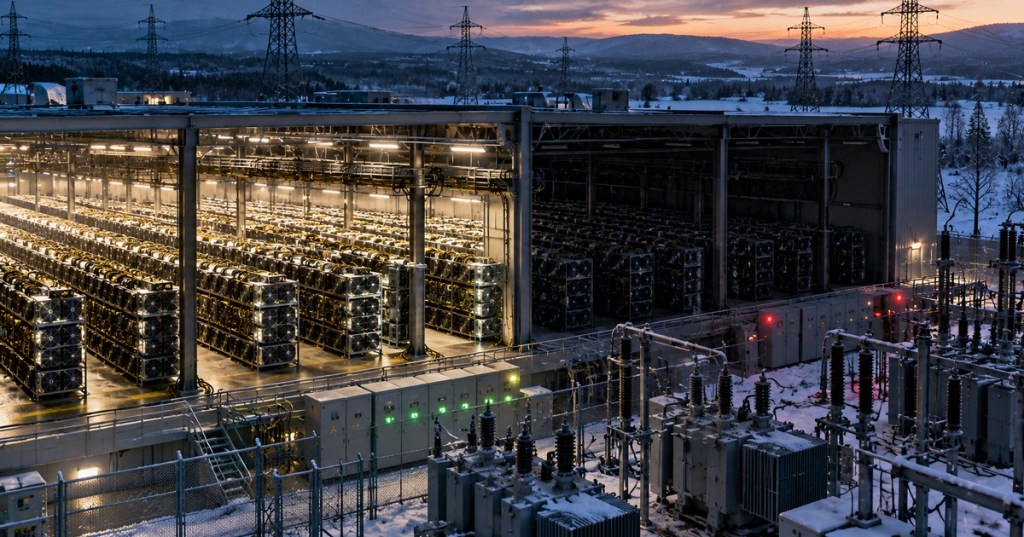
Russia is changing how new cryptocurrency mining facilities connect to the power grid. Under Government Resolution No. 1300, qualifying mining projects must accept a lower-reliability Category 4 connection that can be curtailed when the grid is short on power.
The rule matters because Russia is already one of the world’s largest Bitcoin-mining regions. BitcoinVersus recently covered Russia’s rise to an estimated 18.1% of global Bitcoin hashrate. The new grid policy does not ban mining nationwide, but it makes interruptible electricity part of the connection model for new and some unfinished mining projects.
The official October 6 resolution says pending applications for mining equipment that had sought first-, second-, or third-category reliability can be redirected toward fourth-category reliability when the specified conditions are met. Grid companies must notify affected applicants, and projects can be paused while the revised connection is processed.
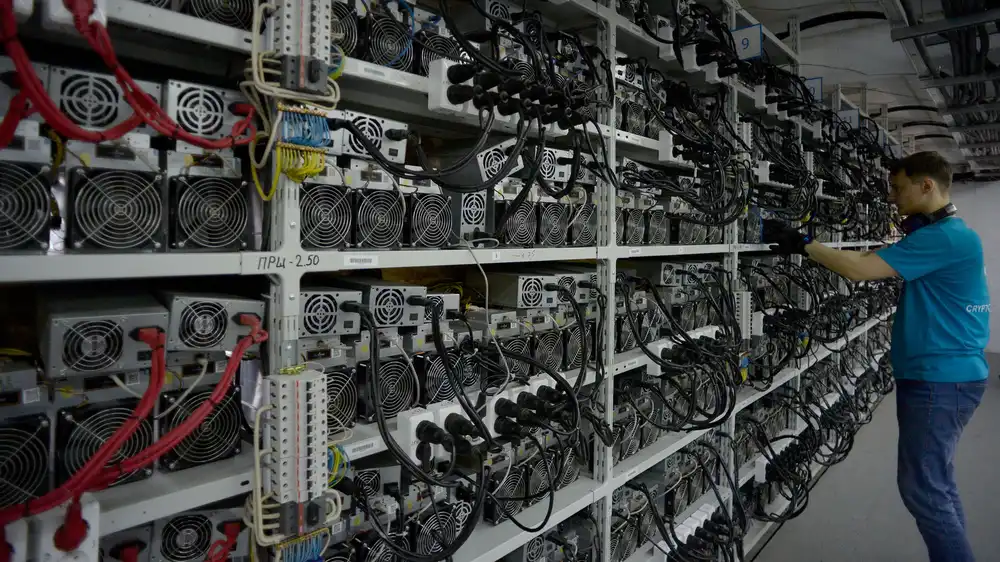
Category 4 means the power is less guaranteed
Category 4 does not mean a mine is scheduled to be dark every day. It means the operator accepts a lower level of supply reliability and has to be prepared for interruptions when the grid needs capacity elsewhere.
Crypto.news reported on October 11 that Russia’s Energy Ministry confirmed the new framework after the decree was adopted. The report says Category 4 consumers can be disconnected during shortages without the same advance coordination associated with higher-priority customers, and their supply may return after higher-priority users are restored.
That effectively turns curtailment risk into part of the miner’s business model. A site that expects near-perfect uptime has to rethink its economics if the power contract itself says the facility can be among the first large loads taken offline.
The new rule does not shut down every existing mine
The scope is important. The October decree focuses on grid connections and unfinished connection applications. It does not say every operating mining farm with a completed higher-reliability connection must immediately be downgraded to Category 4.
For older applications that were already in progress, the resolution gives grid operators a process for offering completion under Category 4 terms. If an applicant does not accept the new path, the existing application or connection agreement can be abandoned under the decree’s procedures.
The government can also cancel or suspend connection work in territories where cryptocurrency mining is prohibited. That means the reliability category does not override regional mining bans.
Russia is formalizing something miners already do elsewhere
Bitcoin miners are unusual industrial loads because ASIC fleets can reduce power quickly without ruining an unfinished physical product. BitcoinVersus explored that operating model in Can Bitcoin Mining Stabilize the Power Grid, or Nah?
In places such as Texas, curtailment can be voluntary, market-driven, or compensated through grid programs. Russia’s new framework is different: for qualifying new mining connections, reduced reliability is becoming a condition of getting connected in the first place.
For miners, uptime is now an economic variable
A Bitcoin mine earns revenue only while its machines are hashing. If a facility loses power for an hour, the hardware is not damaged simply because it stopped, but the site gives up the Bitcoin revenue it could have produced during that hour.
That makes the decision highly sensitive to mining revenue, electricity price, contract terms, and how often the grid expects curtailment. High-efficiency fleets can survive more downtime than inefficient fleets only if the remaining operating hours still produce enough margin to cover fixed costs such as land, transformers, labor, debt, and network infrastructure.
BitcoinVersus’ recent look at Texas reviewing 4CP treatment for Bitcoin miners shows a related theme from a different market. Grid rules can change mining economics even when the Bitcoin protocol and ASIC hardware stay exactly the same.
Flexible load is useful only when the economics still work
The phrase “flexible load” can make curtailment sound free. It is not. Every shutdown has an opportunity cost. A miner will tolerate that cost when the alternative—higher electricity prices, a stricter grid connection, or no connection at all—is worse.
Russia’s policy essentially makes that tradeoff explicit. New mining projects can gain access to existing power infrastructure, but they may have to accept that electricity service is less reliable than it is for ordinary higher-priority customers.
Why the rule matters globally
Russia’s estimated share of Bitcoin mining has been rising while the global network remains geographically concentrated. That means national grid policy in a major mining region can affect where new hashrate gets built, how much uptime operators expect, and which sites remain competitive.
The immediate result is not necessarily a large drop in global hashrate. Existing mines are not all being disconnected at once. The larger change is strategic: developers evaluating new Russian sites now have to price curtailment risk directly into the project before the first ASIC is installed.
BitcoinVersus.Tech Editor’s Note: Resolution No. 1300 changes the grid-connection framework for cryptocurrency mining and certain unfinished applications. It is not a blanket nationwide order to immediately disconnect every existing Russian mining farm. Category 4 should be understood as lower-reliability, interruptible grid access rather than a permanent shutdown.
Follow BitcoinVersus.Tech on X for Bitcoin mining, energy, data centers, AI hardware, semiconductors, and networking.
Support independent technology reporting: Bitcoin donations help fund BitcoinVersus.Tech research and publishing.
Disclaimer: BitcoinVersus.Tech provides technology news and analysis for informational purposes only.


Leave a Reply