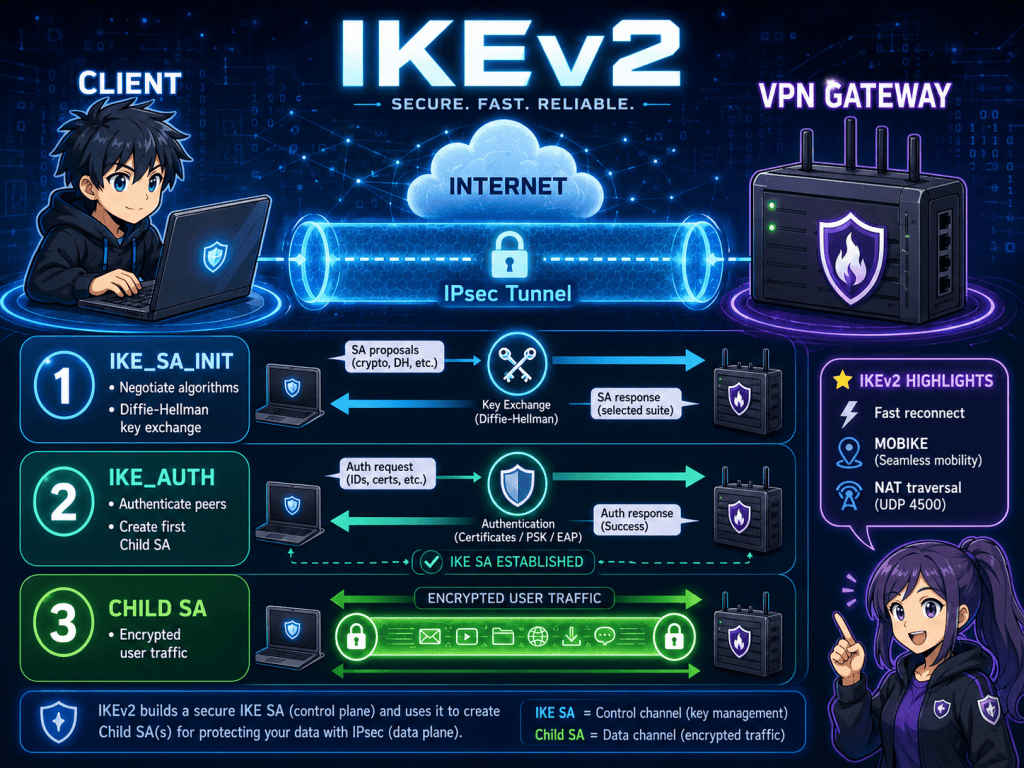
Internet Key Exchange Version 2 (IKEv2) is a security protocol used to establish, authenticate, and manage encrypted connections between network devices.
IKEv2 is most commonly paired with IPsec, where it negotiates the cryptographic algorithms, authentication methods, encryption keys, and Security Associations required to build a protected VPN tunnel.
Standardized in RFC 7296, IKEv2 improved on the original IKE protocol with simpler exchanges, stronger reliability, improved error handling, and more efficient tunnel establishment.
During an IKEv2 connection, two endpoints first establish an IKE Security Association through the IKE_SA_INIT exchange.
The devices negotiate encryption and integrity algorithms, exchange Diffie-Hellman values, and generate shared cryptographic keying material.
The subsequent IKE_AUTH exchange authenticates the peers and establishes the first Child Security Association, which is normally responsible for carrying encrypted IPsec traffic. Additional Child SAs can later be created, rekeyed, or removed without rebuilding the entire connection.
IKEv2 is particularly valuable for modern VPN deployments because it handles connection changes efficiently. Through extensions such as MOBIKE, a VPN session can survive changes between network interfaces or IP addresses, such as a laptop moving between Wi-Fi networks or a smartphone switching between Wi-Fi and cellular service.
IKEv2 also supports features such as NAT traversal, certificate authentication, pre-shared keys, EAP authentication, Perfect Forward Secrecy configurations, tunnel rekeying, and Dead Peer Detection.
From an enterprise networking perspective, IKEv2 is commonly found in site-to-site VPNs, remote-access VPNs, firewalls, routers, security gateways, and cloud networking environments.
Network engineers may configure IKEv2 policies specifying AES encryption, SHA-based integrity algorithms, Diffie-Hellman groups, authentication credentials, IPsec proposals, traffic selectors, and tunnel lifetimes.
Understanding these components is important for troubleshooting failed VPN negotiations because an incorrect proposal, certificate, PSK, routing rule, or firewall policy can prevent the tunnel from establishing.
IKEv2 therefore sits at an important intersection of network security, cryptography, VPN architecture, and IPsec engineering. Rather than directly carrying ordinary user traffic itself, IKEv2 provides the secure control framework that allows two systems to authenticate one another and agree on how protected IPsec communication should operate.
BitcoinVersus.Tech Editor’s Note:
We volunteer daily to ensure the credibility of the information on this platform is Verifiably True. If you would like to support to help further secure the integrity of our research initiatives, please donate here: 3C9o19EH5HSiwEPyCTmEKzxhNCbo2X6TTb
BitcoinVersus.tech is not a financial advisor. This media platform reports on financial subjects purely for informational purposes.


Leave a Reply