
Bitcoin-only exchange Bull Bitcoin announced on November 5, 2026, that on-chain buys and sells made through its integrated BULL Wallet now use Payjoin by default, when an eligible transaction can be negotiated. The company says the feature makes trading harder to trace using common blockchain assumptions while automatically combining small Bitcoin wallet outputs. The change expands Payjoin beyond the wallet’s existing peer-to-peer support, which dates to December 2024. Bull Bitcoin’s release and contemporaneous Bitcoin Magazine reporting document the announcement.
Unlike a bank balance, a Bitcoin wallet owns separate unspent transaction outputs, or UTXOs. Every on-chain spend consumes outputs and creates new ones. Blockchain observers frequently assume all inputs in a transaction belong to one sender. Payjoin challenges that assumption by allowing both parties to supply inputs to a single valid Bitcoin transaction, without changing Bitcoin’s consensus rules.
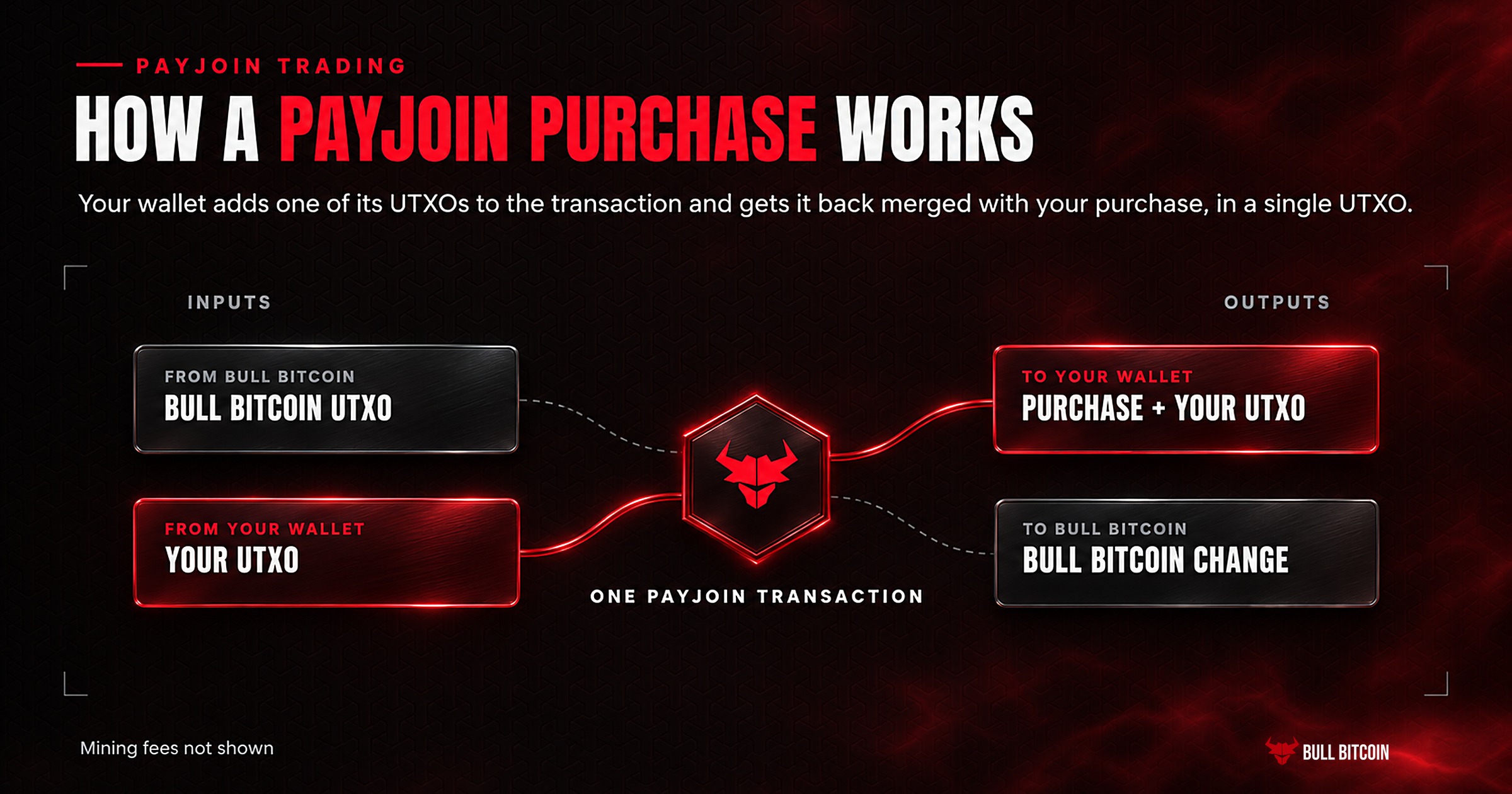
Payjoin combines purchases without a separate consolidation
For a supported purchase, BULL Wallet contributes one of the customer’s existing UTXOs while the exchange contributes the purchased bitcoin. The resulting payment returns a combined output to the buyer. Instead of receiving another small coin to manage, the customer can end with a larger UTXO. BitcoinVersus.Tech’s UTXO explainer describes why the number and size of outputs affect future transaction construction.
Potential savings arise when future spends require fewer inputs, reducing their virtual-byte size. Payjoin does not guarantee a lower fee for every current transaction: including an extra input also consumes block space. Actual savings depend on fee rates, transaction structure and whether the user would otherwise consolidate coins separately.
First purchases and failed negotiations remain ordinary transfers
The company lists several exceptions. An empty wallet has no existing UTXO to contribute, so its first purchase uses a regular Bitcoin transaction. If Payjoin negotiation fails or the user leaves the app before completion, the exchange falls back to a standard transfer. The customer must leave the wallet open until the app displays completion. Lightning and Liquid trades are not Payjoins under the announced exchange integration.
The default applies to on-chain purchases and sales made through BULL Wallet’s embedded exchange, not every Bitcoin transaction worldwide. The operator says on-chain exchange orders start at 25,000 satoshis. That minimum is an exchange order rule, not a new Bitcoin protocol minimum. The company has not published independent adoption totals, network-wide privacy measurements or a universal fee-savings percentage.
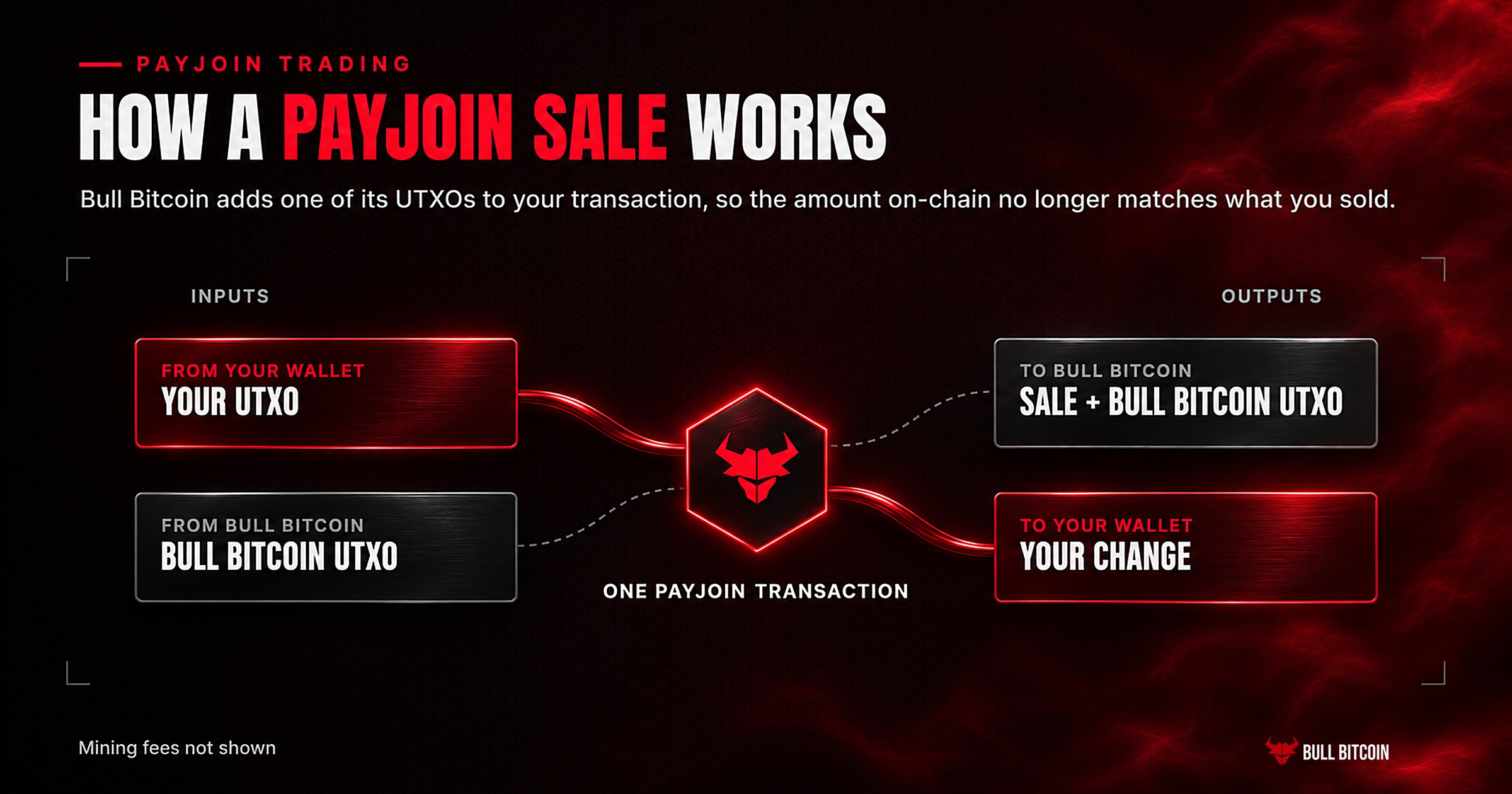
Privacy improves, but Bitcoin amounts remain public
A collaborative transaction disrupts common-input ownership analysis and may obscure which output represents the actual economic payment. It does not encrypt Bitcoin’s public ledger, hide every address, or prevent the trading venue from knowing its own customer. Bull Bitcoin also warns that sharing a special wallet-generated mempool link can reveal the user’s input/output labels and defeat the privacy benefit.
The mechanism differs from the Silent Payments development work, which focuses on reusable private receiving arrangements. It also differs from the recent Bitcoin miner-fee environment: Payjoin changes how transactions are assembled, not miners’ consensus fee schedules.
BIP 77 specifies asynchronous, encrypted Payjoin message coordination through an intermediary directory. The sender must still validate the final proposal before signing; the directory is not supposed to receive the plaintext transaction. BULL Wallet’s protocol implementation is open-source, but the November company announcement does not independently establish code-audit results for every exchange workflow.
The new exchange integration is confirmed as a product announcement and documented workflow. Its wider significance will depend on verified transaction use, interoperability, user experience and reproducible fee measurements. BitcoinVersus.Tech previously covered Bitcoin’s original public transaction model; Payjoin modifies wallet coordination while leaving the base protocol intact.
Editor’s Note: Primary reporting draws from Bull Bitcoin’s November 5, 2026 Payjoin Trading announcement, earlier Payjoin technical explainer, and the public BIP 77 protocol documentation. The company first integrated Payjoin V2 in 2024; the new development is default Payjoin trading with its exchange. Claims of being the first exchange, lower future fees and improved privacy are attributed to Bull Bitcoin; no independent transaction-volume study or wallet testing was conducted. Both illustrations are original Bull Bitcoin company graphics, and both YouTube tutorials are linked from the company’s site or official channel. WordPress iframe rendering, actual playback and independent mobile/desktop checks are separate validation stages.

To donate 5,000 sats, display the original QR code on a second screen and scan it with a compatible Bitcoin wallet. On mobile, use another device or a wallet’s supported saved-image scanning feature. Verify the payment destination before sending any funds.
We volunteer daily to ensure the information on this platform is Verifiably True. If you would like to support the research, please scan QR code.
BitcoinVersus.Tech is not a financial advisor. Bitcoin privacy tools are not guarantees of anonymity, savings or protection against exchange, network and device risks.


Leave a Reply