A forecast suggesting all seven Millennium Prize Problems could be solved by the end of January 2027 is a dramatic claim. But the Clay Mathematics Institute’s official register does not support declaring that outcome imminent: it currently lists one solved problem, one active problem, and five unsolved problems. New artificial-intelligence research has nevertheless made the question more interesting than it was a year ago.
The distinction matters when interpreting a Polymarket social post alongside the platform’s actual prediction contract. The contract counts qualifying AI-lab announcements made through December 31, 2026, rather than Clay-certified mathematical solutions by January 31, 2027. The complete text of the linked social post could not be independently recovered.
Archival Clay Mathematics Institute lecture by Michael Atiyah, supplied by CMI. Educational context; not evidence of a new AI proof.
The seven problems, one by one
- Poincaré Conjecture, solved. Grigori Perelman resolved the topological characterization of a three-dimensional sphere in work published during 2002–2003. Clay awarded the prize in 2010.
- Navier–Stokes existence and smoothness, active. The problem asks whether physically meaningful three-dimensional fluid solutions remain smooth or develop singularities. Following a high-profile AI-assisted 2026 announcement, Clay still labels the prize “Active.”
- Riemann Hypothesis, officially unsolved. Its statement concerns the nontrivial zeros of the zeta function and prime-number distribution. A November 20 claim, followed by an independent formal-checking statement on November 21, is major new evidence, although Clay’s list has not yet changed.
- P versus NP, unsolved. The question asks whether problems whose proposed answers can be checked efficiently can also be solved efficiently.
- Yang–Mills existence and mass gap, unsolved. A rigorous mathematical foundation is sought for a quantum field theory exhibiting a positive mass gap.
- Hodge Conjecture, unsolved. It asks which cohomological structures on certain algebraic varieties arise from algebraic cycles.
- Birch and Swinnerton-Dyer Conjecture, unsolved. It connects arithmetic information about elliptic curves to the behavior of a corresponding L-function.
Why the Riemann news changes the conversation
On November 21, the Lean and Mathlib communities announced that they had checked Levent Alpöge’s 17-million-line formal proof of the Riemann Hypothesis and certified its statement and proof as correct. The work was developed with Claude. For broader background, BitcoinVersus.tech separately reported the Lean verification and previously examined the Navier–Stokes credit dispute. A computer-checked result deserves serious attention, yet verification and the Clay prize procedure are different processes.
Archival Clay Mathematics Institute lecture by John Tate, linked by CMI. Historical mathematical background, not a report on the November AI announcements.
Prediction-market deadlines are not mathematical certification
Polymarket’s 2026 contract excludes announcements concerning Navier–Stokes and the already solved Poincaré problem. Its possible counts refer to the remaining five qualifying questions. Under the market rules, eligible laboratory announcements may qualify without subsequent Clay recognition; the trading outcome therefore cannot establish that all seven problems have been solved. On a November 22 UTC snapshot, the market favored exactly one additional qualifying announcement, not five, six, or seven.
Clay’s prize rules require a qualifying publication, at least two years after publication, and broad acceptance by the mathematics community before prize consideration. Even an authentic breakthrough announced in late 2026 cannot complete that standard process by January 2027. Readers should distinguish a claim, a verified formal proof, a recognized solution and a prize award.
What changes for computing?
A resolution of P versus NP could ultimately reshape theoretical computer science, while Yang–Mills concerns fundamental physics. Neither outcome automatically delivers a faster processor, a cheaper Bitcoin mining ASIC or broken cryptography. For context, BitcoinVersus.tech has examined other AI-assisted complexity claims and questions around the Navier–Stokes result. The measurable achievement now is accelerating mathematical research and proof checking; the remaining problems demand their own rigorous solutions.
Sources and verification
- Clay Mathematics Institute: seven-problem register
- Clay prize-award criteria
- Lean and Mathlib joint verification statement, November 21, 2026
- Polymarket prediction market and its resolution rules
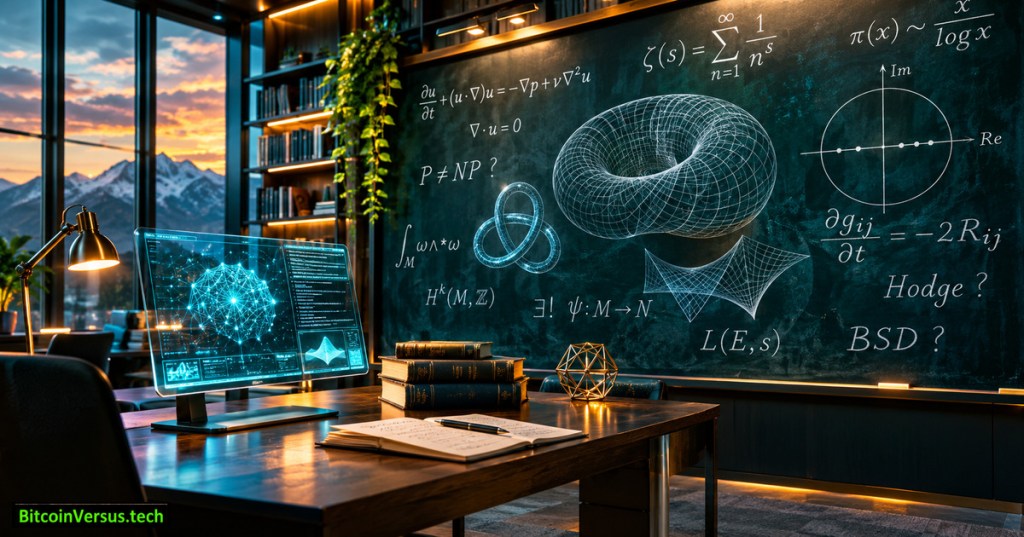
Cover: Original editorial illustration, not a photograph. Mathematics on the background chalkboard is illustrative rather than a presentation of a proof.


Leave a Reply