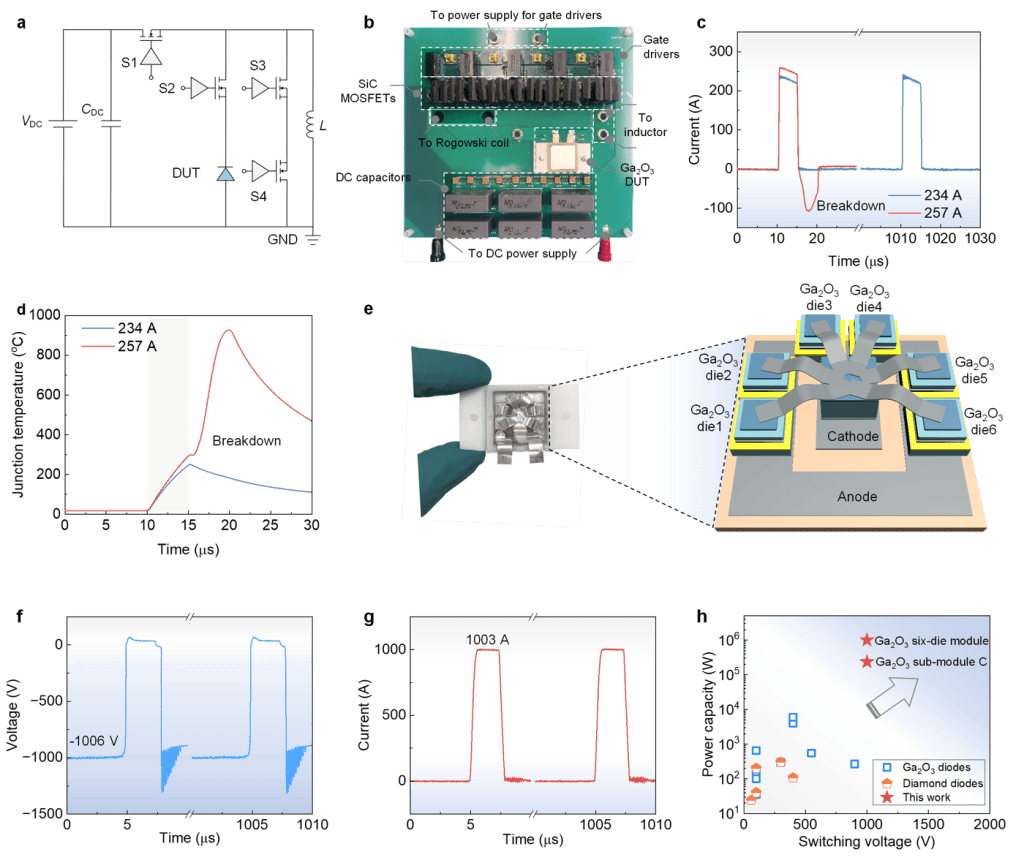
The University of Hong Kong highlighted a gallium oxide power module in its November 9, 2026 research announcement. The experiment, originally published March 30 in Nature Communications, demonstrates repetitive switching at nominal ratings of 1,000 volts and 1,000 amperes. Their product corresponds to a megawatt of pulsed switching capacity, not a continuous megawatt electrical supply. The development complements our coverage of Cornell’s oxide semiconductor research by demonstrating how packaging can translate material properties into usable circuit performance.
Why gallium oxide needs a different package
A semiconductor must withstand electric fields when blocking voltage and safely conduct current when required. Gallium oxide belongs to the ultra-wide-bandgap family, offering attractive electric-field characteristics alongside a difficult thermal constraint: relatively poor heat conduction. Our semiconductor energy-band explanation provides the underlying material physics. During short pulses, however, volumetric heat capacity becomes important because energy accumulates locally before reaching an external heat sink. A material that tolerates high transient temperatures can therefore be useful even when steady-state heat removal is challenging.
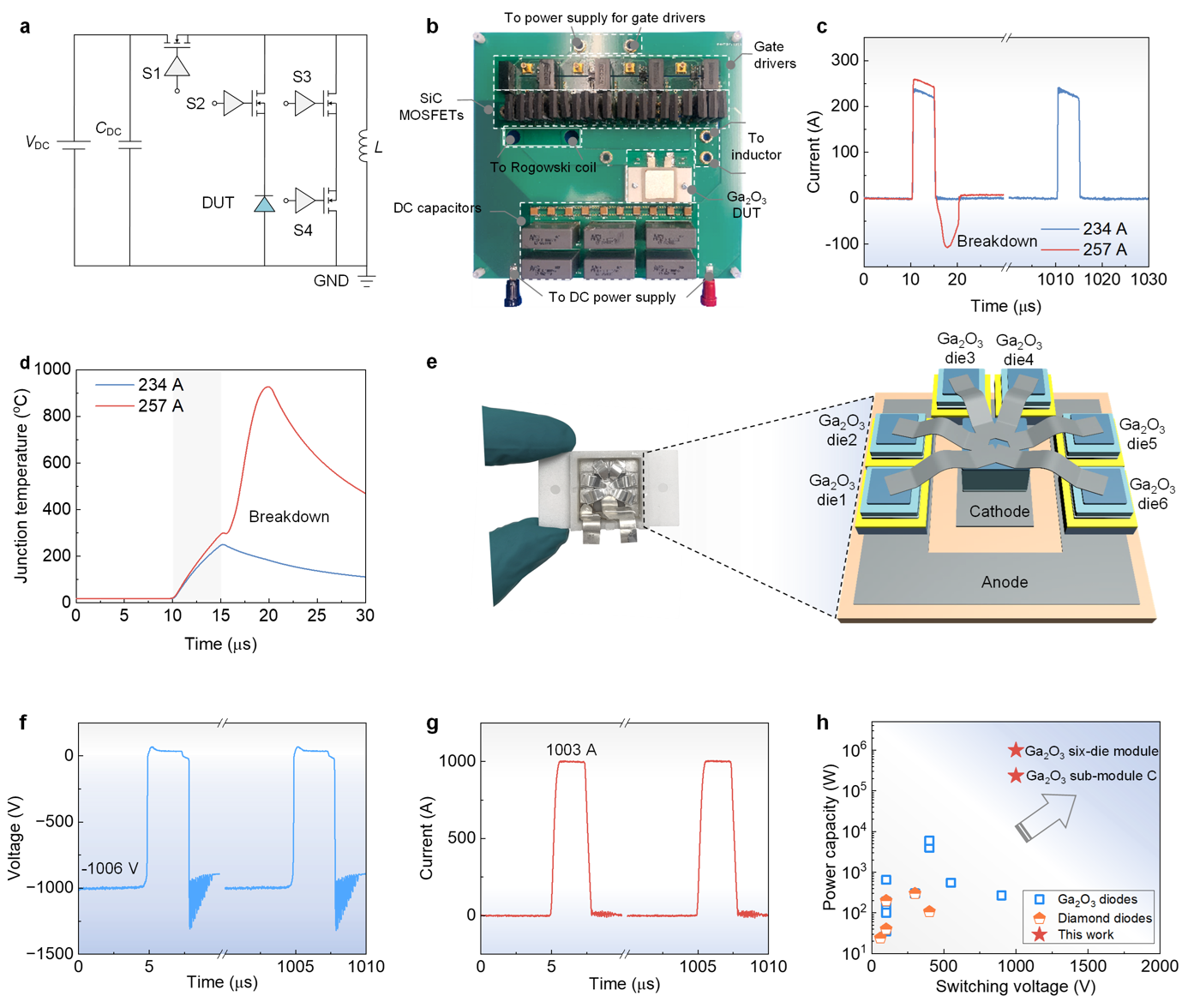
The researchers designed the semiconductor and enclosure together, shortening the thermal path near the junction and incorporating a high-permittivity interface to manage electric fields. A symmetric arrangement of six diode submodules distributes current across the larger assembly. The published experiment used external silicon carbide MOSFETs in its test circuit; the gallium oxide module itself is not an all-gallium-oxide transistor converter.
What the electrical measurements establish
The full assembly operated at a repetition rate of 1 kHz. The investigators extracted a 23-nanosecond turn-off interval and reported steady-state case temperatures of 92°C on top and 81°C underneath the submodules during repetitive pulsing. These are case temperatures, not peak junction temperatures. Separately, a single submodule carried 234 A in a 5-microsecond pulse with a 1 kV bus. Its modeled junction temperature peaked at approximately 251°C. The authors distinguish the thermal simulation from the electrical measurements in the full research paper.
Switching capacity is calculated as nominal blocking voltage multiplied by nominal conducted current: 1,000 V × 1,000 A = 1,000,000 W. In a rectifier, voltage and current describe different operating states. Consequently, that product is neither the heat dissipated inside the device nor proof that a load received one megawatt continuously. Average delivered power requires the actual load waveforms, pulse duration and duty cycle. At 1 kHz the repetition period is one millisecond, but the repetition period alone does not establish how much energy reaches a load.
Where pulsed power could matter
Particle accelerators, medical equipment and specialized grid protection may need electrical pulses rather than constant power. Compact high-voltage devices could eventually reduce the physical size of selected conversion stages. For continuous-duty infrastructure, such as the Cyprus high-voltage transmission project, a separate evaluation of losses, cooling requirements and service life would be indispensable. Data centers also require sustained, reliable conversion rather than impressive peak figures alone.
The next engineering challenge is moving from laboratory diode modules to qualified production devices and complementary transistors. Manufacturers must demonstrate repeatable wafer quality, packaging reliability, and application-specific lifetime. As our report on gallium nitride transistor frequency dispersion illustrates, device behavior under changing electrical conditions matters as much as a headline specification. The megawatt demonstration establishes a useful benchmark for pulsed rectification, but it does not establish commercial availability or continuous converter efficiency.


Leave a Reply