Tech Docs
-
The apropos command searches manual page names and descriptions for a given keyword, helping users quickly discover relevant commands for a task. The apropos command helps Linux users find commands related to a keyword quickly. For example, typing apropos copy lists commands involving copying files or directories. Similarly, apropos network shows commands associated with network…
-

Linux file permissions are a fundamental aspect of system security and file management, dictating how users can interact with files and directories. Each file or directory has an associated set of permissions that determine the actions permitted for the owner, the group, and others. These permissions are typically represented in a symbolic notation, such as…
-
File System Hierarchy Standard (FHS): The File System Hierarchy Standard defines a consistent directory structure for Linux systems, specifying locations for system files, user files, and application data. FHS ensures predictability and uniformity across distributions, facilitating easier management and maintenance. Standard directories include /etc for configuration files, /var for variable data, /bin for essential binaries,…
-
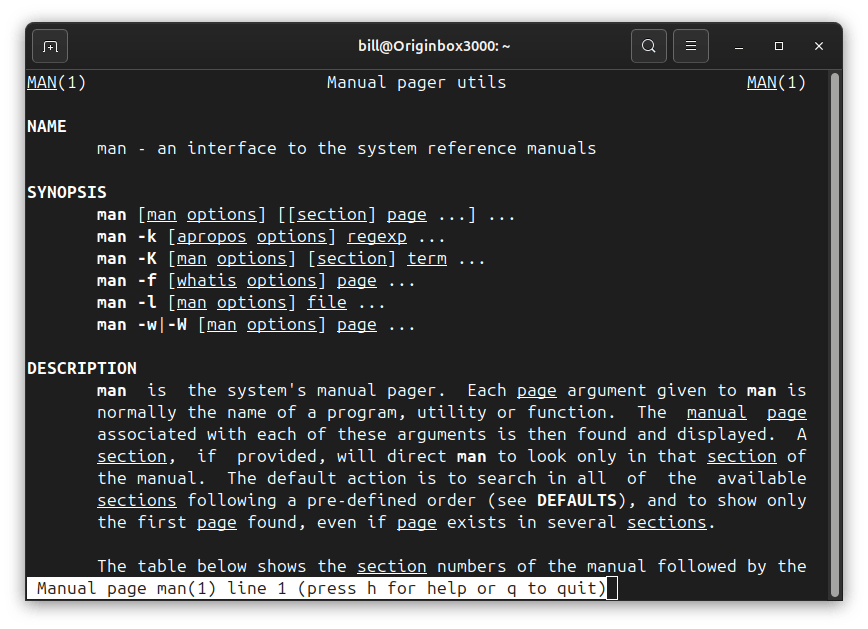
The man command, short for ‘manual’, is an essential tool in Linux, offering detailed documentation on virtually every command and program. By typing man followed by a specific command name, users gain immediate access to comprehensive manuals covering syntax, usage options, and practical examples. Ideal for beginners and seasoned professionals alike, the man command fosters…
-

Definition and FunctionalitySerial communication refers to the process of transmitting data one bit at a time over a communication channel or computer bus. Unlike parallel communication, which sends multiple bits simultaneously, serial communication reduces signal interference and supports long-distance data transfer with fewer wires. It is widely used in telecommunications, industrial automation, and computer networking…
-

The Power-On Self-Test (POST) is a fundamental diagnostic process performed by computers immediately after they are powered on. This procedure verifies the functionality and integrity of essential hardware components before the operating system loads, ensuring that the system operates correctly. During POST, the system’s firmware—commonly the BIOS or UEFI—conducts a series of checks on…
-

Overclocking involves increasing a computer component’s clock rate beyond the manufacturer’s specifications to boost performance. This practice is commonly applied to processors and graphics cards, allowing them to execute more operations per second. While overclocking can lead to significant performance gains, it also raises power consumption and heat output, necessitating improved cooling solutions to maintain…
-
Client-side virtualization enables users to run multiple operating systems simultaneously on a single physical machine, enhancing flexibility and resource utilization. This technology allows each virtual machine (VM) to operate independently, with its own CPU, memory, and storage resources. A key component in client-side virtualization is the hypervisor, also known as the Virtual Machine Manager (VMM).…
-

The central processing unit (CPU) serves as the brain of a computer, executing instructions and processing data essential for system operations. A CPU’s architecture encompasses various components and functionalities that determine its performance and capabilities. Instruction Set Architecture (ISA) The ISA defines the set of instructions a CPU can execute, including operations like arithmetic, data…
-

Before you can use python in the Linux terminal, you need to download the python version that you wish to utilize on your operating system. For example your python version might be 3.12 so make the call “python3 –version” After you confirm python is downloaded run the application by calling the version for example, “python3”…
-

RAID (Redundant Array of Independent Disks) is a data storage technology that combines multiple physical drives into a single logical unit to enhance performance, reliability, or both. Various RAID levels offer different balances between these factors. RAID 0 utilizes data striping, distributing data across multiple disks without redundancy. This configuration enhances read and write speeds…
-
Python’s package management landscape has been significantly shaped by pip, the default package installer for the language. Introduced in 2008 by developer Ian Bicking, pip—an acronym for “Pip Installs Packages”—was created to enhance the process of installing and managing Python software packages. It serves as a direct interface to the Python Package Index (PyPI), a…

