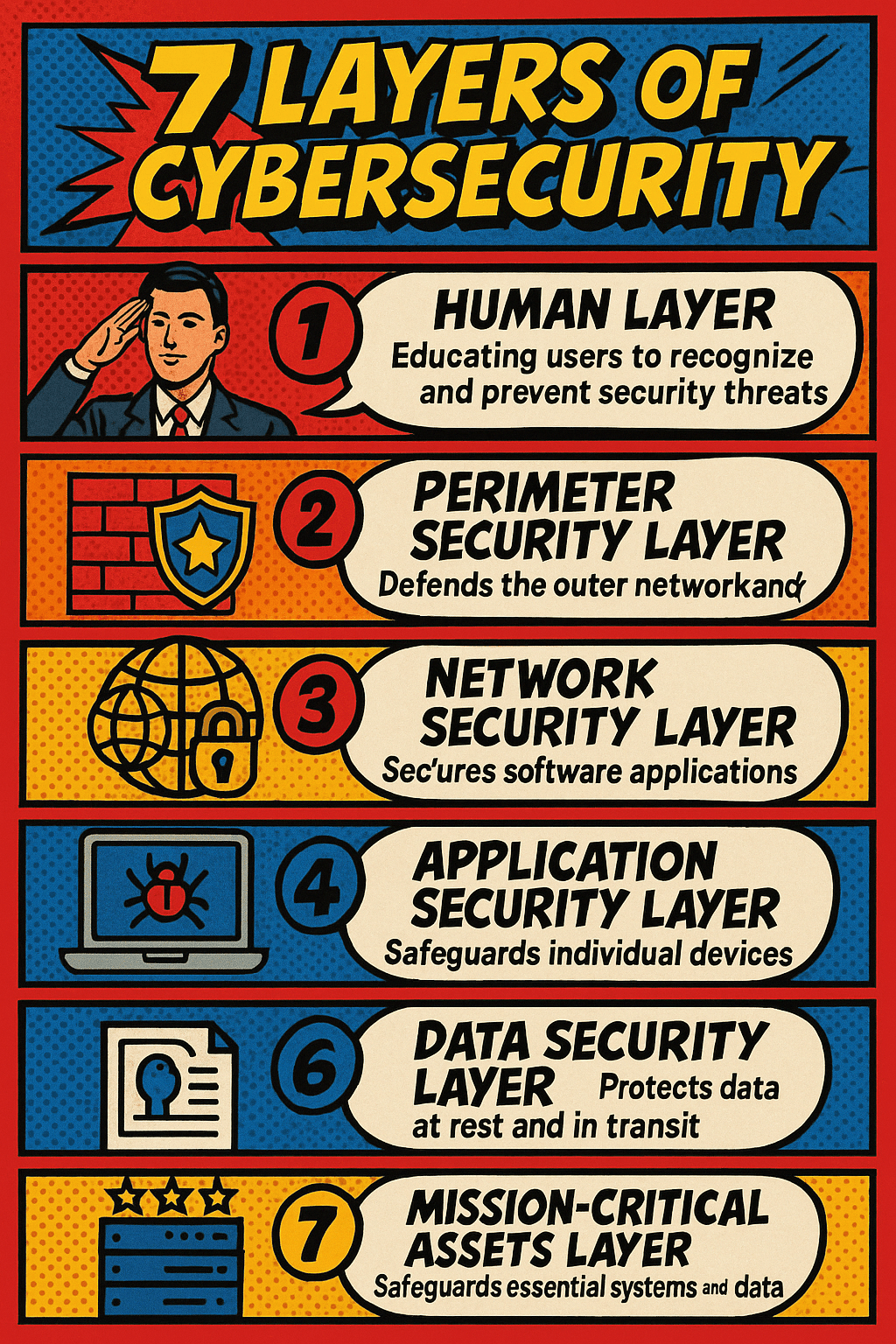
The 7 Layers of Cybersecurity

The 7 Layers of Cybersecurity framework offers a comprehensive approach to safeguarding digital assets by addressing threats at multiple levels.


Ad: Unlock 5% Off Bitcoin Mining Products 📟@ tinychiphub.com/BILLBURTONUse the Code BILLBURTON to unlock 5% Off Bitcoin Mining Productstinychiphub.com/BILLBURTONOne-time use per customer. Happy mining!

— BitcoinVersus.tech (@bitcoinversus.bsky.social) 2025-01-17T18:23:17.472Z

  1. Human (User Education) Layer
    Focuses on educating users to recognize and prevent security threats like phishing and social engineering. Implementing strong password policies and regular training sessions are key.
  2. Perimeter Security Layer
    Acts as the first line of defense, controlling traffic between external networks and your internal systems. Tools like firewalls, intrusion detection/prevention systems (IDS/IPS), and VPNs are essential here.
  3. Network Security Layer
    Ensures secure data transmission within your network. Employing secure protocols (e.g., HTTPS), network segmentation, and continuous monitoring helps prevent unauthorized access and data breaches.
  4. Application Security Layer
    Protects software applications from vulnerabilities. Regular code reviews, security testing, and deploying web application firewalls (WAFs) can mitigate risks like SQL injection and cross-site scripting (XSS).
  5. Endpoint Security Layer
    Secures individual devices like computers and smartphones. Utilizing antivirus software, endpoint detection and response (EDR) solutions, and device encryption helps protect against malware and unauthorized access.
  6. Data Security Layer
    Focuses on protecting data at rest and in transit. Implementing encryption, access controls, and regular backups ensures data integrity and availability.
  7. Mission-Critical Assets Layer
    Safeguards essential systems and data crucial for business operations. This includes implementing disaster recovery plans, redundancy, and continuous monitoring to ensure resilience against attacks.

Ad: Unlock 5% Off Bitcoin Mining Products 📟@ tinychiphub.com/BILLBURTONUse the Code BILLBURTON to unlock 5% Off Bitcoin Mining Productstinychiphub.com/BILLBURTONOne-time use per customer. Happy mining!

— BitcoinVersus.tech (@bitcoinversus.bsky.social) 2025-01-17T18:23:17.472Z

BitcoinVersus.Tech Editor’s Note:

We volunteer daily to ensure the credibility of the information on this platform is Verifiably True. If you would like to support to help further secure the integrity of our research initiatives, please donate here

BitcoinVersus.tech is not a financial advisor. This media platform reports on financial subjects purely for informational purposes.

7 responses to “The 7 Layers of Cybersecurity”

  1. […] same layered thinking appears in BitcoinVersus.Tech’s seven-layer cybersecurity framework. No single control stops every identity, application, network and endpoint failure, so useful […]

    Like

  2. […] layered approach is consistent with BitcoinVersus.Tech’s broader seven-layer cybersecurity framework: endpoint security is only one layer, and attackers can move to identity, communication or […]

    Like

  3. […] timing makes this more than another generic cybersecurity incident. Oracle issued an out-of-band security alert on June 10 for CVE-2026-35273, a critical […]

    Like

  4. […] broader defense-in-depth idea is why BitcoinVersus.Tech’s seven layers of cybersecurity still matter. Authentication is one layer. Endpoint security, software updates, network security, […]

    Like

  5. […] That distinction matters because conventional botnets already exploit weakly secured IoT hardware. BitcoinVersus.Tech recently covered PoeLLM turning AI servers into a cryptomining botnet, while earlier coverage looked at AI-assisted cyberattacks and defenses and the broader layers of cybersecurity. […]

    Like

  6. […] distinction matters. BitcoinVersus.Tech’s overview of the seven layers of cybersecurity shows why remediation is only one part of defense. TruRisk Eliminate 2.0 is specifically trying to […]

    Like

  7. […] BitcoinVersus.Tech recently covered a fake Web3 accelerator spreading malware, while our guide to the seven layers of cybersecurity explains why endpoint, network and application defenses have to overlap rather than depend on one […]

    Like

Leave a Reply