The FBI says a third-party contractor failed to apply an explicitly issued security patch before a damaging breach exposed sensitive information belonging to thousands of bureau employees. Reuters reported on October 6 that the FBI removed the contractor after its review traced the incident to a security failure on a platform managed by an outside organization.
The bureau did not publicly identify the contractor’s employer or the affected platform. Two sources familiar with the incident told Reuters that the provider was Accenture and that the breached system was Oracle PeopleSoft, the enterprise software platform ShinyHunters said it used to reach the FBI’s jobs infrastructure.
A patch was available before the breach
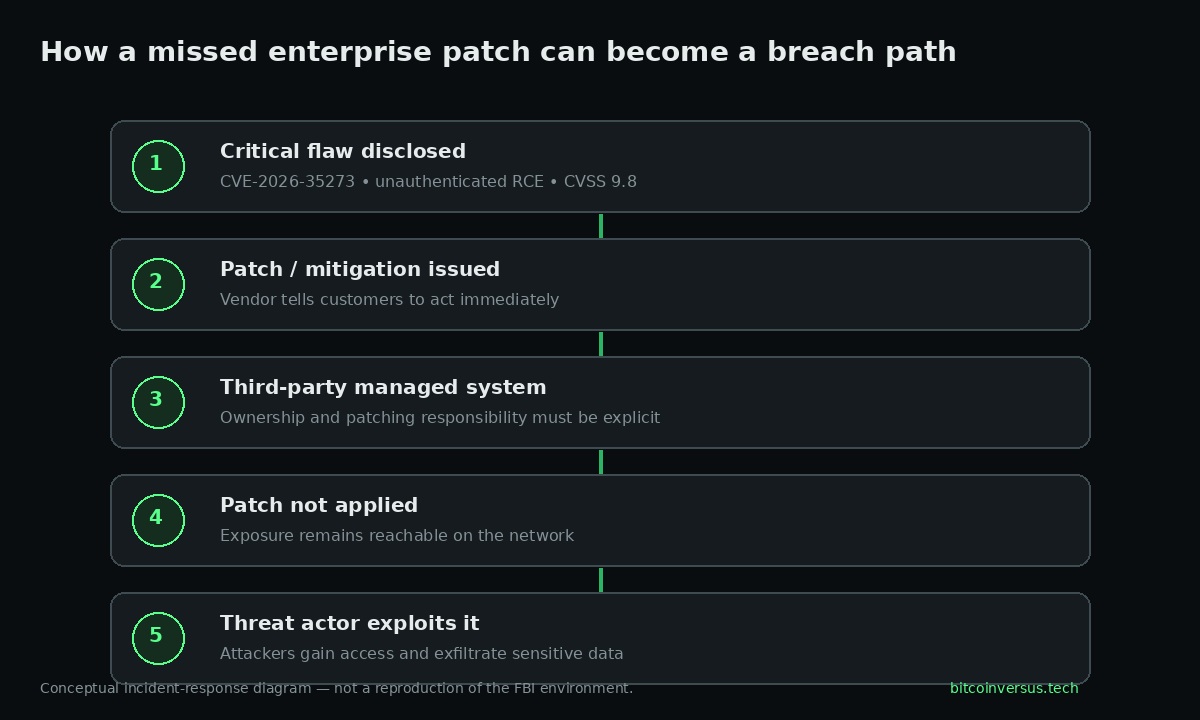
The timing makes this more than another generic cybersecurity incident. Oracle issued an out-of-band security alert on June 10 for CVE-2026-35273, a critical vulnerability in PeopleSoft Enterprise PeopleTools. Oracle rated it CVSS 9.8, said it was remotely exploitable without authentication, and warned that successful exploitation could lead to remote code execution.
Oracle’s advisory urged customers to take immediate action. Google’s Mandiant and Google Threat Intelligence Group reported the next day that ShinyHunters had already been exploiting the vulnerability as a zero-day between May 27 and June 9, before Oracle’s public advisory.
The FBI confirmed the missed patch — not the exact CVE
That distinction matters. FBI Cyber Division Assistant Director Brett Leatherman said the bureau’s review found that the incident followed a contractor’s failure to implement a security patch that had been explicitly issued to secure the affected platform. Reuters’ sources connected the platform to PeopleSoft. Public reporting and Mandiant’s research strongly connect ShinyHunters to CVE-2026-35273, but the FBI has not publicly confirmed that this exact CVE was the technical entry point in its own breach.
In September, Google said the group had resumed mass exploitation of CVE-2026-35273 and was bypassing some temporary firewall rules by URL-encoding a character in the vulnerable PSEMHUB path. That is an important operational lesson: a compensating control such as a web application firewall is not the same thing as installing the vendor fix.
Why the exposed data matters
Reuters reported that the breach exposed highly sensitive personnel information, including counterintelligence job descriptions, home addresses tied to human-intelligence personnel, and medical information. That elevates the incident beyond ordinary identity theft. Personnel records can become counterintelligence material when they reveal where people live, what they work on, their family relationships, or vulnerabilities that an adversary could attempt to exploit.
The episode also reinforces why authentication and authorization are only part of enterprise security. An organization can have strong identity controls and still be exposed if a public-facing application contains a remotely exploitable vulnerability that has not been patched.
ShinyHunters was already targeting third parties
The FBI has described ShinyHunters as a prolific cybercrime group that targets third-party vendors and cloud platforms to steal sensitive data. In a September 28 video, Leatherman said the group and alleged co-conspirators had breached more than 140 organizations since the previous year and taken at least $70 million in extortion payments.
FBI Director Kash Patel also publicly highlighted the international investigation after Dutch authorities arrested a suspected ShinyHunters member. The post is directly relevant because it shows the bureau’s response shifting from incident containment toward identifying and arresting people it believes are connected to the wider group.
The real failure is patch governance
Large organizations often outsource pieces of infrastructure, application management, hosting, or support. That can improve efficiency, but it does not outsource the consequences of a missed patch. The customer still needs a measurable process for deciding who owns vulnerability intake, who approves emergency changes, who installs the update, who verifies the installation, and who can prove the system is no longer exposed.
The most important question after a critical advisory is therefore not merely, “Did the vendor release a patch?” It is, “Can we prove every exposed instance received it?” That requires asset inventory, vulnerability management, change control, logging, verification, and escalation when a critical fix misses its deadline.
What comes next
The FBI says it has taken steps to mitigate further risk and protect its workforce while continuing the investigation. Accenture told Reuters it remains proud to support the FBI but did not answer Reuters’ questions about the individual contractor or the alleged patch failure.
For defenders, the takeaway is less exotic than the attacker’s name: critical patches have expiration dates measured in attacker time, not maintenance-calendar time. Once exploitation is public and automated, every unpatched internet-facing system becomes a race between the organization responsible for it and whoever scans it first.
Sources: Reuters; Oracle Security Alert CVE-2026-35273; Google Threat Intelligence / Mandiant.
Editor’s Note: BitcoinVersus.Tech covers technology, infrastructure, cybersecurity, hardware, energy, finance, Bitcoin, and the systems connecting them.
Disclaimer: This article is for informational and educational purposes only and does not provide legal, cybersecurity, investment, or financial advice.


Leave a comment