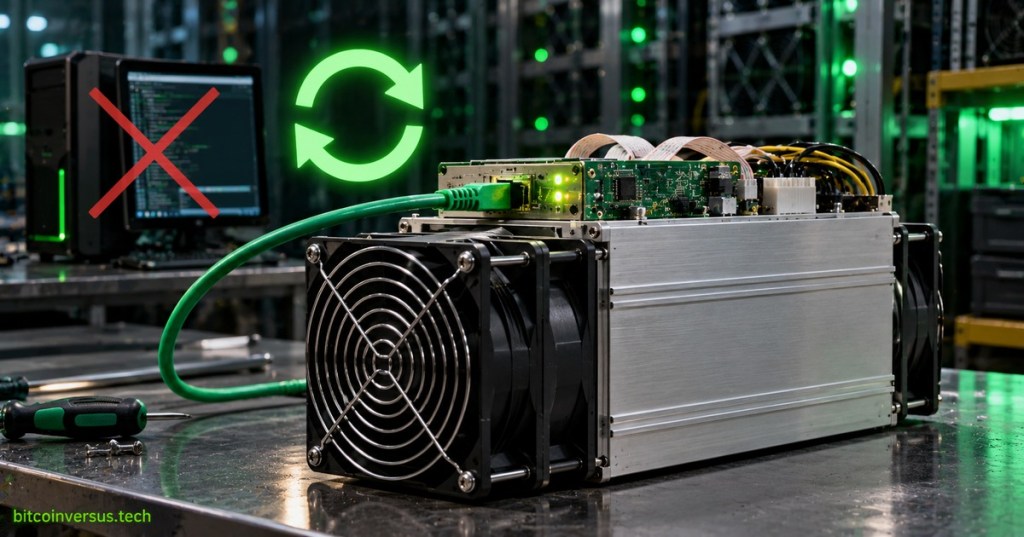
VNISH 1.3.6 removes one of the more annoying recovery steps for Bitcoin miners running supported CVitek control boards. After a reboot, the firmware can now initialize again automatically instead of depending on a separate computer running Hashcore Toolkit or Phoenix just to bring the miner back.
For one machine, that is a convenience. For a farm with dozens or hundreds of ASICs, it can mean fewer manual recovery steps after scheduled restarts, firmware maintenance, or power interruptions.
VNISH 1.3.6 Adds Automatic Startup on CVitek Boards
VNISH lists version 1.3.6 stable as its current release, published September 21, 2026. The release catalog covers 76 verified builds across 47 Antminer models and four control-board families.
The main operational change for supported CVitek hardware is automatic startup after reboot. VNISH says the firmware now comes back on its own rather than requiring another computer to keep Hashcore Toolkit or the Phoenix service running continuously.
Why This Matters at Farm Scale
A Bitcoin mine is full of small dependencies that become large problems when multiplied across hundreds of machines. A single recovery utility is easy to tolerate. An entire fleet depending on an extra PC, service, or manual restore step after every reboot adds another operational failure point.
Removing that dependency makes restart behavior more predictable. That matters in environments where miners are routinely rebooted after maintenance, firmware changes, network work, thermal events, watchdog actions, or site-level power cycling.
BitcoinVersus recently covered watchdog timers and reset loops, which illustrates the larger principle: recovery behavior is part of system reliability. A reboot is only useful if the device returns to the intended operating state afterward.
Toolkit Is Still Used for Installation and Updates
The change does not mean Hashcore Toolkit disappears from the workflow. VNISH still requires Toolkit for supported installation and update operations. Its current documentation says to use Hashcore Toolkit 1.7.4 or later for version 1.3.6 deployment.
The difference is what happens afterward. Once the firmware is installed on supported CVitek hardware, Toolkit no longer has to remain running on another computer simply so VNISH can return after a miner reboot.
VNISH’s installation guide also recommends confirming the miner model and board, preserving settings, validating the installed version, checking pool configuration, and watching temperatures, hashrate, and errors before expanding the update across a larger fleet.
There Is Also a CVitek Cleanup Fix
Version 1.3.6 also fixes the CV control-board log-cleanup routine used when removing the firmware. That is less visible than automatic startup, but it is still useful for operators moving devices between firmware states or returning hardware to a different configuration.
This is where hardware/firmware compatibility becomes important. Antminer model names alone are not always enough to identify the correct firmware route. VNISH’s catalog distinguishes between Amlogic, BeagleBone, Xilinx, and CVITEK control-board families and publishes exact build IDs and SHA-256 checksums.
Firmware Verification Matters More as Fleets Get Larger
VNISH’s current catalog publishes a checksum for every verified build. That gives operators a way to confirm that the downloaded package matches the expected file before it reaches production hardware.
BitcoinVersus’ firmware backup and recovery lesson covers the same operational discipline: verify images, preserve rollback paths, and avoid treating a firmware update like a casual software install.
The latest VNISH documentation also warns that Bitmain stock firmware released in August 2026 or later may carry installation restrictions. Operators with those builds should confirm support before flashing rather than assuming an older procedure still applies.
One Less Thing for a Technician to Babysit
This release is not a giant hashrate jump or a new ASIC generation. It is the kind of small operational improvement that can matter just as much inside a real mine.
A miner that reboots and returns to the intended firmware automatically is easier to manage than one that depends on an external recovery process. At farm scale, reducing those dependencies can translate into faster recovery, fewer manual touches, and a cleaner operating procedure.
What Comes Next
The next useful question is how reliably the new behavior performs across large mixed CVitek fleets during real power events, firmware maintenance windows, and scheduled restart cycles.
For now, the practical win is clear: on supported CVitek Antminers, VNISH 1.3.6 can return after a reboot without requiring an always-on PC to bring the firmware back.
BitcoinVersus.Tech
Editor’s Note: Firmware changes can affect stability, warranty support, pool settings, power limits, and recovery behavior. Match the exact firmware file to the miner model and control board, verify the published checksum, preserve configuration and rollback information, and test on one machine before expanding across a fleet.
We volunteer daily to improve the credibility of the information on this platform. If you would like to support the research, please donate here: 3C9o19EH5HSiwEPyCTmEKzxhNCbo2X6TTb
BitcoinVersus.tech is not a financial advisor. This media platform reports on technical and financial subjects purely for informational purposes.


Leave a comment