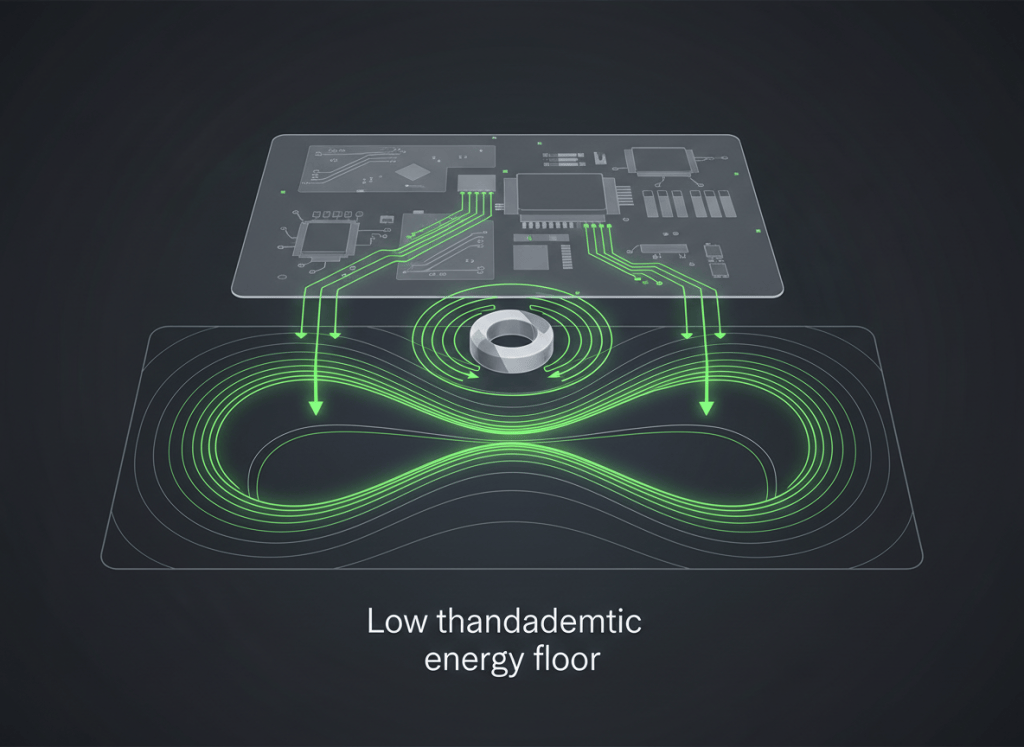
Every bit stored in a computer is physical.
A zero or one may look abstract on a screen, but underneath the software it ultimately corresponds to a physical state that must be created, maintained or changed. That means computation has an energy cost—and physics places boundaries on how small that cost can become.
Researchers led by the University of Edinburgh have developed a mathematical framework that could move magnetic memory closer to one of those boundaries. Their work applies optimal control theory to the problem of switching magnetic states, calculating how a magnetic-field pulse can reach the required state while consuming as little energy as possible.
That makes the research especially interesting for the intersection of theory, computing hardware and power efficiency.
The Landauer Limit
The theoretical foundation begins with an idea associated with physicist Rolf Landauer: information processing is constrained by thermodynamics.
In simplified terms, erasing a bit of information has a minimum possible energy cost related to temperature. The result does not mean today’s processors operate at that minimum. Real devices generally consume far more energy because switching transistors, moving data, operating memory and maintaining the surrounding system introduce additional losses.
The Landauer limit is therefore better understood as a physical floor than as a specification engineers can simply order from a semiconductor manufacturer.
The new research asks a useful engineering question: how much unnecessary energy can be removed from the process before that physical floor becomes important?
Optimization Instead of Brute Force
Magnetic memory stores information using different magnetic states. Changing the stored bit requires changing that state.
Instead of simply applying a conventional switching pulse, the researchers mathematically optimized how the magnetic field evolves over time. The method accounts for realistic experimental constraints while searching for a lower-energy switching path.
This is an important distinction. The theory is not proposing that information can be manipulated with zero energy. It is trying to identify a more efficient route between two physical states.
Think of it as finding the lowest-energy trajectory rather than simply applying more force until the bit changes.
Why Memory Efficiency Matters
Processor efficiency receives enormous attention, particularly as AI accelerators become larger and more power hungry. But computation is not only arithmetic.
Modern systems constantly move information between processors, caches, memory and storage. As AI models and data-center workloads increase the volume of information being processed, the energy associated with memory operations becomes increasingly important.
A highly efficient arithmetic unit cannot eliminate the cost of repeatedly moving and changing enormous quantities of data. That is why advances in memory architecture belong in the same efficiency conversation as the processors covered in BitcoinVersus.tech’s Semiconductors reporting.
Several Orders of Magnitude Is a Simulation Result
There is an important boundary between the theory and commercial hardware.
The researchers’ dramatic efficiency improvement comes from simulations and mathematical optimization. It does not mean today’s DRAM or MRAM can immediately be replaced by memory operating near the Landauer limit.
Real hardware introduces fabrication tolerances, thermal effects, control circuitry, signal delivery, reliability requirements and other energy costs. The research instead establishes a theoretical route worth testing.
That distinction matters because theoretical efficiency and system-level efficiency are not the same measurement.
The Mathematics Could Extend Beyond Magnetic Fields
One particularly interesting part of the work is that the optimization framework may not be restricted to magnetic-field switching. The researchers say the underlying mathematics could potentially be adapted to switching driven by electrical currents or ultrafast laser pulses.
If experimentally validated, that would make the work broader than a single proposed memory device. It would demonstrate a more general idea: better control of the switching process itself can become an efficiency technology.
The Bigger Theory
For decades, computer performance improved partly by making electronic components smaller and faster.
The next phase of computing may require another dimension: making the physical transition underlying each operation more deliberate. Instead of asking only how small a device can become, engineers can ask how closely its physical behavior can approach the minimum energy required to accomplish the task.
That is where information theory, thermodynamics, semiconductor engineering and computing architecture begin to overlap.
The Landauer limit remains a theoretical boundary—not a promise about the next generation of commercial memory. But research that moves practical device models closer to that boundary helps reveal how much efficiency may still be hidden inside the physics of computation.
BitcoinVersus.Tech Editor’s Note:
We volunteer daily to ensure the credibility of the information on this platform is Verifiably True. If you would like to support to help further secure the integrity of our research initiatives, please donate here: 3C9o19EH5HSiwEPyCTmEKzxhNCbo2X6TTb
https://x.com/1BitcoinVersus/status/1937006164555993338
BitcoinVersus.tech is not a financial advisor. This media platform reports on financial subjects purely for informational purposes.


Leave a Reply