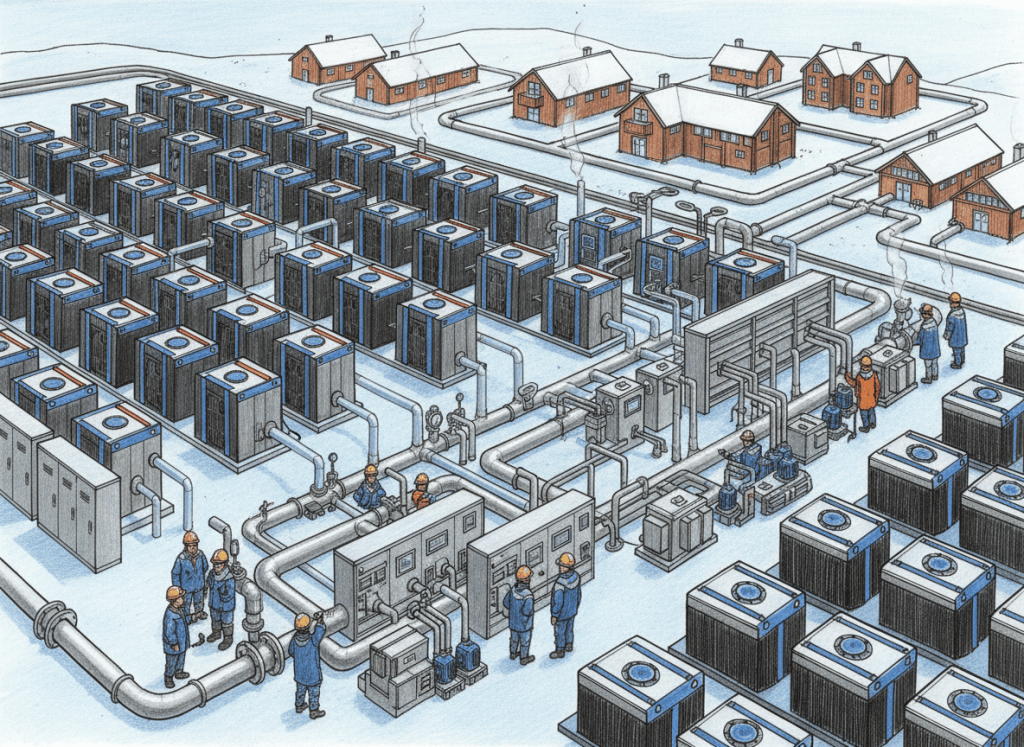
Canaan says an approximately 8 MW Nordic district-heating installation built around its hydro-cooled Avalon A1566HA Bitcoin mining systems is now fully online, turning ASIC heat into hot water for roughly 2,800 homes.
The September 24 update marks a significant milestone for a project Canaan first detailed in May. At that point, approximately 2 MW of the system, consisting of 228 A1566HA units, was operating. The heating provider had ordered another 6 MW, or 692 units, after evaluating competing solutions. Canaan now says the approximately 8 MW installation has delivered heat to about 2,800 homes.
Bitcoin ASICs Produce 80°C Water
The engineering feature separating the project from conventional air-cooled mining is its thermal output. Canaan says the A1566HA hydro-cooled systems can produce water at approximately 80°C, allowing the recovered heat to feed directly into existing district-heating infrastructure.
That changes the role of mining-site cooling. Instead of treating ASIC heat purely as waste that must be rejected into the atmosphere, the liquid loop becomes part of a useful thermal system. Pumps move coolant through the mining equipment, heat exchangers transfer thermal energy, and the district network carries that energy to buildings that need heat.
Canaan says the heating nodes consist of numerous parallel A1566HA units that can be dynamically overclocked or underclocked. A parallel architecture also allows individual units to be serviced without removing the entire heat source from operation, an important reliability consideration when compute equipment is also serving a heating load.
Data Center Fundamentals Become Heating Fundamentals
An 8 MW hash-to-heat system links electrical and thermal infrastructure unusually closely. Utility service, transformers, switchgear, protection and distribution must reliably energize the ASIC fleet. On the thermal side, operators have to manage coolant flow, pump availability, heat-exchanger performance, supply and return temperatures, pressure and the changing demand of the receiving district-heating network.
Operational performance therefore cannot be judged from Bitcoin hashrate alone. Useful measurements include accepted hashrate, total wall power, miner uptime, pump power, coolant temperatures and the quantity of useful heat actually delivered. A system that captures more of its electrical input as saleable or useful thermal energy can create a second productive output from the same computing load.
From 8 MW District Heating to Home Bitcoin Miners
Canaan is presenting the project at BTCHEL in Helsinki on September 25 and 26 alongside smaller heat-reuse hardware. Its Avalon Nano 3S is rated at 6 TH/s with a maximum 140 W draw, while the Avalon Mini 3 combines approximately 37.5 TH/s of Bitcoin mining with 800 W of heating output. The AvalonQ is rated at 90 TH/s.
The product range shows the same engineering idea at very different scales: electricity entering an ASIC becomes computation and heat. The economic and infrastructure question is whether that heat can be captured at a temperature, location and time when someone can use it.
The Nordic installation provides an important operating example because it connects hydro-cooled Bitcoin hardware to an existing heating network rather than demonstrating heat recovery only as a laboratory concept. The next useful disclosures will be sustained operating hashrate, measured electrical consumption, pumping overhead, thermal delivery efficiency, uptime and seasonal performance as heating demand changes.
Sources
- Canaan: Nordic district-heating project announcement
- Canaan/PR Newswire: September 24 BTCHEL and project update
BitcoinVersus.Tech Editor’s Note:
We volunteer daily to ensure the credibility of the information on this platform is Verifiably True. If you would like to support to help further secure the integrity of our research initiatives, please donate here: 3C9o19EH5HSiwEPyCTmEKzxhNCbo2X6TTb
Follow BitcoinVersus.Tech on X.
Financial Disclaimer: BitcoinVersus.Tech provides information for educational and informational purposes only. Nothing published here constitutes financial, investment, legal or tax advice. Readers should conduct independent research and consult qualified professionals before making financial decisions.


Leave a Reply