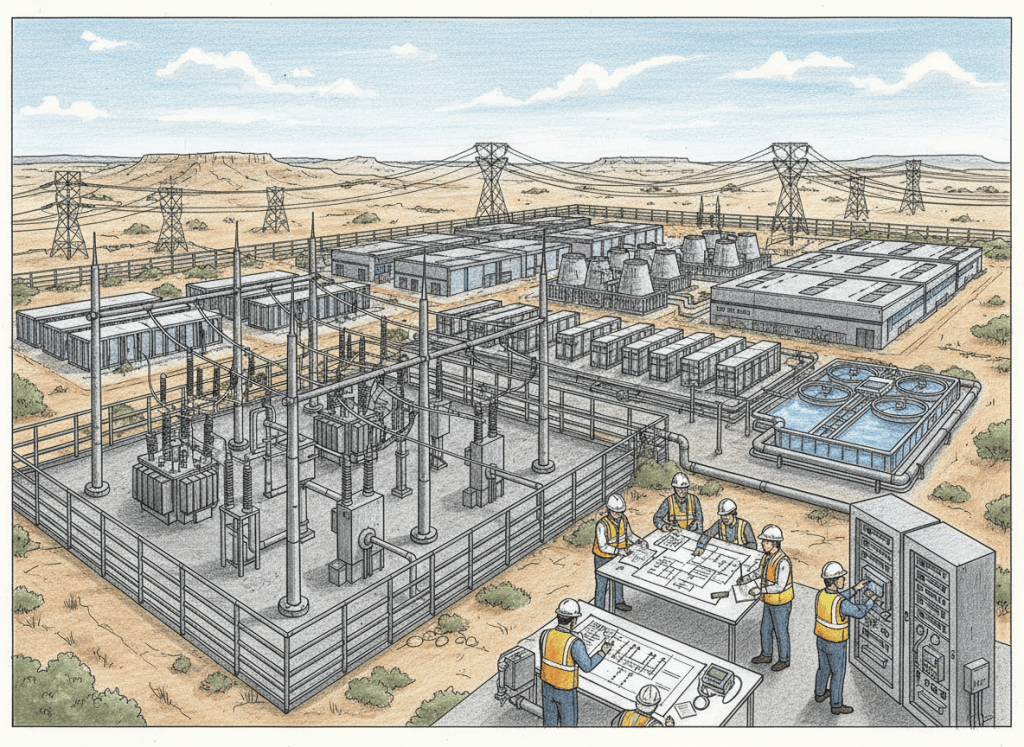
Texas has placed new scrutiny on the infrastructure pipeline supporting large data centers, a development with direct implications for Bitcoin miners competing for the same substations, transformers, transmission capacity, powered land and water resources.
Governor Greg Abbott directed the Texas Commission on Environmental Quality to pause permitting associated with data-center projects while the Electric Reliability Council of Texas, or ERCOT, completes a review of large-load interconnections. The state is also examining the electricity and water demands created by rapid data-center development.
Texas Faces an Enormous Large-Load Queue
ERCOT has been confronting a connection pipeline far larger than the state’s existing peak load. Recent reporting puts large-load connection requests above 474 GW, more than five times Texas’ record peak electricity demand.
Not every project in that queue will be constructed, and connection requests should not be interpreted as committed electrical demand. The scale nevertheless illustrates the pressure that AI campuses, cloud facilities, industrial loads and cryptocurrency mining can place on transmission planning and generation forecasts.
The governor’s directive calls for large projects to bear the cost of electrical infrastructure required to serve them and asks for reporting on electricity and water use. State agencies are also reviewing how proposed developments could affect community water supplies.
Why Bitcoin Miners Should Watch the Review
Texas has become one of the most important U.S. markets for industrial Bitcoin mining. Miners have been attracted by its competitive electricity market, large generation fleet, renewable resources and ability to participate as flexible loads.
But an ASIC mining campus is ultimately an electrical infrastructure project. Before thousands of miners can hash, a site may require utility interconnection studies, transmission or distribution upgrades, substations, medium-voltage switchgear, transformers, protection systems, conductors, power distribution and cooling equipment.
Those components increasingly overlap with the infrastructure demanded by AI and high-performance-computing campuses. The competition is therefore not simply for megawatt-hours. It can also be for transformer manufacturing slots, switchgear, transmission capacity, suitable land, construction labor and access to water or alternative cooling systems.
Behind-the-Meter Power Does Not Eliminate Every Constraint
Developers sometimes reduce grid dependence by building generation behind the meter. That architecture can change the interconnection problem, but it does not automatically eliminate permitting, environmental, fuel, water or local infrastructure requirements. Legal analysis following the Texas directive indicates the state’s review may also affect projects designed around on-site generation.
For Bitcoin miners, that makes electrical one-lines and energy contracts only part of site diligence. Developers also need to understand permitting timelines, utility upgrade responsibilities, water availability, cooling architecture, emissions requirements where generation is on site, and whether a project can curtail rapidly when the grid is stressed.
Flexible Mining Loads Remain Technically Different
Bitcoin mining has one important engineering distinction from many conventional data-center workloads: ASIC fleets can often reduce load quickly without moving a customer-facing application or interrupting a long-running AI training job. Texas miners have used that flexibility in ERCOT demand-response and curtailment programs.
That does not remove the need for transmission and generation planning, but it means policymakers and grid planners can evaluate large loads according to how they actually behave rather than treating every megawatt of data-center demand identically.
The key metrics to watch now are how ERCOT changes its large-load interconnection process, which projects remain in the queue, what infrastructure costs developers must assume, and whether flexible-load characteristics receive different treatment. Those decisions could materially affect where the next generation of Texas Bitcoin mining and AI data-center capacity is built.
Sources
BitcoinVersus.Tech Editor’s Note:
We volunteer daily to ensure the credibility of the information on this platform is Verifiably True. If you would like to support to help further secure the integrity of our research initiatives, please donate here: 3C9o19EH5HSiwEPyCTmEKzxhNCbo2X6TTb
Follow BitcoinVersus.Tech on X.
Financial Disclaimer: BitcoinVersus.Tech provides information for educational and informational purposes only. Nothing published here constitutes financial, investment, legal or tax advice. Readers should conduct independent research and consult qualified professionals before making financial decisions.


Leave a Reply