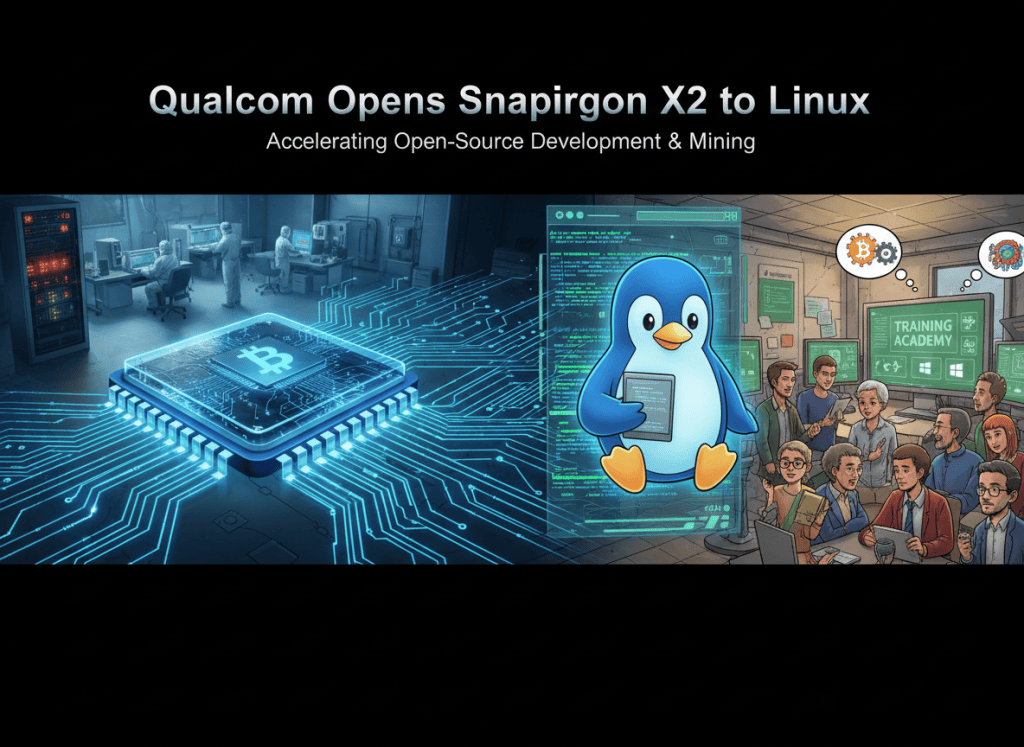
Qualcomm is expanding Linux support around its Snapdragon X2 platform, giving developers another path toward running open-source operating systems on high-performance Arm hardware.
The company’s developer work uses Debian 13 “Trixie” as a current reference environment while support is being developed and upstreamed across major parts of the platform.
Linux support reaches the hardware stack
The important part is not simply getting Linux to boot. Platform support involves the hardware interfaces that determine whether a system is actually useful: graphics, AI acceleration, storage and peripheral connectivity, power management and thermal control.
Qualcomm’s Linux work includes support around the Adreno GPU and Hexagon NPU, alongside USB, PCIe, UART, I²C and SPI interfaces. Power and thermal management are particularly important on mobile-derived silicon because performance depends on keeping the processor inside tight electrical and temperature limits.
Why upstream Linux support matters
Upstream support can reduce dependence on heavily customized vendor kernels. When hardware enablement reaches established Linux projects, distributions and developers can inherit improvements through normal kernel, firmware and userspace updates rather than maintaining a completely separate software stack.
That matters for developers working on Linux workstations, edge systems, AI applications and embedded computing. PCIe support can connect accelerators and storage devices. GPU drivers determine graphics and compute capabilities. NPU support can expose dedicated AI hardware without sending every workload through the CPU or GPU.
Arm PCs become more interesting for Linux developers
Snapdragon’s expansion into PCs has made Qualcomm increasingly relevant beyond smartphones. Better Linux support could make these systems more practical for developers who rely on terminals, containers, compilers, Python environments and open-source infrastructure tools.
The engineering challenge remains broader than processor performance. A Linux machine needs reliable suspend and resume behavior, networking, graphics acceleration, external displays, storage, USB devices, thermal management and firmware integration before it can compete with mature x86 Linux platforms.
What comes next
Qualcomm has indicated that the current production-readiness phase is targeted around the end of November 2026, while upstream development is expected to continue beyond that milestone. Developers should therefore distinguish between hardware that can run Linux today and functionality that has reached mature upstream support.
For the broader computing market, the project is another sign that Linux support is becoming part of the competitive landscape for Arm PCs and AI-capable client hardware.
BitcoinVersus.tech covers Linux, open-source software, semiconductors, AI hardware, data centers and computing infrastructure.


Leave a Reply