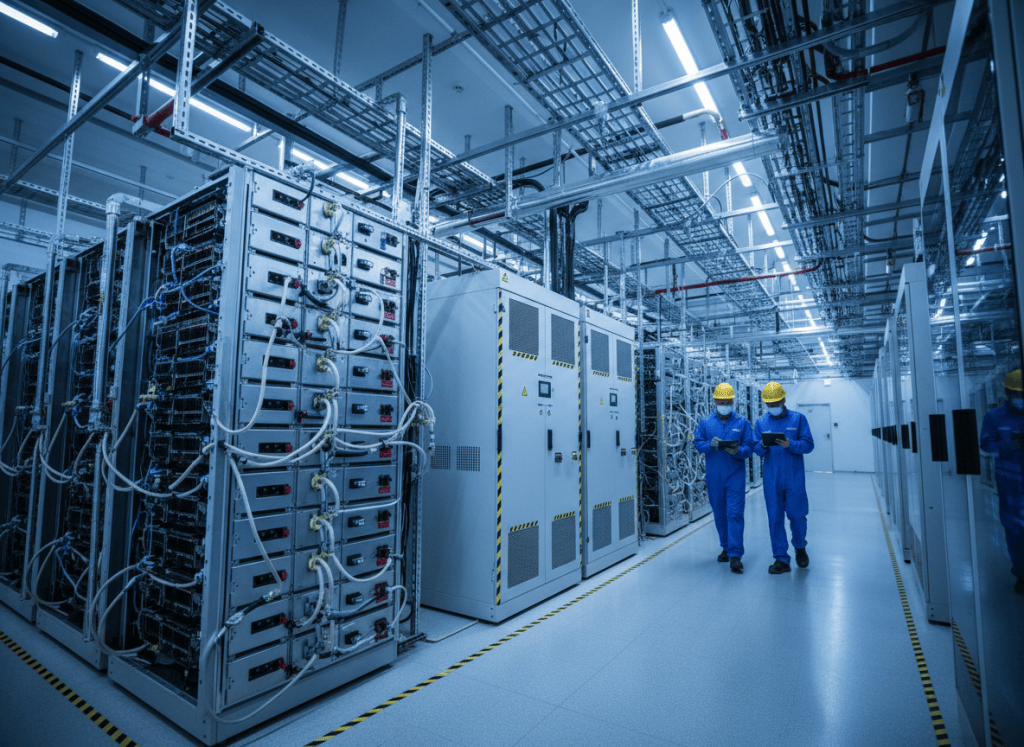
Delta Electronics is packaging power delivery and liquid cooling into a single infrastructure stack for NVIDIA DSX-based AI factories, including 800-volt DC distribution and coolant distribution units rated as high as 3 megawatts.
The September 17 announcement targets one of the biggest constraints facing high-density AI computing: a GPU rack cannot produce useful compute unless the electrical and thermal systems around it can continuously deliver power and remove heat.
800 VDC Moves Power Deeper Into the AI Rack
Delta says its 800 VDC architecture can reach up to 98% conversion efficiency at the facility and rack level. At the board level, the company describes DC-to-DC hardware that converts 800 VDC directly to 50 VDC or 12 VDC with peak efficiency of up to 98.5%.
The design is intended to reduce conversion stages, electrical losses and the amount of copper required to feed increasingly power-dense AI systems. Delta’s high-density in-row equipment can deliver up to 800 kW from a single power rack, according to the company.
Liquid Cooling Reaches 3 MW
The thermal side is equally large. Delta lists liquid-to-liquid cooling distribution units at 2.4 MW and 3 MW. The 3 MW system is designed to move enough coolant for next-generation high-density AI infrastructure, while smaller in-rack cooling equipment can serve individual GPU systems.
Delta is also combining the power and cooling hardware into prefabricated AI data-center modules. The company says factory assembly and validation can reduce the amount of integration work that has to happen at the construction site.
From the Grid to the Chip
The broader architecture extends beyond server racks. Delta’s portfolio includes energy storage, medium-voltage infrastructure, solid-state transformers, rack power, battery and capacitance backup systems, cold plates and coolant distribution equipment.
NVIDIA describes DSX as a framework for co-designing the entire AI factory, from grid and facility infrastructure through accelerated computing and operations software. Delta is one of the infrastructure suppliers building hardware around that model.
AI Compute Is Becoming an Electrical Engineering Problem
For data-center operators, the significance is larger than another server specification. As rack densities increase, power conversion, transient GPU loads, coolant flow, pumps, heat rejection and backup energy increasingly determine how much accelerator hardware can actually be brought online.
Delta’s efficiency and performance figures are company specifications rather than independent field measurements. Actual facility efficiency will depend on the complete electrical path, cooling design, utilization, climate and operating conditions. Still, the scale of the equipment shows how rapidly the supporting infrastructure around AI chips is changing.
Sources: Delta Electronics and NVIDIA DSX.
BitcoinVersus.Tech Editor’s Note: We volunteer daily to ensure the credibility of the information on this platform is Verifiably True. If you would like to support to help further secure the integrity of our research initiatives, please donate here: 3C9o19EH5HSiwEPyCTmEKzxhNCbo2X6TTb
Disclaimer: BitcoinVersus.tech is not a financial advisor. This media platform reports on financial subjects purely for informational purposes.


Leave a comment