K1Pool and GMiner have released SHA-256 ASIC firmware version 1.30 with a particularly practical thermal-control feature: individual hot BM1368 chips can now be automatically downclocked instead of forcing an operator to reduce an entire miner’s performance.
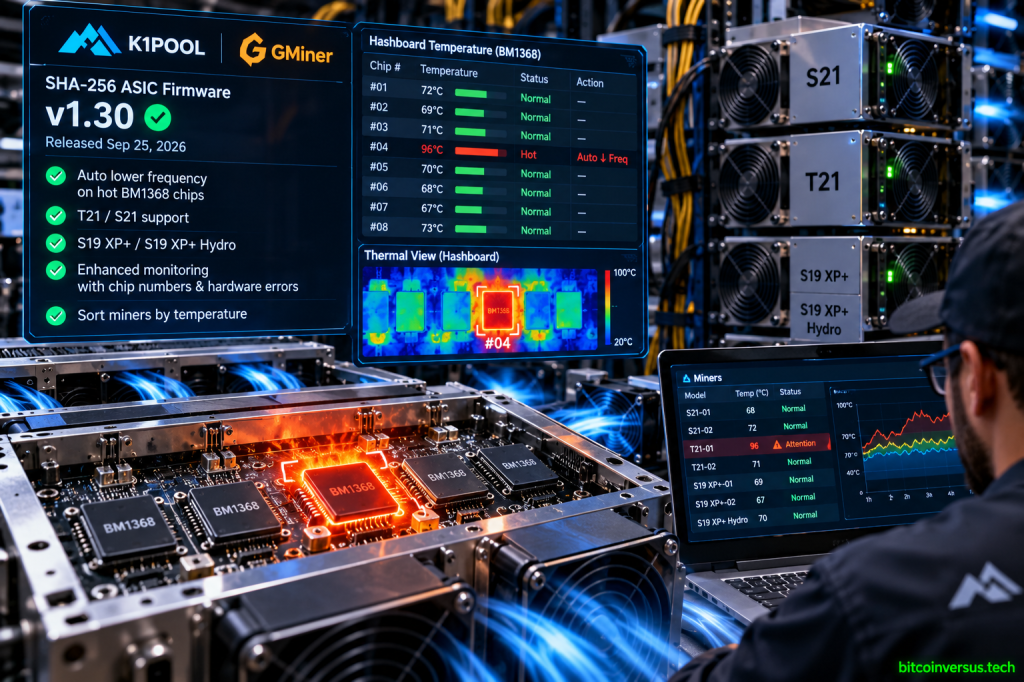
One hot chip no longer has to dictate the whole hashboard
The mining platform lists firmware 1.30 as its September 25 release. Its headline change is automatic frequency reduction for overheating chips on BM1368-based machines, including T21 and S21 hardware as well as S19 XP+ and S19 XP+ Hydro systems.
That is an operationally meaningful distinction. A hashboard contains many ASIC dies, and thermal behavior is rarely perfectly uniform. One chip can run hotter because of silicon variation, airflow, heatsink contact, dust or another local condition even while neighboring chips remain inside their normal operating envelope.
BitcoinVersus.tech recently explained why hashboards cannot simply be swapped between every ASIC model. Firmware has the opposite challenge: it must understand the exact chip and board platform well enough to control those components safely.
Firmware 1.30 exposes more chip-level data
Technical analysis of the release reports that the Performance page now exposes chip numbers and hardware errors, while the companion Toolkit can sort miners by temperature. Less frequently used cooling and performance controls have also been moved into advanced panels.
Those changes sound small compared with a new ASIC launch, but they address daily fleet-management work. A technician diagnosing an unstable unit wants to know whether the problem is miner-wide, board-specific or concentrated around one chip. Better telemetry shortens that path.
The approach complements the power and startup diagnostics added in Braiins OS 26.09 and the signed-firmware and S21++ work in LuxOS. Mining firmware is increasingly becoming a fleet reliability layer rather than merely an overclocking tool.
Thermal control matters more as ASIC density rises
Modern SHA-256 machines pack enormous compute into each chassis. BitcoinVersus.tech recently covered an air-cooled miner rated at 600 TH/s and 9.8 J/TH, illustrating how quickly per-machine density is increasing.
Higher density makes local thermal management more valuable. If firmware can reduce frequency only where heat is excessive, operators may preserve more aggregate hashrate than with a blunt whole-machine derate. The exact benefit will depend on hardware condition, ambient temperature, cooling and the firmware’s tuning behavior.
That chip-level view also connects to our ASIC architecture guide and the recent Bitaxe firmware-warning improvements. Whether a fleet has one machine or thousands, useful telemetry ultimately comes down to seeing failures before they become downtime.
Operators should validate before fleet-wide deployment
Third-party firmware changes the control layer of expensive mining equipment, so a production rollout should be staged. Operators should confirm supported model and control-board combinations, preserve known-good configuration, test thermal and hashrate behavior on a small sample, and watch hardware-error rates before pushing an update across a site.
Version 1.30’s most interesting idea is therefore not simply “more performance.” It is finer-grained control: identify the chip that is actually hot, reduce stress there, and leave healthy silicon working closer to its intended operating point.
BitcoinVersus.Tech Editor’s Note: Firmware behavior can vary by ASIC model, control board, stock-firmware lineage and cooling environment. Operators should verify compatibility and test on a limited number of miners before any fleet-wide deployment.
Support independent Bitcoin, ASIC and mining infrastructure reporting: 3C9o19EH5HSiwEPyCTmEKzxhNCbo2X6TTb
BitcoinVersus.tech is not a financial advisor. This media platform reports on financial subjects purely for informational purposes.


Leave a Reply