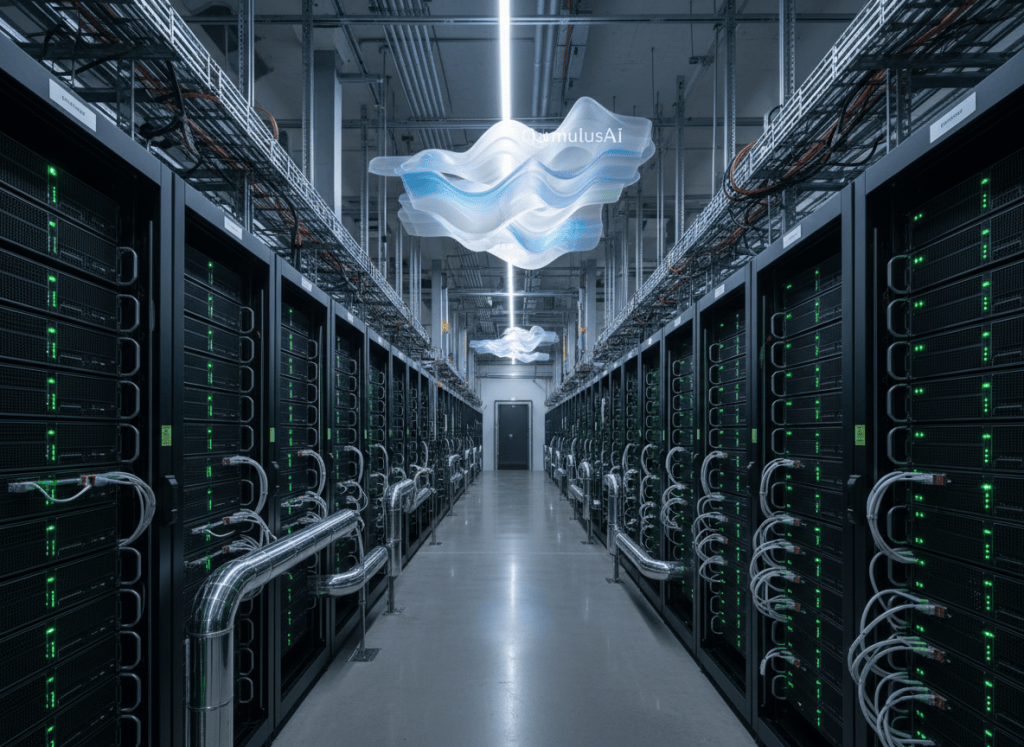
QumulusAI says it has activated 616 NVIDIA RTX PRO 6000 Blackwell GPUs for Runpod across 77 GPU nodes, putting the full reserved capacity online ahead of its original September 1 target.
The company said the deployment reached full activation in August and is being served from its existing U.S. data-center footprint. Separate coverage confirms the 616-GPU deployment and the mix of one- and two-year reserved-capacity agreements.
The Important Metric Is 77 Active Nodes
GPU announcements are easy to make. Activated infrastructure is harder. QumulusAI says all 77 nodes covered by the Runpod agreements are live, which moves this story from a planned hardware purchase into operating compute capacity.
The hardware is NVIDIA’s RTX PRO 6000 Blackwell Server Edition, a 96 GB GDDR7 accelerator aimed at enterprise data-center workloads including AI inference and visual computing. BitcoinVersus.tech has been tracking the broader Blackwell GPU infrastructure buildout as operators turn accelerator supply into functioning clusters.
Runpod Gets Inference Capacity Without Building a Data Center
Runpod plans to make the capacity available to developers for production inference and agentic workloads. That matters because the AI infrastructure market is separating into multiple layers: companies that own facilities and power, companies that operate GPU fleets, and platforms that package that compute for developers.
That separation is visible elsewhere. AI GPU-cloud pricing is responding to compute demand, while large AI infrastructure financings show how much capital is required to secure accelerators, power and facilities at scale.
Existing Power Can Be More Valuable Than New Construction
QumulusAI’s deployment model is notable because these GPUs are operating from existing U.S. data-center capacity. The company describes its strategy as using distributed colocation sites where power is already secured rather than waiting for a new hyperscale campus to be constructed.
That approach puts a premium on energized infrastructure. BitcoinVersus.tech recently examined 283 MW of added AI data-center power and the growing conversion of Bitcoin-mining infrastructure toward AI workloads. In each case, the scarce asset is not simply the GPU. It is the combination of power, cooling, networking, rack space and an operating site.
RTX PRO 6000 Is Not the Same Product as B300
The distinction matters. QumulusAI also operates Blackwell B200 and B300 hardware, but the RTX PRO 6000 Server Edition targets a broader mixture of inference, visualization and enterprise workloads. The company says it matches architectures to workloads rather than treating every Blackwell accelerator as interchangeable.
At the rack level, this sits inside a much larger hardware transition. Our breakdown of the components inside NVIDIA’s GB200 NVL72 rack illustrates why accelerators are only one part of a deployable AI system, while GB300 NVL72 deployments show the higher-density end of the current infrastructure curve.
What This Deployment Actually Proves
The 616 GPUs do not by themselves establish utilization, profitability or customer demand beyond the reserved-capacity agreements. QumulusAI has not disclosed workload-level utilization data for these 77 nodes.
What the deployment does establish is narrower and useful: hundreds of current-generation accelerators have moved into active U.S. infrastructure under contracted terms, and Runpod can expose that capacity to production AI developers without constructing the underlying data center itself.
NVIDIA explains the accelerator itself here, including the RTX PRO 6000 Server Edition’s role in enterprise data-center AI and visual computing.
QumulusAI is also discussing the deployment and its infrastructure strategy through this channel.
BitcoinVersus.Tech Editor’s Note
Support independent technology reporting: BTC donations may be sent to 3C9o19EH5HSiwEPyCTmEKzxhNCbo2X6TTb.
Follow BitcoinVersus.tech on X/Twitter for Bitcoin mining, semiconductor, AI hardware and data-center reporting.
Disclaimer: BitcoinVersus.tech is not a financial advisor. This media platform reports on financial subjects purely for informational purposes.


Leave a Reply