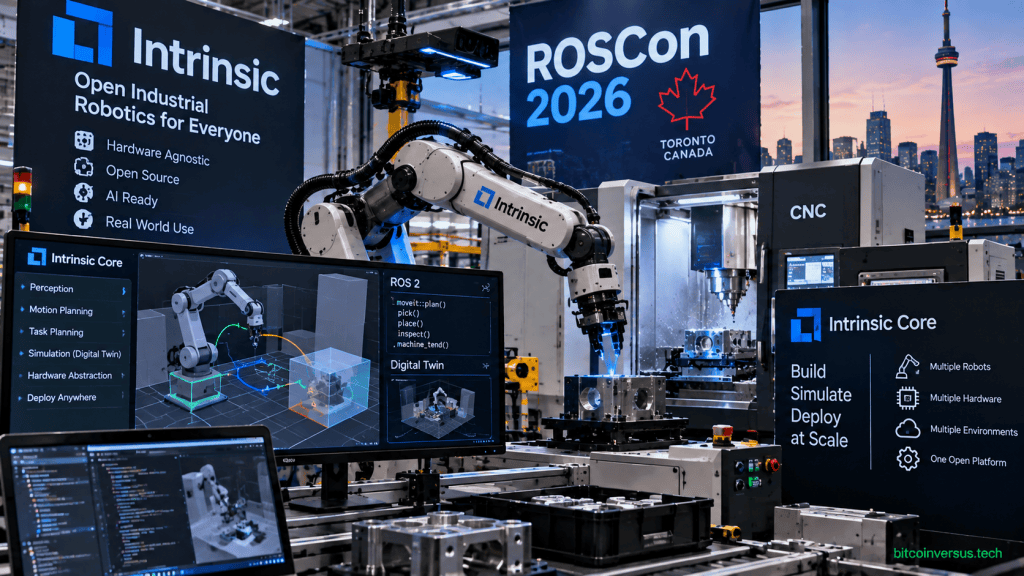
Intrinsic has open-sourced Intrinsic Core, releasing foundational industrial-robotics software under Apache 2.0 so developers can build physical-AI systems on top of ROS-compatible control, perception, simulation and machine-tending tools.
In the company’s September 22 announcement at ROSCon 2026 in Toronto, Intrinsic said the release is meant to shorten the path from prototype to production by packaging capabilities it already uses in real manufacturing deployments. A first-party X post introduced the project publicly and linked developers directly to the open-source release.
A robotics stack built around ROS
Intrinsic Core works with the Open Robotics Suite and includes a local runtime, SDK, digital twin, motion planning, grasp planning, perception and a hardware-agnostic real-time control framework. The software is designed so developers can swap robot arms, grippers and other hardware without rebuilding an entire application stack around each machine.
The Open Source Robotics Alliance described Intrinsic Core as the first of a new generation of opinionated ROS distributions built on top of the Open Robotics Suite, noting that ROS, Gazebo, ros-controls and OpenRMF sit at the center of the platform.
The first reference application targets CNC machine tending
Intrinsic is also releasing the Open Machine Tending Solution, a reference design for AI-enabled CNC machine tending. The goal is to give developers a working industrial template they can customize instead of starting with low-level motion, control and perception infrastructure from scratch.
That approach fits a broader shift toward more reusable robotics software. BitcoinVersus.Tech recently covered Qualcomm expanding into robotics through PickNik, NVIDIA bringing AI agents into Isaac ROS 5.0, and XDOF scaling robot-training data. Intrinsic Core addresses a different layer: the reusable runtime and control foundation underneath industrial robot applications.
Open source could lower the cost of physical AI
Industrial robotics projects often spend significant engineering time integrating controls, simulation, drivers, perception and application logic before a machine performs useful work. By open-sourcing those building blocks, Intrinsic is betting that developers can spend more time on task-specific behavior and less time reconstructing infrastructure that already exists.
The release does not make industrial robotics simple. Intrinsic itself notes that users still need baseline robotics expertise. But putting production-oriented control, digital-twin and perception components into an open stack gives smaller teams access to capabilities that previously required more proprietary integration work.
For physical AI, that may be as important as another robot model. Better shared software can make it easier for the same perception, planning and autonomy ideas to move across different factories and hardware platforms.
BitcoinVersus.Tech
Advertisement: See the BitcoinVersus.Tech X post below for the current Bitaxe mining-hardware promotion.
BitcoinVersus.Tech Editor’s Note:
We volunteer daily to ensure the credibility of the information on this platform is Verifiably True. If you would like to support to help further secure the integrity of our research initiatives, please donate here: 3C9o19EH5HSiwEPyCTmEKzxhNCbo2X6TTb
BitcoinVersus.tech is not a financial advisor. This media platform reports on financial subjects purely for informational purposes.


Leave a comment