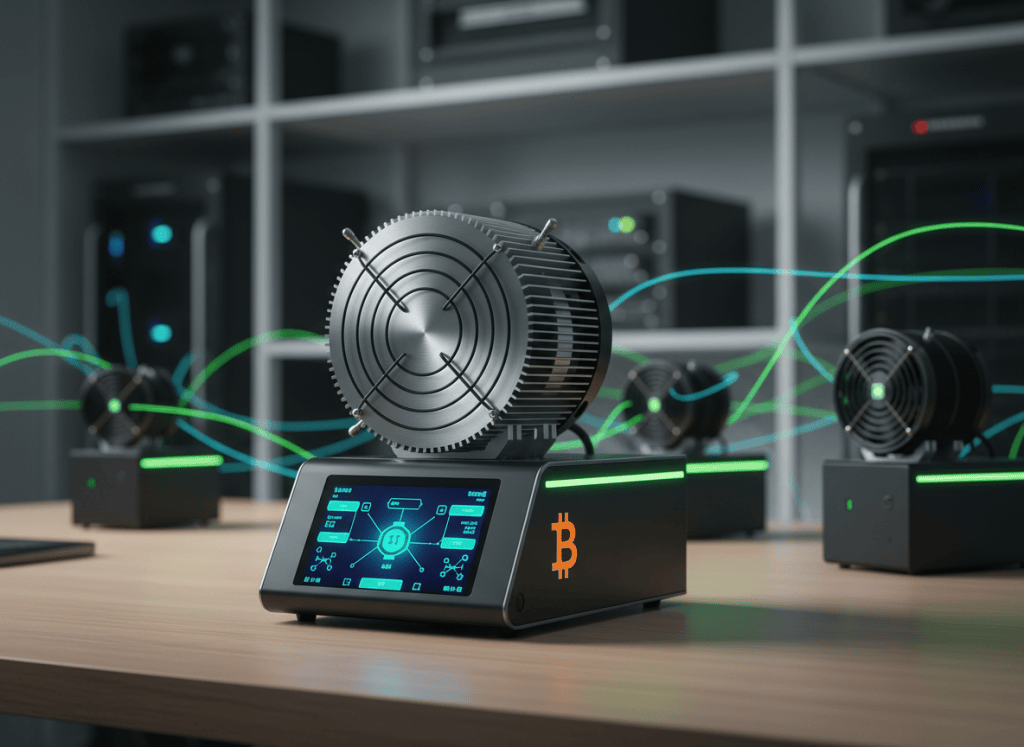
Hammer Miner’s new Glod Omni combines a 1.2 TH/s desktop Bitcoin miner with a 5.08-inch smart display that can discover compatible miners on a local network and act as a small fleet-monitoring terminal.
Altair Technology introduced the device in a September 30 launch post, describing a system that mines Bitcoin while also displaying live mining data, market charts, media and productivity tools from the same screen.
The current product listing identifies Hammer Miner as the manufacturer and specifies approximately 1.2 TH/s of SHA-256 hashrate at about 20W, a single BM1370 ASIC, a 5.08-inch smart display, an open API, local data access and public flashing tools.
The miner and the dashboard are becoming the same device
Small Bitcoin miners have traditionally been controlled through a browser dashboard running somewhere else on the network. Glod Omni moves part of that management layer onto the miner itself.
According to the launch material, the device can automatically detect compatible miners on the local network and display fleet information from its own screen. That turns a desktop miner into a basic control-room endpoint rather than a device that only reports its own hashrate.
The idea builds on a pattern BitcoinVersus.tech covered earlier when a custom Bitaxe dashboard brought multiple mining metrics into one interface. The difference is that Glod Omni packages the screen, mining hardware and monitoring function into one product.
BM1370 keeps the mining side familiar
The mining hardware itself uses a familiar architecture. Glod Omni’s product page says it runs a single Bitmain BM1370 chip, the same class of silicon used by popular Bitaxe Gamma designs.
A recent D-Central technical guide describes the single-chip Bitaxe Gamma as operating around 1.1 to 1.2 TH/s at roughly 15 to 25W. That does not independently test Glod Omni, but it does show that the product’s advertised mining range is consistent with the established BM1370 home-miner class.
BitcoinVersus.tech has followed that chip family since Bitaxe Gamma pushed single-chip solo mining beyond 1 TH/s. Glod Omni is therefore less about introducing a new hashrate class than changing what the surrounding device does with that chip.
Open API and local data may matter more than the screen
The more technically interesting claim is the software layer. Altair lists an open API, local data access and public flashing tools among the device’s features.
If those interfaces remain open and documented, Glod Omni could become a useful node for home-lab automation. A local endpoint could potentially collect temperatures, hashrates, uptime and pool information without forcing every workflow through a cloud service.
That philosophy overlaps with the direction BitcoinVersus.tech recently covered in Solo Satoshi’s browser-based Bitaxe and NerdAxe flasher: make the tools around small miners easier to access while keeping firmware and device control visible to the operator.
Glod Omni is not independently tested yet
There is an important limitation to the launch story. Independent hands-on Glod Omni testing was not available when BitcoinVersus.tech verified the announcement. The 1.2 TH/s, 20W, fleet-detection and software-function claims currently come from the launch material and product listing rather than third-party measurements of a retail unit.
That means the most important follow-up questions remain open: how reliably the network discovery works across different miner brands, which devices are actually compatible, how much data the API exposes, whether the 20W figure represents full wall power, and how usable the monitoring interface is with a larger fleet.
The product is also unusual because mining may not be its primary practical value. At 1.2 TH/s, solo block discovery remains an extremely low-probability event. The more immediate utility may be having an always-on desk device that participates in mining while also acting as a local monitor for more powerful machines elsewhere on the network.
Home mining is becoming a software product
Glod Omni points toward a broader shift in small-scale Bitcoin hardware. The early goal was simply to make an ASIC quiet and low-power enough to place on a desk. The next step is making that desk miner useful as part of the rest of the mining system.
A device that can hash, monitor neighboring miners, expose local data and accept custom integrations starts to look less like a novelty lottery miner and more like a small operations terminal with an ASIC attached.
BitcoinVersus.Tech
Advertisement
BitcoinVersus.Tech Editor’s Note:
We volunteer daily to ensure the credibility of the information on this platform is Verifiably True. If you would like to support to help further secure the integrity of our research initiatives, please donate here: 3C9o19EH5HSiwEPyCTmEKzxhNCbo2X6TTb
BitcoinVersus.tech is not a financial advisor. This media platform reports on financial subjects purely for informational purposes.


Leave a Reply