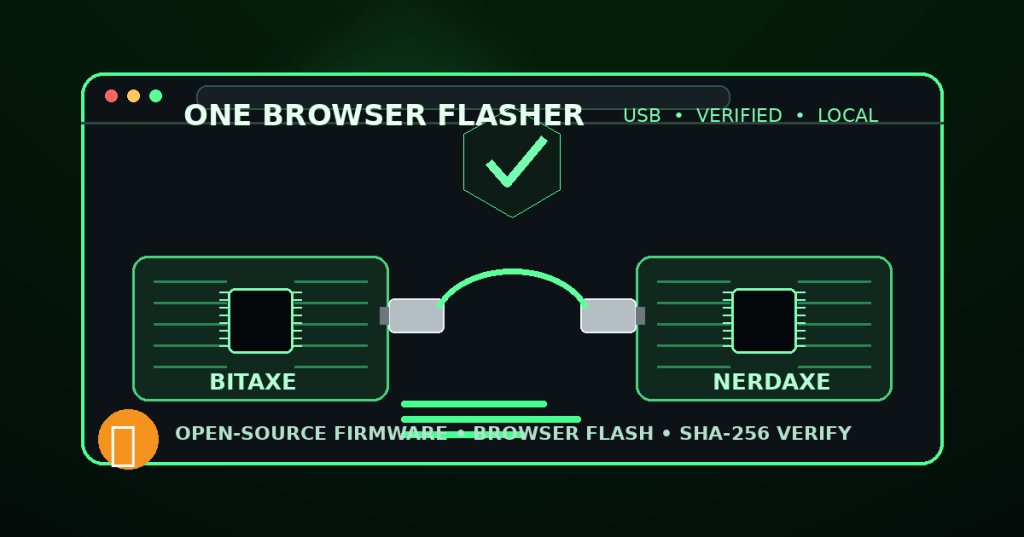
Solo Satoshi has released a browser-based firmware flasher that brings Bitaxe and NerdAxe home miners into one interface, with SHA-256 verification before firmware is written to the device.
The project was announced in a September 24 X post as an open-source tool for installing official ESP-Miner releases or a user’s own compiled ESP32-S3 firmware directly from a desktop browser over USB.
Solo Satoshi’s public source repository says the flasher verifies official firmware with SHA-256 before writing it, checks write results, can preserve settings during verified-release installs, and keeps custom firmware local in browser memory rather than uploading it to a remote server.
One browser workflow replaces separate flashing paths
Until now, Bitaxe and NerdAxe users often moved between separate flashing tools, command-line procedures or model-specific recovery instructions. The new flasher consolidates device selection, board matching, firmware-channel selection, checksum verification and installation into one browser workflow.
That is a meaningful usability step for the same open-source mining ecosystem BitcoinVersus.tech recently covered in AxeOS Fundamentals: How Open-Source Bitaxe Firmware Works. The miner remains an open hardware platform, but a simpler flashing path reduces the friction between source code and a working device.
Verification happens before the flash
The strongest technical feature is not simply that flashing happens in a browser. The tool requires an expected firmware digest and checks the downloaded image against that SHA-256 value before installation. If the bytes do not match, the write is stopped.
The flasher then ties those verified images back to the upstream projects. Solo Satoshi identifies the official Bitaxe ESP-Miner codebase as one of the firmware sources feeding the verified-release workflow, alongside the corresponding NerdAxe project.
That matters because firmware integrity and firmware compatibility are different problems. A file can be authentic and still be wrong for a particular board revision. The new workflow therefore filters builds by miner family, model, board revision and the release where support for that hardware first appeared.
Recovery is as important as updating
Firmware flashing is not only an upgrade workflow. It is also one of the main recovery paths when a miner receives the wrong image, an update fails, or the device no longer boots normally. BitcoinVersus.tech has previously documented NerdAxe recovery after a failed or incompatible firmware state.
The new browser tool also supports rollbacks to earlier compatible releases and gives advanced users a separate path for their own merged ESP32-S3 binaries. Solo Satoshi makes an important distinction: official images are verified against known releases, while custom binaries are the user’s responsibility.
That separation mirrors the approach in BitcoinVersus.tech’s earlier NerdAxe firmware-flashing guide: recovery tools are most useful when the operator knows exactly which hardware is connected and exactly which firmware image is being written.
Open-source mining is moving up the software stack
Bitaxe helped make open-source SHA-256 mining hardware accessible at the board level. AxeOS and ESP-Miner made the control layer inspectable. A unified web flasher moves that openness one layer higher by making installation, rollback and recovery easier to audit and easier to repeat.
The result is not a new ASIC or a higher hashrate number. It is infrastructure for maintaining open-source miners with fewer opaque steps between the source repository and the machine on the desk.
BitcoinVersus.Tech
Advertisement
BitcoinVersus.Tech Editor’s Note:
We volunteer daily to ensure the credibility of the information on this platform is Verifiably True. If you would like to support to help further secure the integrity of our research initiatives, please donate here: 3C9o19EH5HSiwEPyCTmEKzxhNCbo2X6TTb
BitcoinVersus.tech is not a financial advisor. This media platform reports on financial subjects purely for informational purposes.


Leave a Reply