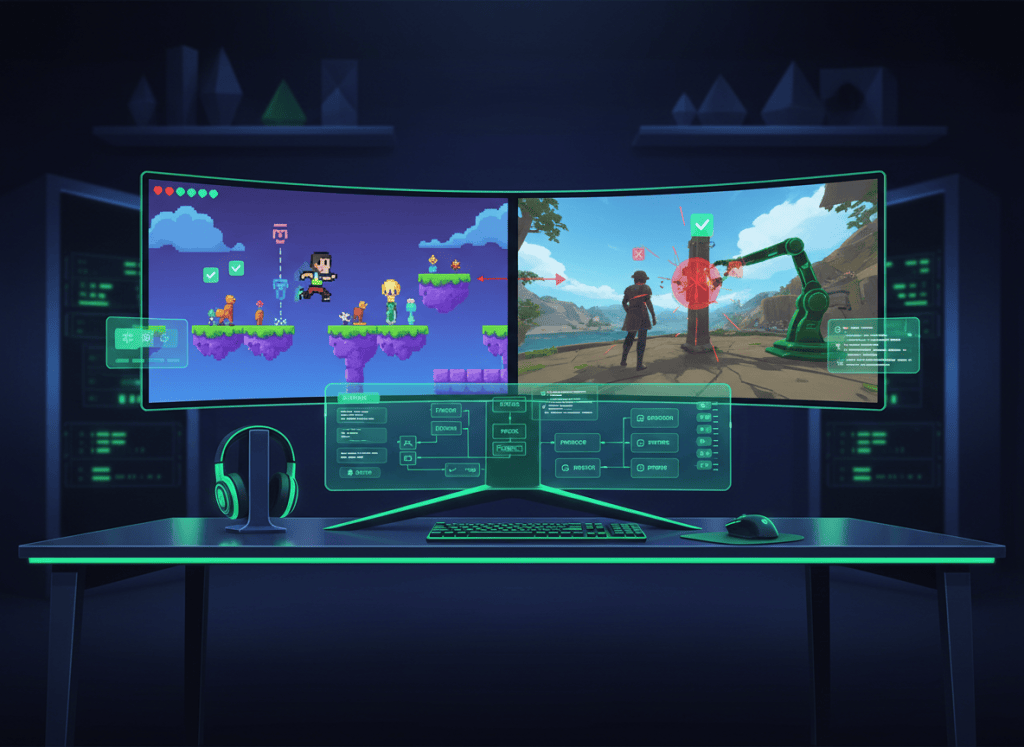
A new benchmark is putting coding assistants through a harder test than generating a snippet: build, repair and port actual playable games, then prove the result works at runtime.
The newly released SWE-Game research benchmark contains 247 tasks derived from 41 executable Godot games across 13 categories in both 2D and 3D. The work was submitted September 27 and updated September 29.
Building the game is harder than writing code
SWE-Game divides the work into five types: creating a game from a short brief, implementing from a game design document, completing a project skeleton, repairing 83 deliberately injected faults, and porting Godot projects to Unity. A game can compile and launch while still implementing the requested mechanic incorrectly.
Runtime proof beats a screenshot
The researchers evaluate generated games using engine-state checks, certified input replay and feature demonstrations. On human-labeled behaviors from 100 generated games, executable checks reached 92.59% balanced accuracy, compared with 78.41% for a video-based vision-language judge. Visible output is useful evidence, but executable behavior is stronger evidence.
A practical analysis published by PowerHub draws a similar lesson for developers: define playable proof for a feature before accepting a generated build.
Gameplay requirements remain difficult
Across six tested models, the best overall scores remained below 60 out of 100 on the three construction-oriented task types. The paper identifies omitted requirements and gameplay-logic errors as major failure modes. Today’s coding assistants can perform meaningful development work, but successful generation does not automatically mean the requested game was built correctly.
That matters as automated creation moves directly into development environments. BitcoinVersus.tech just covered Meta’s push to turn natural-language prompts into editable games. SWE-Game supplies a useful counterpoint: generation speed matters, but verification becomes more important as software takes on larger development tasks.
Godot becomes a testing ground
Godot’s scene structure, scripting and open development model give researchers a practical environment for observing changes and executing the result. The engine itself continues to evolve; the recent Godot 4.8 development cycle added safer refactoring and faster C# calls.
SWE-Game even tests Godot-to-Unity ports, forcing systems to translate behavior between engines rather than simply reproduce syntax. That exposes whether gameplay intent can be reconstructed under a different architecture.
Specify, build, run, inspect and prove
The workflow emerging from the research looks less like “prompt and trust” and more like “specify, build, run, inspect and prove.” Acceptance should depend on exact runtime behavior and regression checks. That principle applies equally to hand-written simulation systems such as the interconnected logic discussed in BitcoinVersus.tech’s GTA 6 wanted-system engineering analysis.
For game developers, the benchmark’s most useful message may therefore be about testing rather than generation. As automated coding handles larger changes, the proof layer has to become stronger too.
BitcoinVersus.Tech
Advertisement
Editor’s Note
We volunteer daily to ensure the credibility of the information on this platform is Verifiably True. If you would like to support to help further secure the integrity of our research initiatives, please donate here: 3C9o19EH5HSiwEPyCTmEKzxhNCbo2X6TTb
BitcoinVersus.tech is not a financial advisor. This media platform reports on financial subjects purely for informational purposes.


Leave a comment