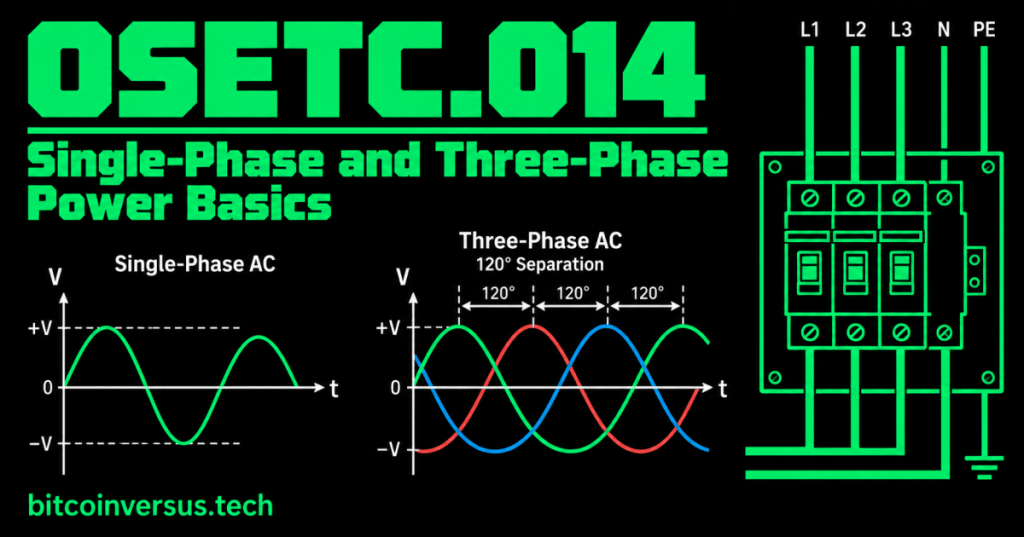
Single-phase and three-phase describe two common ways alternating-current (AC) electrical power is delivered. A technician does not need advanced power-system math to recognize the basic difference: single-phase power uses one repeating AC waveform, while three-phase power uses three AC waveforms separated by 120 electrical degrees.
This lesson follows OSETC.012 on grounding and bonding and OSETC.013 on GFCIs. The goal here is simple recognition: know what single-phase and three-phase mean, where you may encounter them, and why larger electrical equipment often uses three-phase power.
Single-Phase Power
Single-phase AC has one alternating voltage waveform. It is common for everyday residential and light commercial loads such as lighting, outlets, computers, televisions, and many small appliances.
Three-Phase Power
Three-phase AC uses three alternating waveforms. The waveforms are offset from one another by 120 degrees. Because the phases do not all rise and fall at the same instant, three-phase systems can deliver power smoothly to larger loads such as motors, pumps, cooling equipment, industrial machinery, and data-center electrical systems.
Video: How Three-Phase Power Works
This Engineering Mindset walkthrough begins with single-phase AC and then visually shows how three phase-shifted waveforms work together.
Think of the Difference Simply
Imagine pushing a playground merry-go-round. With one person pushing once per rotation, the force rises and falls. With three people spaced evenly around it and taking turns pushing, the motion can stay smoother. That is not an electrical calculation, but it is a useful mental picture for why three evenly separated phases can provide smoother power transfer.
Where a Technician May See Each Type
- Single-phase: homes, offices, ordinary receptacles, lighting, and smaller equipment.
- Three-phase: large motors, pumps, chillers, industrial equipment, electrical distribution gear, and many data-center loads.
Data Center Example
A data center can receive three-phase power for large facility loads and distribution equipment while individual devices may ultimately operate from a single phase or from converted DC power. A technician should identify the equipment rating and approved connection rather than assume every device uses the same supply.
Bitcoin Mining Example
Large Bitcoin-mining facilities often distribute substantial electrical loads across three-phase systems. Individual power supplies and miners must still be connected according to their rated input voltage and the facility’s engineered distribution design.
Safety Boundary
Recognizing phases is not authorization to open energized equipment or take live measurements. Follow site procedures, equipment ratings, lockout/tagout requirements, PPE rules, and qualified-person boundaries. When the task exceeds your training or authorization, stop and escalate it.
Practice
- Describe single-phase power in one sentence.
- Describe three-phase power in one sentence.
- State the phase separation used in a three-phase system.
- Name two common single-phase loads.
- Name two common three-phase loads.
- Explain why a technician must check the equipment rating before connecting a load.
Key Takeaway
Single-phase power uses one AC waveform. Three-phase power uses three waveforms separated by 120 degrees and is common where larger amounts of power or large motors are involved. For technicians, the essential skill is recognizing the system, reading equipment ratings, and staying within safe work boundaries.


Leave a Reply