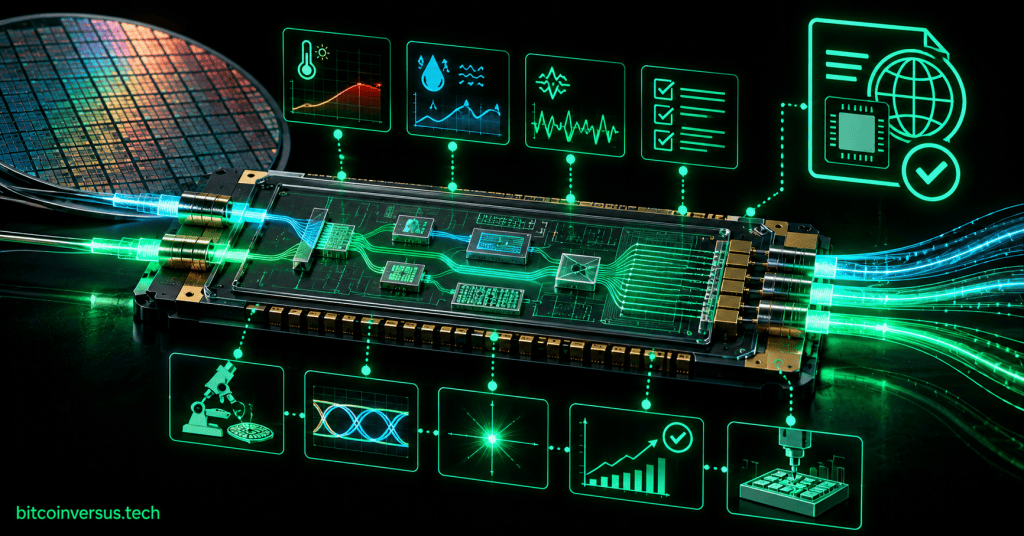
JEDEC has announced JESD264, a new silicon-photonics qualification and reliability standard aimed at giving AI, datacenter and telecom vendors a common way to test optical chips before they are deployed at scale.
According to JEDEC’s October 1 announcement, JESD264 is the first industry-wide standard built specifically around qualification and reliability requirements for silicon-photonics dies and chipsets. The goal is to reduce deployment risk as optical links move deeper into high-bandwidth computing systems.
Silicon photonics is becoming infrastructure, not an experiment
Silicon photonics combines optical and electrical functions on semiconductor devices so data can move with light instead of relying entirely on electrical traces. That matters as AI clusters push toward denser racks, faster switch fabrics and more bandwidth between accelerators, memory and storage.
BitcoinVersus has already tracked that shift through Coherent’s PhotonLink platform for AI data centers, where optical connectivity is being pulled closer to high-performance compute infrastructure.
JEDEC says the new framework covers reliability protocols for silicon-photonics dies and integrated chipsets, component qualification for modulators, photodiodes and waveguides, assembly processes, laser integration, manufacturing controls and traceability.
The missing piece was a shared reliability baseline
Traditional CMOS components have long benefited from mature qualification practices, but silicon photonics combines optical devices, semiconductor processing, lasers, packaging and assembly in ways that complicate failure ownership across suppliers.
Semiconductor Engineering’s October 2 industry review highlights JESD264 as the industry’s first silicon-photonics reliability standard and places it within a broader move toward optical interconnects as AI-network bandwidth becomes a larger system constraint.
That reliability question gets harder as optical density rises. BitcoinVersus recently covered Molex packing 3,456 fibers into 1RU for AI networks, illustrating how quickly optical complexity can climb inside modern datacenter infrastructure.
Why qualification matters more as optics moves closer to the chip
Co-packaged and near-packaged optics reduce the distance that high-speed electrical signals have to travel before they become optical signals. That can improve bandwidth density and power efficiency, but it also changes the service model. A failed optical engine sitting close to expensive switch silicon is a very different operational problem from replacing a front-panel transceiver.
The following explainer is not about JESD264 specifically, but it shows why reliability and maintenance are becoming central questions as AI networking moves toward co-packaged optics.
Other optical approaches are trying to make that serviceability problem easier. BitcoinVersus recently covered Avicena’s detachable MicroLED optical links for AI racks, where the architecture is explicitly designed to keep optics replaceable rather than permanently trapping them next to compute.
JESD264 could make the photonics supply chain easier to qualify
A common standard does not guarantee that every silicon-photonics product will be equally reliable. What it does provide is a shared framework for manufacturers, foundries, OSATs, system designers and end users to define what gets tested, how qualification is performed and where responsibility sits when optical and semiconductor components are combined.
That matters because AI networking is moving toward increasingly heterogeneous systems. Electrical switching, optical engines, lasers, chiplets, advanced packaging and fiber all have to behave like one infrastructure layer. Standardized reliability requirements can make it easier to compare suppliers and qualify parts before they are deployed across thousands of links.
JESD264 arrives as the industry is already pushing toward 800G, 1.6T and co-packaged optical architectures. As those systems move from demonstrations into production, reliability standards become part of the scaling problem—not an afterthought.
BitcoinVersus.Tech
Advertisement
Editor’s Note:
We volunteer daily to ensure the credibility of the information on this platform is Verifiably True. If you would like to support to help further secure the integrity of our research initiatives, please donate here: 3C9o19EH5HSiwEPyCTmEKzxhNCbo2X6TTb
BitcoinVersus.tech is not a financial advisor. This media platform reports on financial subjects purely for informational purposes.


Leave a comment