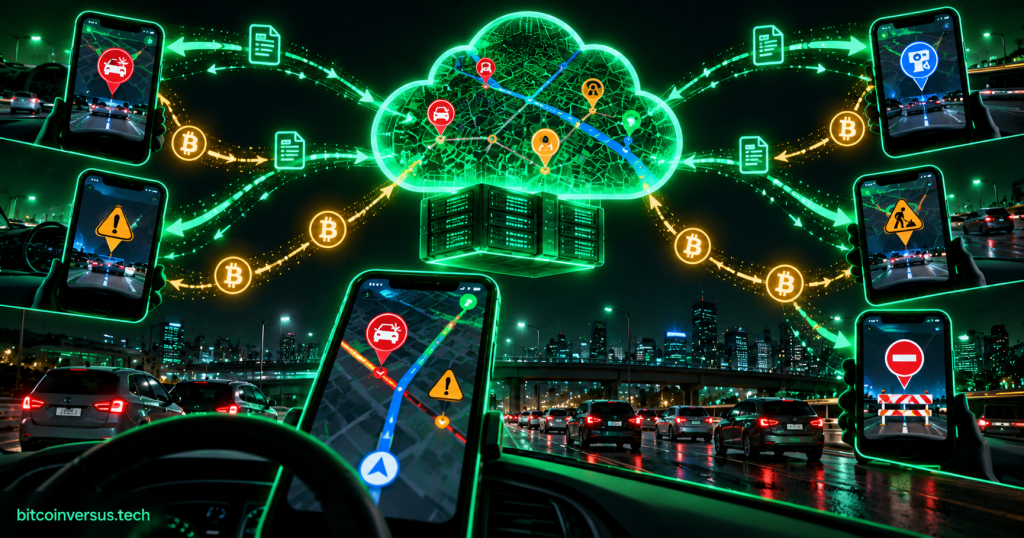
Opinion: If a driver tells a navigation network that a crash just happened, a lane is closed, a pothole appeared, traffic stopped or a hazard has cleared, that driver has done more than tap a button. The driver has produced fresh, location-specific data that can immediately improve a commercial digital service for everyone behind them.
BitcoinVersus.Tech believes the next step for Apple Maps, Google Maps, Waze and other navigation platforms should be simple: when users repeatedly provide accurate, verified real-time road intelligence, pay them a micropayment.
Drivers are already doing real-time data work
Apple’s own Maps documentation says users can report accidents, hazards, speed checks, traffic, roadwork and road closures, and can report whether some incidents are cleared or still present. Apple evaluates incoming reports and can display or clear incident markers for other users when confidence is high enough.
That is useful work. The driver is acting as a distributed sensor, identifying an event, classifying it, attaching location and time, and sometimes returning later validation about whether the event remains true. The network receives information it did not have moments earlier and other drivers receive a better map because of it.
A recent BGR post about Apple Maps highlights how drivers can report crashes, hazards and cleared incidents, including through Siri while on the road.
Waze makes the value exchange even clearer
Waze explicitly awards points for driving, submitting reports, voice reports, confirming whether an alert is still there and editing map information. In other words, the platform already recognizes that contributions have measurable value. The disagreement is not over whether a contribution deserves credit. It is whether that credit should stop at points, levels and badges.
BitcoinVersus.Tech argues that verified contributions should sometimes cross that line into money. A point is recognition. A micropayment is compensation.
Your phone is not only consuming the map
Navigation is often described as a service flowing one direction: the company owns the map and the user receives directions. Real-time navigation is more circular. Millions of phones and drivers become inputs to the network. Their movement can reveal congestion, while deliberate reports can explain why traffic changed.
That distinction matters. Passive telemetry is one question. A person deliberately observing a crash, construction zone, stopped vehicle or blocked lane and submitting a structured report is an active contribution.
A fair system would pay for verified information, not random taps
The obvious objection is spam. If every report automatically generated cash, people would manufacture reports. A useful payment system therefore should not pay immediately for every submission.
Instead, a platform could assign each contributor a reputation score. A report would become payable only after independent confirmation from other drivers, matching sensor data or subsequent verification. False reports would earn nothing and repeated abuse would reduce future eligibility.
A first accurate report might earn ₿0.00000100 (about $0.09 at roughly $86,700 per BTC). A high-value road closure or unusually early verified hazard could earn ₿0.00000500 (about $0.43). Confirmations could receive smaller amounts. The exact number matters less than establishing the principle that useful verified data has economic value.
Bitcoin makes tiny payments technically interesting
This is exactly the kind of machine-scale payment problem that makes Bitcoin’s faster payment layers interesting. BitcoinVersus.Tech has previously examined the Lightning Network’s potential for moving small amounts without treating every payment like a conventional card transaction.
The broader payment stack continues to evolve. RGB and Lightning are also expanding what can move across Bitcoin-connected rails, while Apple itself has already opened more of the iPhone’s NFC payment infrastructure to third parties.
The network should share some value with the people improving it
Free navigation is valuable, and users clearly receive something in return for participating: better routes, fresher traffic information and safer warnings. That is a legitimate part of the exchange. But it should not end the conversation.
When a user contributes a verified real-time observation that improves a commercial network for thousands of other people, the contribution begins to resemble distributed data work. Trillion-dollar technology ecosystems should be capable of recognizing that distinction.
The future map should not merely ask, “Is the crash still there?” It should be able to say: “Thanks. Other drivers confirmed your report. Here are a few sats.”
BitcoinVersus.Tech
Advertisement
Editor’s Note
We volunteer daily to ensure the credibility of the information on this platform is Verifiably True. If you would like to support to help further secure the integrity of our research initiatives, please donate here: 3C9o19EH5HSiwEPyCTmEKzxhNCbo2X6TTb
BitcoinVersus.tech is not a financial advisor. This media platform reports on financial subjects purely for informational purposes.


Leave a Reply