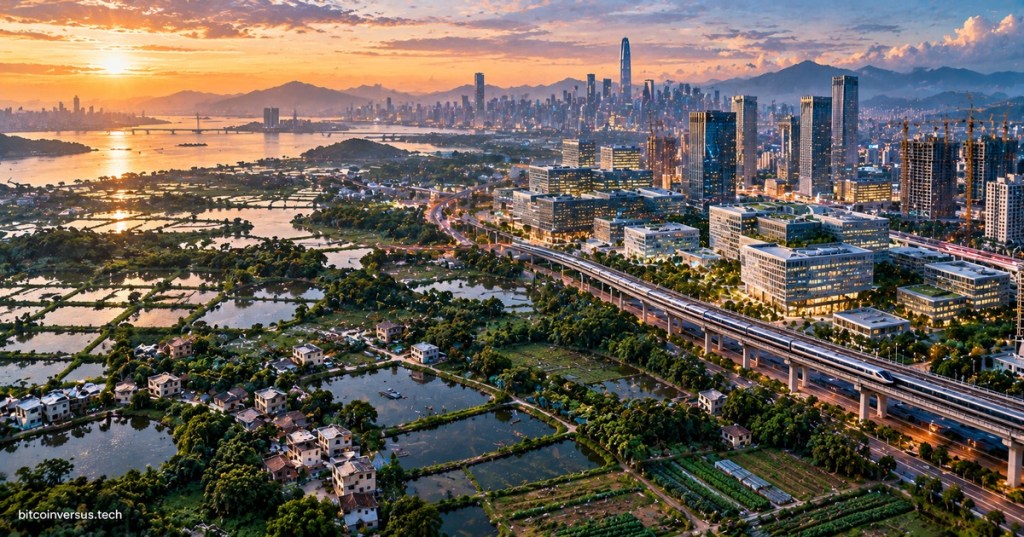
Hong Kong is turning its northern border with Shenzhen into one of the most consequential urban experiments in the world: a new technology, education and housing corridor designed to pull the city more tightly into China’s Greater Bay Area.
The Northern Metropolis is no longer being treated as a distant concept. In September, Hong Kong formally placed it at the center of the city’s first Five-Year Plan for Economic and Social Development, making the project a core part of the government’s strategy for technology, universities, industry, housing and deeper integration with mainland China.
That makes the project bigger than another real-estate expansion. It is becoming a live test of a much larger Chinese idea: link neighboring cities so tightly through transport, labor, research, manufacturing and capital that they begin functioning like one economic system.
One-third of Hong Kong is being pulled into a new urban center
Hong Kong’s 2026 Policy Address says the Northern Metropolis accounts for roughly one-third of the city’s land area and projected population. The government now describes it as a strategic platform for universities, innovation and technology, industry, international talent and participation in the Greater Bay Area.
The plan centers on new university towns, the San Tin Technopole, cross-border infrastructure and districts intended to mix laboratories, companies, campuses and housing. In government language, education, technology, industry, talent and urban development are supposed to reinforce one another instead of being separated into isolated zones.
That vision fits China’s broader push to connect advanced manufacturing with AI, robotics and large-scale digital infrastructure. BitcoinVersus.Tech recently covered AGIBOT deploying humanoid robots across 100 Chinese retail stores, an example of how quickly robotics is moving from demonstration environments into commercial operations.
Bloomberg frames it as part of a much bigger Chinese experiment
Bloomberg Originals’ documentary on China’s megacity strategy places Hong Kong inside an even larger national experiment. The film argues that Beijing’s urban policy is increasingly organized around megaregions: clusters of cities linked by rail, highways, industrial specialization and integrated labor markets.
A Bloomberg post on X described the Northern Metropolis as an ambitious attempt to create a new technology and business hub on Hong Kong’s border with Shenzhen.
The Greater Bay Area is the immediate test
The Northern Metropolis matters because Hong Kong is not being developed in isolation. It sits next to Shenzhen, one of China’s most important technology centers, and inside the Greater Bay Area network that also includes Guangzhou, Macau and other Pearl River Delta cities.
Instead of asking every city to duplicate the same industries, the megaregion model tries to make specialization an advantage. Hong Kong brings global finance, universities and international legal systems. Shenzhen brings hardware, software, manufacturing and an enormous technology ecosystem. Guangzhou contributes another major industrial, research and logistics center. High-speed transport and cross-border infrastructure are meant to make those differences productive rather than restrictive.
The technology side of that strategy is already visible elsewhere in China. Alibaba’s Zhenwu V900 and large cloud-infrastructure expansion show the scale at which Chinese companies are planning compute capacity. The Northern Metropolis is essentially an attempt to give that kind of industrial and digital growth a geographic home next to Hong Kong’s capital markets and universities.
The promise is density, speed and specialization
The economic case for megaregions is straightforward. Companies gain access to deeper labor pools. Universities and laboratories sit closer to manufacturers. Workers can reach more employers without moving across the country. Infrastructure can be shared across a larger population. Specialized districts can form around semiconductors, robotics, biotechnology, logistics or finance.
That density can create feedback loops. A robotics startup needs engineers, precision components, venture capital, customers, testing facilities and factories. The closer those pieces are to one another, the faster ideas can move from prototype to production.
China is also experimenting with infrastructure at unusual scales. BitcoinVersus.Tech previously examined China’s use of underwater server infrastructure for artificial intelligence, another example of the country treating physical infrastructure and compute capacity as parts of the same industrial strategy.
But efficiency is not the same thing as quality of life
The strongest argument against the megaregion model is visible on the ground. Fish ponds, wetlands, farms and villages are not empty spaces waiting for a planner’s map. They are ecosystems, communities and histories.
Large-scale redevelopment can create better transit, more housing and higher-productivity industries while still imposing real costs on people who already live there. Once a village is cleared or a wetland is paved, economic output cannot recreate what disappeared.
That is where the “utopia or dystopia” question becomes useful. The risk is not simply that a dense, connected region becomes technologically advanced. The risk is that efficiency itself becomes the dominant value: shorter commutes, denser labor markets, more sensors, more optimized land, more coordinated infrastructure—while local autonomy, cultural continuity and ecological resilience become secondary.
Hong Kong also has to prove that the economics work
Reuters reported that Hong Kong’s first Five-Year Plan accelerates the Northern Metropolis while tying it to housing, employment, technology and closer mainland integration. That matters because the project is being asked to solve several problems at once: diversify the economy, create jobs, expand housing and preserve Hong Kong’s relevance inside a rapidly changing Chinese economy.
Those goals can reinforce one another, but they can also conflict. A technology district designed around global talent may not automatically solve affordability for existing residents. New housing can increase supply while redevelopment simultaneously displaces long-established communities. Faster connections to Shenzhen can create economic opportunity while also making Hong Kong more structurally dependent on the Greater Bay Area.
The real experiment is whether a megaregion can still feel human
The Northern Metropolis should not be judged only by how many towers, campuses or rail lines appear on the skyline. The deeper test is whether it creates an urban system that people actually want to live inside.
If Hong Kong can connect finance, universities, laboratories, housing and Shenzhen’s technology ecosystem while preserving meaningful community life and environmental space, the project could become a powerful model for dense twenty-first-century development.
If the result is instead a highly optimized corridor where existing landscapes and communities are treated mainly as inefficiencies to be removed, Bloomberg’s warning becomes harder to dismiss.
That is why Hong Kong matters beyond Hong Kong. China’s larger megaregion strategy is ultimately asking whether humanity’s next urban form should be a bigger city—or a network so tightly integrated that the boundaries between cities almost stop mattering.
BitcoinVersus.Tech
Advertisement
Editor’s Note
We volunteer daily to ensure the credibility of the information on this platform is Verifiably True. If you would like to support to help further secure the integrity of our research initiatives, please donate here: 3C9o19EH5HSiwEPyCTmEKzxhNCbo2X6TTb
BitcoinVersus.tech is not a financial advisor. This media platform reports on financial subjects purely for informational purposes.


Leave a Reply