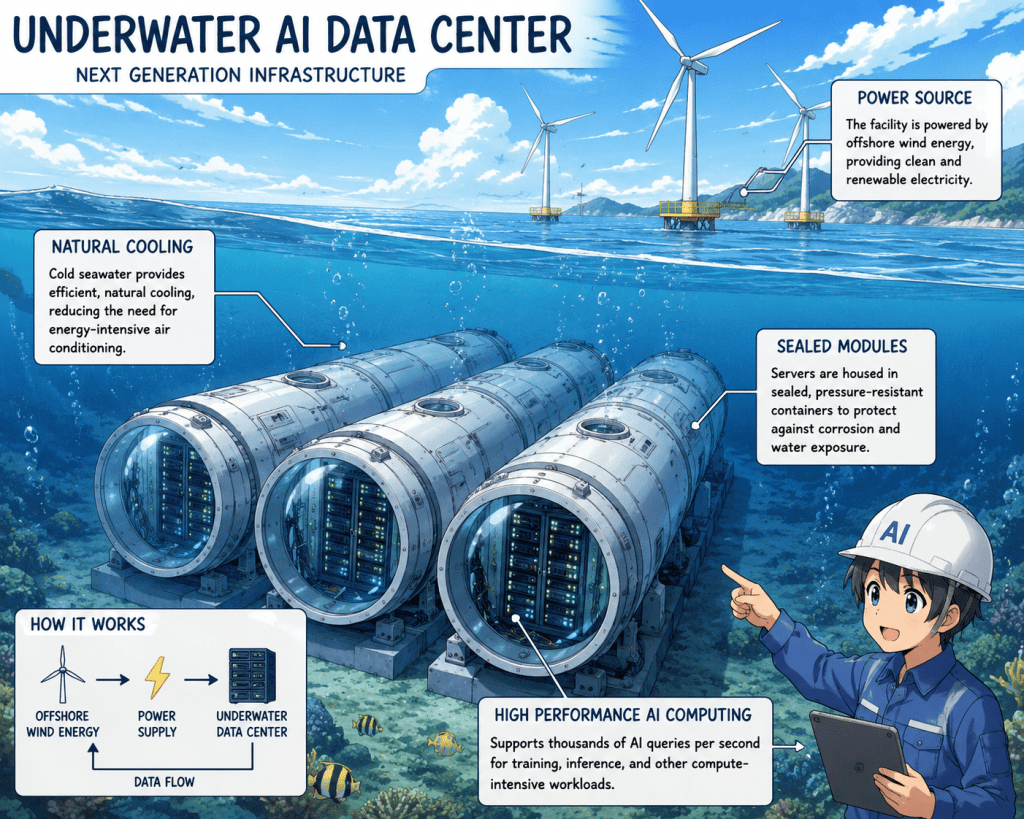
China is expanding its artificial intelligence infrastructure with underwater data center technology designed to support high-performance computing while reducing cooling costs.
The sealed server modules are deployed on the seafloor, where naturally cold seawater provides passive cooling that can significantly reduce the energy required for traditional air conditioning.
This design is intended to improve energy efficiency while supporting AI training, inference, and other compute-intensive workloads.
The latest expansion of the Hainan underwater intelligent computing cluster reportedly adds more than 400 high-performance servers and provides computing capacity comparable to roughly 30,000 high-end gaming PCs.
According to Chinese state media, the facility can support approximately 7,000 DeepSeek AI queries per second and is already being used for AI model training, industrial simulation, gaming, and marine research.
Similar underwater data center concepts have previously been explored by Microsoft through Project Natick, although Microsoft’s work remained an experimental research program rather than a commercial deployment.
While these commercial underwater facilities are still relatively new, they reflect growing global interest in reducing the energy and cooling demands created by rapidly expanding AI infrastructure.
BitcoinVersus.Tech Editor’s Note:
We volunteer daily to ensure the credibility of the information on this platform is Verifiably True. If you would like to support to help further secure the integrity of our research initiatives, please donate here: 3C9o19EH5HSiwEPyCTmEKzxhNCbo2X6TTb


Leave a Reply