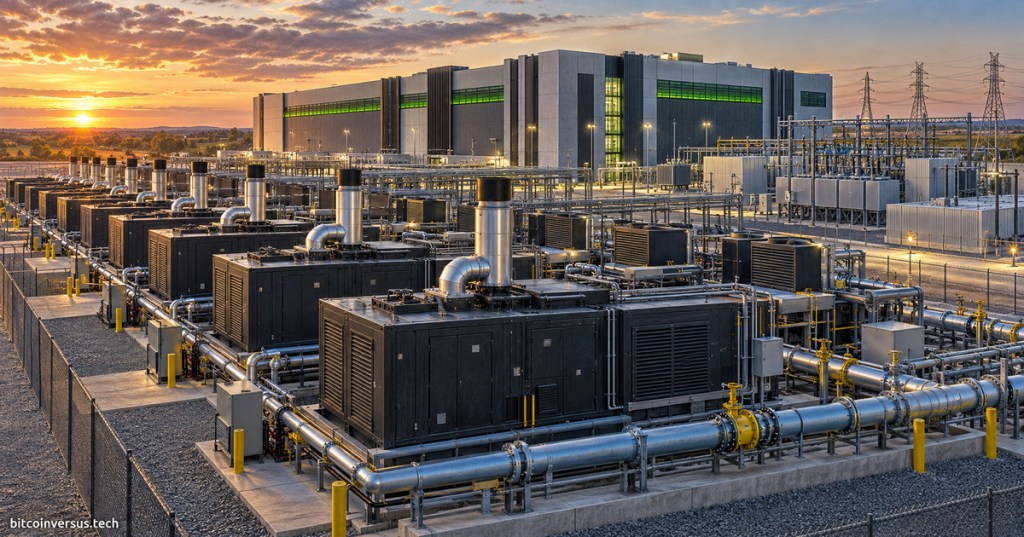
Enerflex has secured a contract to design and build approximately 450 MW of behind-the-meter natural-gas generation for an unnamed North American data-center developer—a major sign that AI campuses are moving power production onto their own sites.
In its October 1 announcement, Enerflex said it will engineer, fabricate and assemble the generation units through its North American manufacturing operations. Deliveries are scheduled to begin in 2027 and finish in 2028.
The distinction matters: this is a contracted equipment program, not 450 MW of operating capacity. Enerflex did not identify the developer, project location, engine supplier, contract value, fuel arrangement or expected commissioning date.
The data center is becoming its own power plant
Behind-the-meter generation sits on the customer side of the utility meter. For a data center, that can mean producing power on-site instead of waiting for the local grid to deliver every megawatt through a conventional interconnection.
Enerflex described the equipment as prime power that does not require a grid connection. That makes the order more consequential than a routine backup-generator purchase: approximately 450 MW is campus-scale infrastructure intended to support continuous digital operations.
Barron’s reported that the award pushed Enerflex shares sharply higher as investors recognized the company’s expansion from traditional oil-and-gas infrastructure into data-center power. The market reaction is secondary to the engineering signal: grid congestion has become large enough to create a new manufacturing market for dedicated generation.
BitcoinVersus.Tech recently examined why small gas turbines are becoming the fast track to AI data-center power. Enerflex’s award turns that broad trend into a specific production commitment with a delivery window extending through 2028.
A 450 MW order moves the bottleneck
Generating electricity behind the meter can reduce dependence on a delayed utility interconnection, but it does not make the rest of the project simple. The developer still needs firm gas supply, air permits, emissions controls, switchgear, transformers, protection systems, controls, cooling, black-start planning and enough redundancy to meet data-center uptime targets.
The delivery schedule also shows that “self-powered” does not mean instant. Manufacturing hundreds of megawatts of packaged generation requires long-lead engines, alternators, breakers and control equipment. Enerflex is expanding its Engineered Systems facilities and manufacturing capability to execute this project and pursue a stated opportunity pipeline above 2 GW.
For operators, the next questions are practical: Will the site run islanded or parallel with the grid? What reserve margin will sit above the IT load? Will waste heat be recovered? How will gas curtailment be handled? What are the overhaul intervals, parts strategy and restart sequence after a trip?
Why Bitcoin miners should care
Bitcoin miners and AI developers increasingly compete for the same power rights, substations and industrial sites. Our earlier report on how miners are shifting megawatts from ASICs to AI showed that electrical infrastructure can become more valuable than the original compute equipment installed behind it.
The operating profiles are different. Mining can curtail rapidly when power prices rise or the grid needs relief. AI tenants generally pay for tighter uptime, denser networking and less interruption. Dedicated generation narrows that flexibility gap by giving an AI campus more control over its power source.
That does not remove mining from the equation. A flexible ASIC load can still absorb unused generation during commissioning, ramp periods or temporary AI demand gaps. BitcoinVersus.Tech has explored that possibility in its analysis of Bitcoin mining as AI’s flexible power backup.
What would confirm the real impact
The strongest next evidence will be the customer and location, executed fuel and interconnection agreements, air permits, the selected generator configuration, factory production milestones and a commissioning schedule. Until then, 450 MW should be described as contracted future equipment—not a live power plant.
Even with those limits, the order is material. It shows that the AI infrastructure race is no longer confined to accelerators, cooling loops and data halls. Data-center developers are now pulling large-scale generation manufacturing directly into their construction supply chain.
BitcoinVersus.Tech
Advertisement
Editor’s Note:
We volunteer daily to ensure the credibility of the information on this platform is Verifiably True. If you would like to support our research initiatives, please donate here: 3C9o19EH5HSiwEPyCTmEKzxhNCbo2X6TTb
BitcoinVersus.tech is not a financial advisor. This media platform reports on financial subjects purely for informational purposes.


Leave a comment