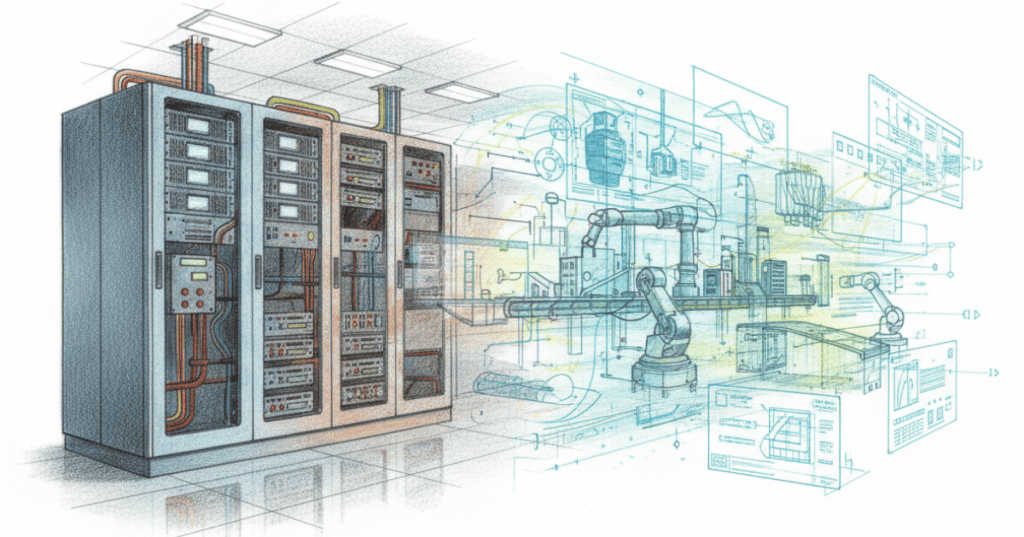
Schneider Electric is reportedly nearing a roughly $20 billion acquisition of U.S. industrial-software company PTC, a transaction that would push one of the world’s biggest electrical-infrastructure suppliers much deeper into the software layer that designs, operates and services modern factories, products and data-center systems.
The Financial Times reported Sunday that Schneider and PTC are in advanced discussions and that a deal could be announced as soon as Monday. The talks are still ongoing, however, and there is no guarantee they will produce a final agreement.
Reuters separately reported that a person close to the deal said Schneider was nearing a purchase at about the same valuation. PTC’s market capitalization was about $15.6 billion, making the reported price a substantial premium and potentially Schneider’s largest acquisition to date.
Schneider is moving from power hardware toward the software stack
The strategic logic is straightforward. Schneider already sells the electrical backbone of industrial sites and data centers: switchgear, power distribution, cooling, racks, automation and control systems. PTC sells software used to design products, manage product data, operate factories and connect physical equipment to digital workflows.
That makes PTC less of a traditional software bolt-on and more of a way for Schneider to move upward into the engineering decisions that determine how physical infrastructure is designed and used. BitcoinVersus.Tech recently examined how Schneider is already turning AI data-center switchgear into a more software-defined system. Buying PTC would extend that logic from electrical control into product lifecycle management, CAD, industrial automation and digital twins.
PTC would deepen Schneider’s industrial AI exposure
PTC’s core platforms include Creo for computer-aided design, Windchill for product lifecycle management, ThingWorx for industrial connectivity and ServiceMax for service operations. Those products sit close to the proprietary engineering data that manufacturers increasingly want to use with AI.
The value of that data is growing because industrial AI depends on more than general-purpose models. Engineering companies need trusted product structures, maintenance histories, design revisions, equipment states and manufacturing context. PTC’s software gives Schneider a possible route into that data layer while Schneider’s physical infrastructure gives PTC a route deeper into energy-intensive factories and data centers.
The deal would also fit Schneider’s AI data-center strategy
The timing is important because Schneider’s fastest-growing infrastructure opportunity is increasingly tied to AI. Hyperscale campuses are demanding more electrical capacity, denser cooling, more automated operations and tighter coordination between physical assets and software.
BitcoinVersus.Tech just covered Schneider’s new Generator-to-Chip architecture with Wärtsilä and Stanley Consultants, which combines onsite generation, electrical distribution, automation and engineering into a coordinated delivery model for U.S. AI data centers. A PTC acquisition would add another layer: the software used to model, configure, manage and service the industrial systems surrounding that infrastructure.
A $20 billion price tag would test the economics
The reported valuation is large enough that execution would matter as much as strategy. Schneider would be paying well above PTC’s current public-market value, which means the combined company would need to produce meaningful growth, cross-selling or operating leverage to justify the premium.
That tension is becoming common across AI infrastructure. Hardware, software and compute are increasingly being financed as long-duration strategic assets rather than simple technology purchases. BitcoinVersus.Tech recently looked at that shift in NVIDIA’s push to make AI compute a financeable asset class. Schneider’s reported PTC deal belongs to the same broader cycle: companies are spending enormous sums now to control the infrastructure and software layers they expect to matter for years.
The bigger target is the digital industrial stack
If the acquisition closes, Schneider would own more of the path from electrical power to automation to product engineering data. That would strengthen a model in which industrial equipment is no longer sold as isolated hardware but as part of a connected software-controlled system.
For data centers, factories and other infrastructure-heavy businesses, that convergence could matter more than the headline acquisition price. The companies that control both the physical layer and the digital model of that physical layer may be in the strongest position to automate maintenance, optimize power, deploy AI agents and keep complex facilities operating efficiently.
For now, the transaction remains a reported negotiation rather than a completed acquisition. The next important development is whether Schneider and PTC announce definitive terms — and how much of the $20 billion valuation is ultimately tied to software growth, industrial AI and the data-center buildout.
BitcoinVersus.Tech
Advertisement
Editor’s Note
If you value independent technology reporting, consider supporting BitcoinVersus.Tech with a Bitcoin donation: 3C9o19EH5HSiwEPyCTmEKzxhNCbo2X6TTb
BitcoinVersus.tech is not a financial advisor. This media platform reports on financial subjects purely for informational purposes.


Leave a comment