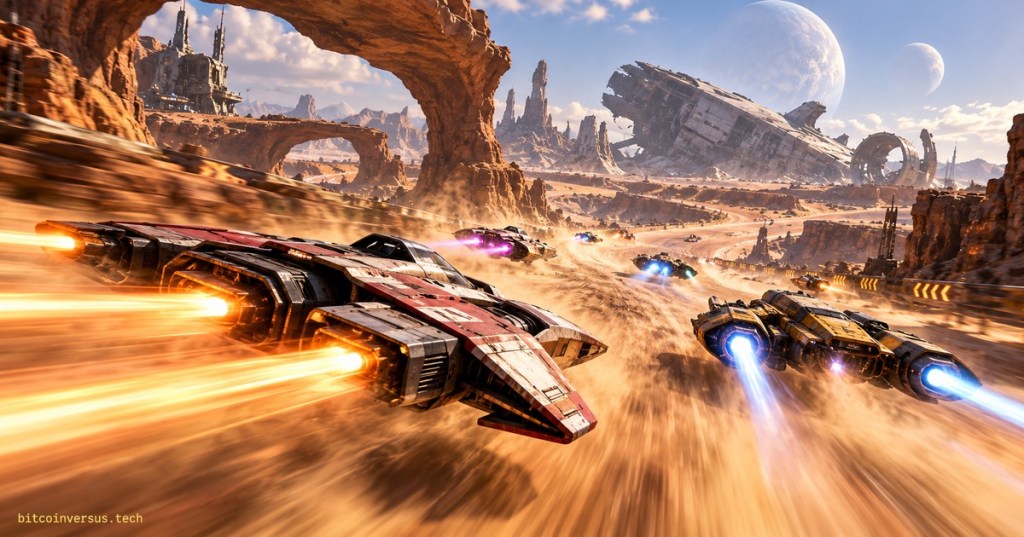
Star Wars: Galactic Racer launches October 6 with a very specific pitch: bring the speed and chaos of podracing back, then rebuild it as a modern run-based racing game where crashes, upgrades and route choices reshape every attempt.
Lucasfilm’s September 29 vehicle guide lays out four playable repulsorcraft classes — podracers, skim speeders, speeder bikes and landspeeders — each with distinct handling, boost mechanics and risk. The Verge’s October 3 review says the game captures the childhood fantasy of podracing while using a roguelike-style structure to keep the campaign from becoming a straight sequence of ordinary races.
Galactic Racer is not just Episode I podracing again
The easiest comparison is the Boonta Eve Classic from The Phantom Menace, but Galactic Racer is trying to broaden that formula. Players move through the underground Galactic League as Shade, a masked racer competing across different worlds, vehicles and event types instead of staying locked to one machine or one planet.
That run-based structure is the bigger design change. A tour becomes a chain of races and decisions. Survive, upgrade and keep moving. Crash too often and the run ends, forcing another attempt with some progress carried forward. It gives the campaign more tension than a traditional menu of disconnected races because every mistake can affect the rest of the tour.
BitcoinVersus.Tech has been following the late-2026 release rush closely. Gears of War: E-Day also reaches its full launch on October 6, making Galactic Racer part of an unusually crowded week for major releases.
Four vehicle classes make the racing more technical
Podracers remain the pure speed machines. Their ramjets deliver extreme acceleration, but braking into tight turns can cost a huge amount of velocity. Skim speeders sit closer to a balance of agility and durability, using a Knife Edge maneuver to carve sharp corners. Speeder bikes trade armor for responsiveness and can trigger a Kinetic Burst that increases speed while making control harder. Landspeeders are heavier and more stable, built around drifting, durability and well-timed boosts.
That setup matters because Galactic Racer wants players to learn more than one handling model. The ideal vehicle can change with the track, the available upgrades and the kind of risk a player wants to take during a run.
The official Star Wars account introduced the project through its Galactic Racer reveal post on X, establishing the game as a return to high-speed Star Wars racing rather than another Jedi-centered adventure.
The gameplay trailer shows why speed is only half the problem
The official gameplay footage shows narrow canyon routes, dense traffic, aggressive rivals and environments where a clean racing line can disappear almost instantly. That puts the emphasis on reflexes and route reading instead of simply holding the accelerator through a familiar circuit.
The visual pressure also makes hardware performance relevant. BitcoinVersus.Tech recently examined how Modern Warfare 4 is pushing ray tracing across every mode. Galactic Racer is chasing a different effect, but both games show how late-2026 releases are leaning on dense lighting, effects and high-speed scene changes to sell their worlds.
A run-based campaign may be the smartest part of the design
Racing games usually solve progression through championships, unlock trees or open worlds. Galactic Racer instead borrows the reset-and-rebuild rhythm of roguelikes. That structure gives every tour a beginning, a build and a failure condition, which can make repeated tracks feel different when the available perks, vehicles and route decisions change.
It also fits the fiction. The Galactic League is presented as an unsanctioned competition built around speed, gambling, sabotage and reputation. A campaign where one bad sequence can end a run feels more consistent with that setting than a conventional racing ladder where losing rarely matters.
That broader release pressure is why BitcoinVersus.Tech recently ranked the most anticipated games still ahead after GTA Six. Galactic Racer now gets a chance to prove that a focused licensed racer can cut through a fall calendar dominated by much larger franchises.
October 6 is the real test
The strongest idea behind Galactic Racer is that it is not trying to turn Star Wars into another open-world action game. It is taking one of the franchise’s most memorable forms of spectacle — impossible speed through dangerous terrain — and building an entire progression system around it.
If the vehicle handling remains distinct across long sessions and the run-based campaign creates enough variation, Galactic Racer could become the modern successor to Star Wars racing games that fans have been waiting for. The launch on October 6 will show whether the combination of podracing nostalgia and roguelike structure has enough depth to last beyond the first adrenaline rush.
BitcoinVersus.Tech
Advertisement
Editor’s Note
If you value independent technology reporting, consider supporting BitcoinVersus.Tech with a Bitcoin donation: 3C9o19EH5HSiwEPyCTmEKzxhNCbo2X6TTb
BitcoinVersus.tech is not a financial advisor. This media platform reports on financial subjects purely for informational purposes.


Leave a Reply