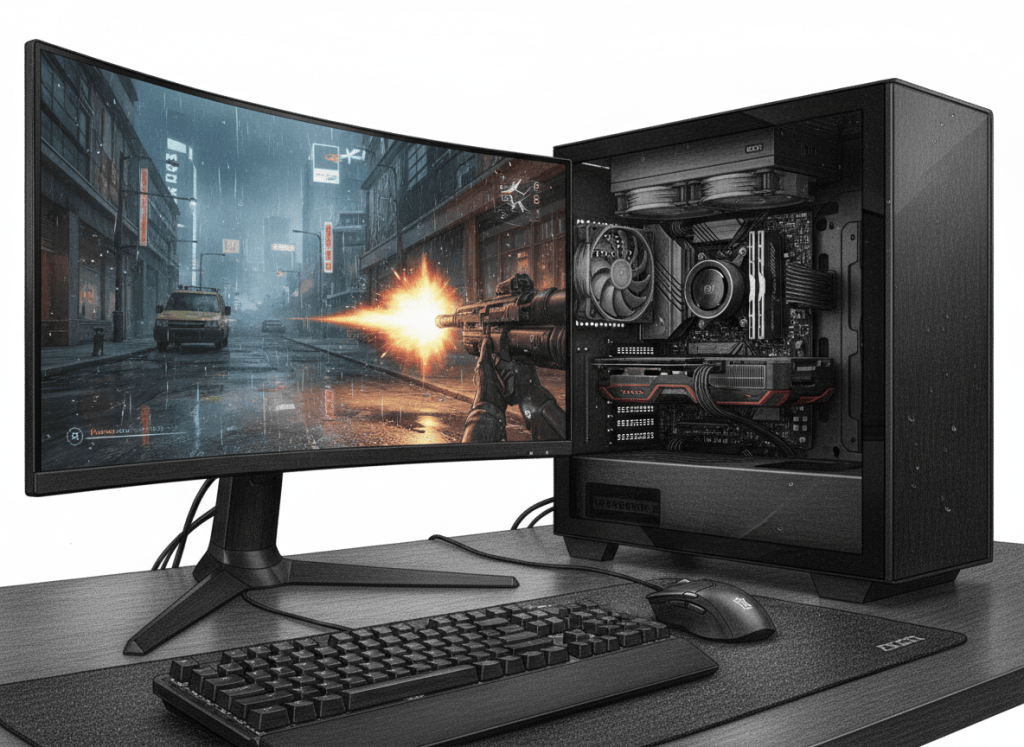
Call of Duty: Modern Warfare 4 is leaning hard into the PC version ahead of its October 23 launch, with ray tracing across Campaign, Multiplayer and DMZ, ultrawide support, HDR10+ and Dolby Vision, an expanded field-of-view range and a built-in benchmark tool. Activision is positioning the PC release as more than a console port, with Beenox again handling the platform-specific work alongside Infinity Ward.
In its official September 29 PC breakdown, Call of Duty said Modern Warfare 4 will support ray tracing in every major mode while adding PC-focused display, peripheral and graphics controls. Neowin’s independent coverage also highlights the new system requirements, upscaling support and security requirements as the release moves toward launch.
Modern Warfare 4 PC puts ray tracing into Campaign, Multiplayer and DMZ
The biggest graphics change is simple: ray tracing is no longer being treated as a campaign-only showcase. Modern Warfare 4 is bringing the feature into Campaign, Multiplayer and DMZ, where reflections, shadows and lighting can affect the look of competitive maps as well as cinematic missions.
That matters because Call of Duty has to balance visual fidelity with extremely high frame-rate targets. A shooter that supports ray tracing in competitive multiplayer has to give players enough control to decide whether image quality or maximum responsiveness matters more on their hardware.
In Call of Duty’s official PC post on X, the publisher specifically calls out enhanced FOV, ultrawide, HDR10+, Dolby Vision and ray tracing across every mode.
More than 800 PC settings turn MW4 into a tuning exercise
The PC build is expected to expose more than 800 adjustable settings, giving players control over graphics, display behavior, input and performance. That level of tuning is especially important for a game expected to run across everything from older mainstream desktops to high-end systems driving ultrawide HDR displays.
BitcoinVersus.Tech recently covered how Gears of War: E-Day is using Microsoft’s Advanced Shader Delivery to cut shader compilation time. Modern Warfare 4 is tackling the same PC friction point with shader preloading and advanced shader delivery designed to reduce the stutter and waiting that can make a powerful gaming PC feel slower than its hardware suggests.
DLSS 4.5, XeSS 3 and FSR expand the performance toolbox
Modern Warfare 4’s PC stack also supports the latest generation of GPU upscaling and frame technologies, including NVIDIA DLSS 4.5, Intel XeSS 3 and AMD FSR Redstone. That gives players several paths to raise frame rates while still enabling heavier effects such as ray tracing.
The practical value will depend on each GPU and display target. A 1080p competitive player chasing very high frame rates has different priorities from someone playing Campaign at 4K HDR on an ultrawide monitor. The built-in benchmark tool should make those tradeoffs easier to measure rather than guess.
TPM 2.0 and Secure Boot are now part of the PC requirement
Activision’s PC requirements also make TPM 2.0 and Secure Boot mandatory. That moves platform security deeper into the basic system requirements and reflects how competitive shooters increasingly treat anti-cheat as part of the hardware-and-operating-system stack rather than only a software layer running after launch.
That requirement could be the most important line in the specifications for players with older Windows installations or custom BIOS settings. A GPU may be fast enough to run the game while the machine still fails the platform-security check until firmware settings are changed.
PC performance is becoming part of the game’s identity
For years, major multiplatform releases often treated the PC edition as one version among several. Modern Warfare 4’s marketing is doing the opposite by making PC-specific graphics, shaders, input freedom and benchmarking part of the launch story itself.
That follows a broader shift BitcoinVersus.Tech has been tracking across gaming. RPCS3’s recent NVIDIA performance workaround showed how much driver and software behavior can change real-world gaming performance, while Modern Warfare 4 already appeared among the major releases players are watching after GTA Six.
The question now is execution. More settings, more rendering features and more upscaling options are useful only if the launch build remains stable and responsive. If Beenox can deliver that balance, Modern Warfare 4 could become one of the clearest tests yet of how far a mainstream competitive shooter can push PC graphics without abandoning high-refresh-rate play.
BitcoinVersus.Tech
Advertisement
Editor’s Note
BitcoinVersus.Tech covers gaming, hardware, software and the technology shaping how games are built and played.
If you value independent technology reporting, consider supporting BitcoinVersus.Tech with a Bitcoin donation: 3C9o19EH5HSiwEPyCTmEKzxhNCbo2X6TTb
BitcoinVersus.tech is not a financial advisor. This media platform reports on financial subjects purely for informational purposes.


Leave a Reply