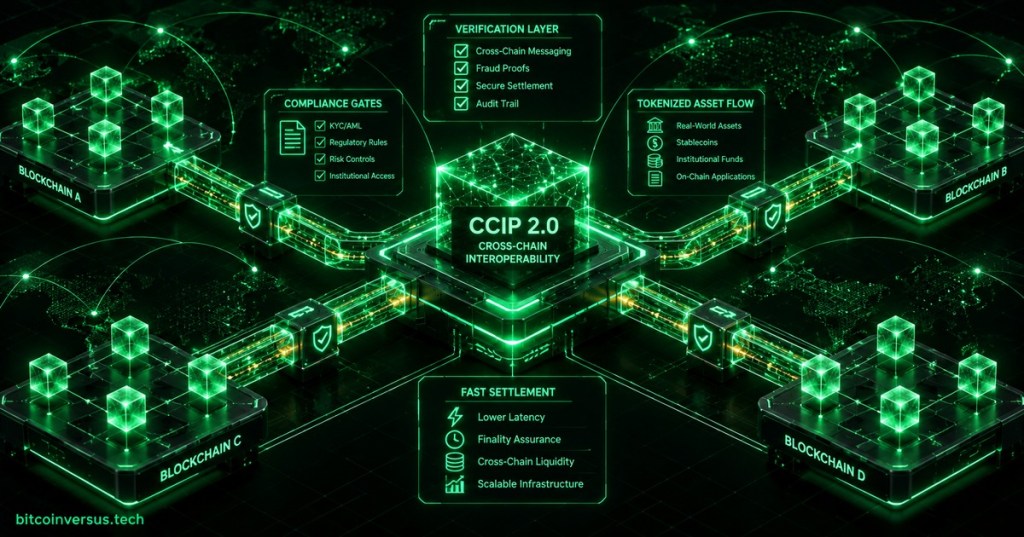
Cross-chain infrastructure is getting a more institutional design. Chainlink’s CCIP 2.0 is now live with new controls for verification, transaction finality, compliance and execution, while a growing group of asset issuers and protocols is moving critical cross-chain infrastructure onto the network.
In its CCIP 2.0 launch announcement, Chainlink says the upgrade lets institutions add their own Cross-Chain Verifiers, choose faster or more conservative confirmation settings, integrate compliance policies and customize how cross-chain transactions are executed.
The change is important because blockchain interoperability is no longer only about getting a token from Chain A to Chain B. As tokenized deposits, stablecoins, funds and securities move onchain, the infrastructure connecting networks increasingly has to support institutional security controls and operating policies without forcing every issuer to build a separate bridge.
CCIP 2.0 turns cross-chain security into a configurable layer
The most significant architectural addition is the Cross-Chain Verifier framework. An issuer can add its own verifier, use a third-party verifier or operate an institution-controlled verification layer on top of CCIP’s existing decentralized oracle network.
That creates an additive security model. Instead of requiring every organization to accept one fixed verification design, institutions can layer their own controls on top of the shared interoperability system.
CoinDesk’s independent reporting highlighted the same shift, describing CCIP 2.0 as an effort to give applications and institutions more control over cross-chain security after a series of industry bridge failures pushed infrastructure risk back into focus.
More than ₿174,600 ($15 billion) is moving toward CCIP infrastructure
Chainlink says more than ₿174,600 ($15 billion) in token value has been migrating to CCIP as projects deprecate older bridging systems. The migration list includes infrastructure supporting wrapped Bitcoin, stablecoins, liquid-staking assets and tokenized real-world assets.
In an October 4 X update on the migration wave, Chainlink said leading teams are consolidating more cross-chain infrastructure around CCIP as the new 2.0 architecture rolls out.
The trend connects directly to the broader institutional tokenization buildout. BitcoinVersus.Tech recently covered UK banks moving live sterling deposits across tokenized rails, showing why banks need infrastructure that can connect regulated digital money across different systems.
Faster-than-finality transfers add a risk dial
CCIP 2.0 also introduces configurable confirmation behavior. Standard transfers can continue waiting for full blockchain finality, while eligible applications can choose faster-than-finality execution when their risk model allows it.
That distinction matters for financial infrastructure because not every transaction has the same urgency or risk profile. A high-value institutional transfer may prioritize the strongest finality guarantee, while other workflows may prioritize speed. The new architecture makes that tradeoff explicit rather than forcing one confirmation policy across every use case.
Compliance is moving into the interoperability layer
Another major addition is native compatibility with Chainlink’s Automated Compliance Engine. That allows policy checks to be incorporated into cross-chain asset movement without requiring every application to bolt on a separate compliance workflow.
This is increasingly relevant as regulated assets move onchain. BitcoinVersus.Tech recently examined the new U.S. path for tokenized stocks to trade onchain. If securities are issued across multiple networks, interoperability infrastructure has to preserve issuer rules as assets move between them.
Cross-chain infrastructure is becoming financial middleware
The bigger story is that interoperability networks are evolving from simple bridges into middleware. They are expected to coordinate verification, policy, messaging, asset movement and execution across public and private chains.
That same transition is visible in stablecoin payments. BitcoinVersus.Tech’s coverage of Citi and Coinbase putting stablecoin payments inside bank rails shows how traditional financial institutions are beginning to treat blockchain networks as another settlement environment rather than a separate crypto-only system.
CCIP 2.0 is therefore less about adding another bridge feature and more about defining a control layer for multi-chain finance. If tokenized assets continue spreading across different networks, the infrastructure that verifies and coordinates movement between those networks may become as important as the chains themselves.
BitcoinVersus.Tech
Advertisement
Editor’s Note
We volunteer daily to ensure the credibility of the information on this platform is Verifiably True. If you would like to support to help further secure the integrity of our research initiatives, please donate here: 3C9o19EH5HSiwEPyCTmEKzxhNCbo2X6TTb
BitcoinVersus.tech is not a financial advisor. This media platform reports on financial subjects purely for informational purposes.


Leave a Reply