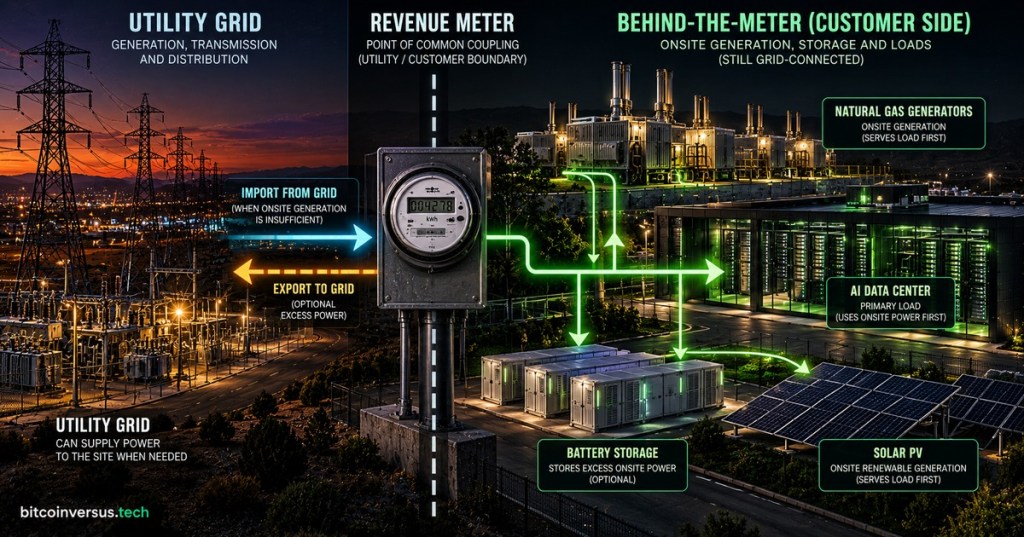
“Behind the meter” sounds like utility jargon, but the basic idea is simple: the customer makes some or all of its electricity on its own side of the utility billing meter, so that power serves the facility before electricity has to be purchased from the grid.
For homes, that might mean rooftop solar. For an AI data center drawing hundreds of megawatts, it can mean natural-gas generators, turbines, batteries, solar, fuel cells or a combination of resources installed beside the campus.
The Meter Is the Boundary
The easiest way to understand the term is to picture the utility revenue meter as a boundary between two electrical worlds. On the utility side are the bulk generators, transmission lines, substations and distribution system. On the customer side are the building loads and any on-site power equipment.
The U.S. Department of Energy’s Onsite Energy Program describes behind-the-meter resources as on-site generation and storage that can decrease, or in some cases eliminate, the amount of electricity an industrial facility pulls from the grid. DOE specifically identifies manufacturers and data centers as potential users.
A 100 MW Example Makes It Click
Imagine a data center consuming 100 MW continuously. If its on-site generators produce 70 MW, the grid needs to supply only about 30 MW, before losses and auxiliary loads. The 70 MW is behind the meter because it is consumed on the customer side before the utility supplies the remainder.
If the same site produced 110 MW while consuming 100 MW, it would have 10 MW of excess power. That excess cannot simply be exported automatically; grid export generally requires the appropriate interconnection agreement, protection equipment, metering and tariff treatment.
Behind the Meter Does Not Mean Off-Grid
A behind-the-meter facility can still be fully connected to the utility grid. The site may import utility power when on-site generation is insufficient, keep the grid connection for redundancy or use the grid during maintenance.
An off-grid facility operates without relying on a utility connection. A microgrid is another related but different concept: it is a coordinated local electrical system that may be able to disconnect from the larger grid and operate in island mode. A microgrid can contain behind-the-meter assets, but not every behind-the-meter project is a microgrid.
It Also Does Not Just Mean Backup Generators
The modern data-center trend goes beyond emergency backup. Developers are increasingly evaluating on-site generation as prime power: equipment intended to operate for long periods and carry a meaningful share of the campus load.
That is why BitcoinVersus.Tech has been tracking deals such as Enerflex’s 450 MW behind-the-meter data-center contract. Hundreds of megawatts of continuous generation is a different business from emergency backup.
Why AI Data Centers Want It
The biggest reason is speed-to-power. A developer may already control land, fiber and customer demand but face a long wait for enough utility transmission and substation capacity. Building generation on the customer side can let part of the project energize sooner.
The second reason is reliability. On-site generation can give a campus another source during grid disturbances and reduce how much power crosses constrained transmission infrastructure. The third is economics: a customer may gain more control over fuel costs, demand charges, power quality and long-term electricity pricing, although results depend on fuel, equipment financing, maintenance and local utility rules.
BitcoinVersus.Tech recently covered ProPetro’s PROPWR unit reaching roughly 510 MW of contracted capacity, with management explicitly pointing to data centers as a future deployment market.
The Grid Still Matters
Behind-the-meter generation does not make the utility disappear. Large sites can still rely on the transmission system for backup service, startup power, maintenance periods or imports during generator outages.
That is why the regulatory details are increasingly important. In 2026, the Federal Energy Regulatory Commission said regional grid operators need clearer rules for large-load customers and specifically identified co-location arrangements and behind-the-meter generation as an area requiring attention. The concern is that large projects be integrated without unfair cost shifting or reliability blind spots.
A Hybrid Power Campus May Be the Key Model
The practical architecture for many large data centers may not be grid or no grid. It may be both. A campus can combine utility service with on-site gas generation, batteries, solar and other resources, then dispatch those assets according to cost, reliability and operating conditions.
That is the logic behind projects such as JERA, Dell and RHAELM’s planned 400 MW AI campus beside a power plant. Putting generation physically close to compute can shorten the electrical path and reduce dependence on new long-distance transmission construction.
The Short Definition
Behind-the-meter power is electricity generated or stored on the customer side of the utility billing meter and used primarily to serve that customer’s own load.
It can reduce grid imports, improve resilience and help a data center energize before major utility upgrades are finished. It does not automatically mean off-grid operation or unrestricted grid export.
For AI infrastructure, that distinction is becoming increasingly important. The next generation of data centers may not simply plug into the grid. Many will increasingly operate as miniature power systems of their own while remaining connected to the larger electrical network around them.
BitcoinVersus.Tech
BitcoinVersus.tech is not a financial advisor. This media platform reports on financial subjects purely for informational purposes.


Leave a comment