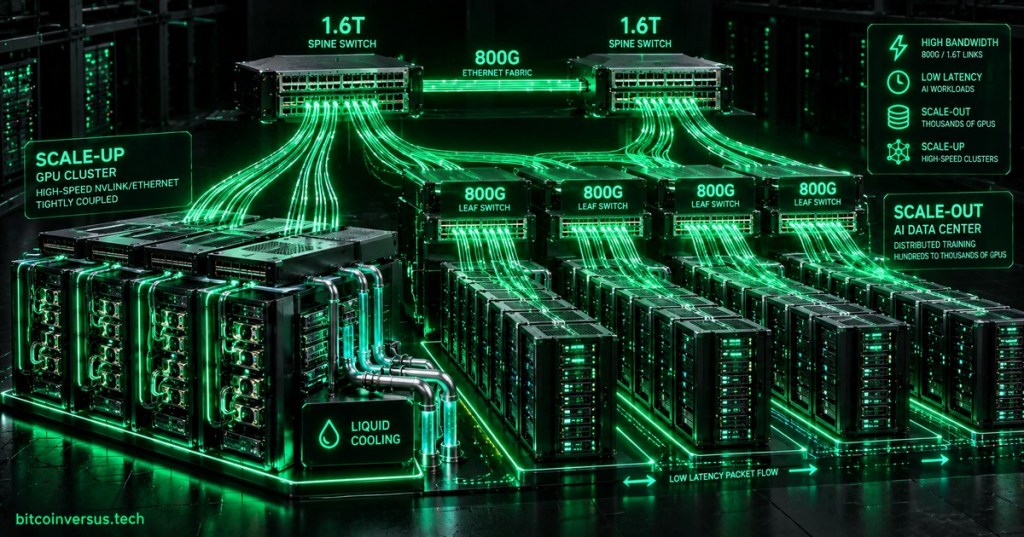
AI infrastructure is turning the network from a supporting utility into a first-class part of the compute system. Hewlett Packard Enterprise now expects its data-center networking business to grow at a low-to-high 50% compound annual rate through fiscal 2029 as GPU clusters demand faster Ethernet, lower latency and tighter integration between switches, compute and cooling.
In its September 30 Networking Investor Day update, HPE said AI is making the network more strategic across data centers, routing, campus systems and security. The company’s highest growth expectation is in data-center networking, where it is combining Juniper technology with HPE’s broader compute and infrastructure portfolio.
The technical reason is straightforward: accelerator utilization depends on the fabric between accelerators. A cluster can contain thousands of high-end GPUs, but collective operations, model synchronization and distributed inference slow down when congestion, tail latency or packet loss prevent the network from feeding those processors consistently.
800G and 1.6T Ethernet are becoming AI infrastructure
HPE says it has been pushing early into 800-gigabit and 1.6-terabit Ethernet as AI clusters increase bandwidth per server and per rack. Those links are no longer just uplinks between conventional servers. They are becoming part of the accelerator fabric itself, carrying synchronization traffic between large pools of compute.
That transition lines up with the broader optical roadmap. BitcoinVersus.Tech recently covered OIF’s push toward 448G electrical lanes and 1.6T coherent optics, which shows how the physical layer is being redesigned around the bandwidth density required by AI systems.
Reuters independently reported that HPE raised its long-term networking growth outlook as AI demand expands the role of switching and routing inside modern data centers.
Scale-up and scale-out are becoming one networking problem
HPE’s strategy spans both scale-up and scale-out networking. Scale-up links connect accelerators inside a tightly coupled compute domain where latency and synchronization are especially sensitive. Scale-out fabrics connect larger groups of racks and clusters over Ethernet, allowing AI systems to expand beyond a single rack or pod.
The company’s first AMD Helios deployment illustrates that integration. In a September 30 HPE X post about the Helios rollout, HPE highlighted a rack-scale system that combines compute with purpose-built HPE networking hardware and software.
BitcoinVersus.Tech covered that deployment separately in its look at HPE’s first AMD Helios rollout with Vultr. The new Investor Day story is broader: HPE is treating the networking layer itself as one of the fastest-growing parts of the AI infrastructure stack.
Juniper gives HPE switching, routing and AI operations under one portfolio
The Juniper integration changes the scope of HPE’s networking business. HPE can now combine Juniper QFX switching, MX and PTX routing, Mist AI operations and custom networking silicon with Aruba campus infrastructure and HPE’s compute systems.
That matters because the AI network extends beyond the back-end GPU fabric. Distributed clusters also require data-center interconnect, edge routing, user access, telemetry and security. HPE expects routing to grow in the low-to-high 20% range through fiscal 2029 as organizations connect AI systems across buildings, campuses and geographies.
The same urgency is visible across the carrier market. BitcoinVersus.Tech recently reported that 90% of service providers expect AI networks to drive revenue while 88% say upgrades are urgent, reinforcing the idea that AI traffic is pressuring both data-center fabrics and the optical networks around them.
Liquid cooling is reaching the switch layer too
High-speed networking is also becoming a thermal-engineering problem. HPE says it has introduced a liquid-cooled Ethernet data-center switch as port speeds and switch-fabric capacity push networking hardware into the same power-density discussion as GPUs.
That is an important architectural shift. In older facilities, the network was often a relatively small fraction of rack power. In dense AI systems, switch ASICs, optical modules and retimers can become significant heat sources, especially as links move from 400G to 800G and 1.6T.
The network is becoming part of the compute budget
The key takeaway from HPE’s new outlook is not the forecast by itself. It is what that forecast says about system design. AI clusters are forcing operators to treat bandwidth, latency, congestion control, routing and thermal management as resources that directly determine how much useful work expensive accelerators can perform.
That makes networking a compute-efficiency problem. As AI systems scale, the winning architecture will not simply be the one with the most accelerators. It will be the one that keeps those accelerators fed, synchronized and connected with the least wasted time and power.
BitcoinVersus.Tech
Advertisement
Editor’s Note
We volunteer daily to ensure the credibility of the information on this platform is Verifiably True. If you would like to support to help further secure the integrity of our research initiatives, please donate here: 3C9o19EH5HSiwEPyCTmEKzxhNCbo2X6TTb
BitcoinVersus.tech is not a financial advisor. This media platform reports on financial subjects purely for informational purposes.


Leave a comment