coreboot 26.09 is a firmware release focused less on flashy platform announcements and more on the code that has to be correct before an operating system ever starts. The project moved its firmware build to C23, audited multiple parsers that consume externally supplied data, added TPM-backed verification for DDR5 SPD cache data, and pushed AMD EPYC Turin support far enough to land the first GIGABYTE MZ33-AR1 server-board port.
The official coreboot release announcement says 120 authors, including 29 first-time contributors, merged more than 1,300 commits during the roughly three months since 26.06. The emphasis this cycle was hardening and refinement of the existing codebase alongside continued platform enablement.
Why firmware parser hardening matters
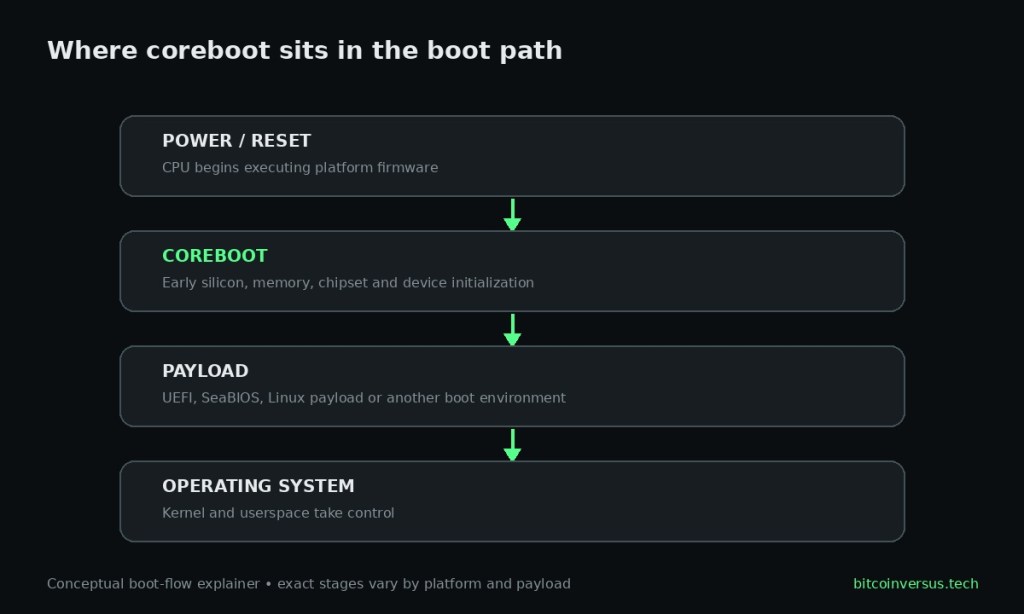
Firmware runs at one of the most privileged points in a computer. It initializes the processor, memory, chipset and attached hardware before the kernel takes over, which means malformed data handled at this stage can create unusually serious failures.
coreboot 26.09 therefore tightened validation across several parsers. EDID handling now rejects short buffers and prevents extension blocks from being read beyond their bounds. Flattened Device Tree parsing checks header consistency and alignment. BMP rendering validates image dimensions, offsets and framebuffer geometry. CBFS and FMAP paths gained additional bounds checks, TPM2 response payload sizes are validated, and ramstage gained heap-overflow checking in its crashlog path.
The release also changes failure behavior in sensitive paths. System Management Mode bus walking now guards against cyclic recursion, while multiprocessor initialization halts the boot if SMM initialization fails instead of continuing with a partially initialized system.
The firmware itself now builds as C23
The coreboot firmware build has moved to -std=gnu23, bringing the project onto the C23 language standard. Mainboard code was updated to use the standardized static_assert keyword instead of the older _Static_assert spelling. Host-side tools briefly moved with it, but that portion was reverted before release because requiring newer compiler support broke builds on older Linux distributions. Host tools therefore remain on their existing C11 baseline.
DDR5 cache data can now be checked against the TPM
Intel platforms gained DDR5 SPD cache support so serial-number and module-geometry information can be reused across boots rather than repeatedly read over SMBus. More importantly, an optional SPD_CACHE_TPM_HASH path stores a SHA-256 hash of that cache in TPM nonvolatile memory.
If the hash no longer matches, coreboot invalidates the cached SPD information and forces a clean Memory Reference Code retraining cycle. The goal is straightforward: if writable flash containing the cached memory description has been altered, firmware should not quietly trust the changed copy.
AMD Turin moves closer to a practical upstream path
The AMD Turin proof-of-concept also matured substantially. coreboot added CPPC support, IOAPIC interrupt-routing hooks, FADT and amdfwtool configuration, ACPI descriptions for CXL and MPDMA devices, plus additional SEV NVRAM and Platform Security Processor integration.
The first board on that path is the GIGABYTE MZ33-AR1, an SP5 server motherboard for AMD EPYC 9004 and 9005 processors. Its upstream port now describes PCIe and MCIO topology, onboard devices and the BMC-oriented BIOS-update packaging needed for the platform. Phoronix notes that the work grows out of 3mdeb’s effort to run coreboot with AMD openSIL on the same server platform.
Updates and recovery are getting attention too
The EFI payload infrastructure gained capsule-on-disk support, while the capsule driver now rejects invalid memory ranges and can be invoked more than once. SMMSTORE dropped its older v1 protocol and received additional range validation. Those changes sit directly in the same problem space as firmware-update architecture, rollback and recovery: an update mechanism has to be reliable even when its input is malformed or interrupted.
coreboot is not a universal drop-in BIOS
It is important not to confuse upstream coreboot support with a generic firmware image that can be flashed onto any PC. Hardware enablement remains board-specific, and systems often rely on a payload such as edk2 or SeaBIOS plus platform-specific initialization components. The distinction is similar to the difference between traditional BIOS and UEFI: the visible boot interface is only one layer of the pre-OS stack.
What 26.09 shows is the less glamorous side of open firmware becoming more mature: stricter bounds checks, clearer failure modes, modern compiler standards, verified cached state and a more complete path onto current server silicon. Those changes are difficult to advertise on a spec sheet, but they are exactly the kind of engineering work firmware needs before the operating system gets its first instruction.
Editor’s Note: BitcoinVersus.Tech covers computing, firmware, semiconductors, infrastructure and other technology from an independent editorial perspective.
Disclaimer: This article is for informational and educational purposes and does not constitute engineering, security or financial advice.


Leave a comment