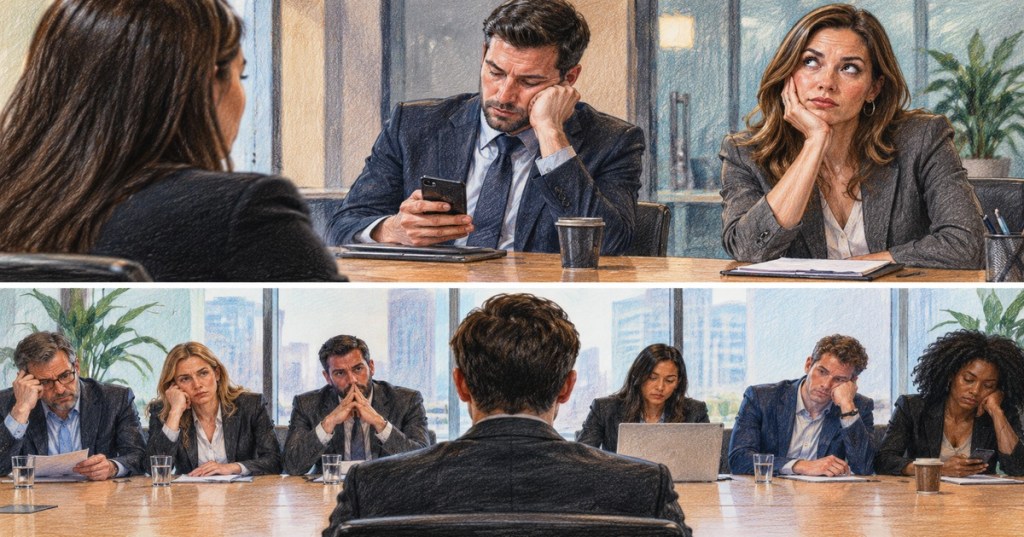
Some bad job interviews are awkward. Others leave candidates wondering why they ever showed up.
BitcoinVersus.Tech searched Reddit, Ask a Manager, Fishbowl, LinkedIn, YouTube, and career-advice discussions for first-person accounts of interviews that candidates described as rude, humiliating, invasive, dismissive, or simply bizarre. These stories are anecdotes, not independently verified findings, and the point here is not to declare any specific employer guilty based on one post. The useful part is the pattern: the same types of disrespect appear again and again across unrelated forums.
This story follows our earlier look at how candidates know an interview has gone badly. This time, the focus is different: interviews where the candidate believed the interviewer crossed the line.
1. The Interviewer Who Rolled His Eyes at Clarifying Questions
One of the clearest recent examples came from a 2026 Reddit post in r/interviews. The candidate said the interviewer became visibly impatient whenever they asked a follow-up question. Then came a heavy sigh and an obvious eye roll.
Instead of silently absorbing it, the candidate stopped the interview and said they were uncomfortable with the frustration being directed at them. According to the poster, the interviewer immediately softened and apologized. The exchange stands out because it shows something candidates rarely feel empowered to do: professionally call out disrespect while it is happening.
2. The CFO Who Paused the Interview to Google the Candidate’s Neighborhood
Another 2026 Reddit account described a remote executive-assistant interview that became uncomfortable almost immediately. The candidate said the executive gave a snarky response to a routine greeting, then kept pressing for a more specific location even though the role was remote.
The candidate said the interviewer then paused the conversation to search the neighborhood online. The rest of the interview was described as terse and dismissive. Whether or not the employer intended anything improper, the candidate came away feeling that a normal location question had turned into an unnecessary invasion of privacy.
3. The Surprise Eight-Person Panel
A 2025 r/interviews post described walking into what was expected to be a normal on-site interview and finding eight interviewers around the table with no warning. The candidate said the room alternated between questions, long silences, note-taking, people looking bored, one person arriving late, and another leaving halfway through.
Panel interviews are not automatically disrespectful. The problem was the surprise. A candidate prepares differently for a one-on-one interview than for an eight-person evaluation. When the format changes without notice, the interview can stop feeling like an assessment and start feeling like an ambush.

4. The Executive Who Reportedly Laughed at the Salary Request
A recent LinkedIn account described a candidate reaching a final executive interview after three successful rounds. The poster said compensation expectations had been disclosed from the start. When the executive asked again and heard the same number, the candidate said he laughed, ended the conversation abruptly, and left them stunned.
Salary expectations can be too high for a company’s budget. That is ordinary negotiation. Mocking the number is different. Compensation discussions should be treated like any other business negotiation: there can be a hard no without turning the candidate into the punch line. BitcoinVersus has covered that difference from another angle in its negotiation masterclass—strong bargaining does not require disrespect.
5. The Interviewer Who Allegedly Asked to See a Candidate’s Leg
One LinkedIn poster described explaining a five-month résumé gap by saying she had recovered from a medical issue involving her leg. According to her account, the interviewer then asked her to stand up so he could see the leg, asked about medical reports, and later asked to inspect another offer letter.
That story is especially useful for drawing a legal boundary. In the United States, the EEOC says pre-employment inquiries should generally focus on information needed to determine whether someone is qualified for the job, and employers generally may not ask disability-related questions or require medical examinations before a conditional offer. Laws vary by jurisdiction, so the forum story itself should not be treated as a legal finding—but the U.S. rule is a reminder that “personal” and “job-related” are not the same thing.
6. Late, Unprepared, Yawning, and Without the Résumé
Fishbowl has its own version of the same pattern. One poster described an interviewer who arrived about 15 minutes late, did not have the candidate’s résumé, asked what felt like random questions, and visibly yawned during the conversation. The candidate had already decided against joining the company and asked the forum whether there was any point in continuing to another round.
The story sounds small compared with fake emergencies or invasive medical questions, but it may be more common. Candidates prepare, take time away from work, arrange transportation, test video calls, and often reorganize their day. The minimum reciprocal obligation is attention. SHRM has specifically identified candidates feeling disrespected or having their time wasted—including interviewers who fail to show up—as a candidate-experience problem. Its broader guidance emphasizes a process that is timely, transparent, empathetic, and personalized.
That matters even more as remote and hybrid work expectations make video interviews routine. A virtual interview may be easier to schedule, but the candidate’s time is not suddenly free.
7. The Interview Panel That Yelled “Fire!” as a Test
One of the most absurd interview accounts collected by Ask a Manager involved a panel suddenly shouting “FIRE!” and running around the room. The candidate reacted by calling 911. According to the story, the panel then had to explain that there was no real emergency—they had staged the scene to test the candidate’s reaction under pressure.
The account is old, but it remains memorable because it captures the worst version of the “stress interview” idea: creating confusion that has little relationship to the job and then evaluating a candidate for reacting normally. A serious assessment should simulate job-relevant pressure, not manufacture chaos for entertainment.
8. The Candidate Who Walked Out of the Surprise Group Interview
A highly upvoted r/recruitinghell post described a candidate arriving for an interview and finding roughly ten other people waiting for what turned out to be a group interview. The poster said that format had never been disclosed. Rather than stay, the candidate returned the paperwork, told the hiring manager the setup felt misleading and uncomfortable, and left.
That story gets at the central lesson from nearly every account in this article: candidates are not required to endure any interview just because an employer invited them. An interview is not a courtroom summons. If the process becomes abusive, deceptive, discriminatory, or simply intolerable, leaving is an option.
The Same Red Flags Keep Reappearing
Across the stories, the exact jobs and industries change, but the disrespect tends to fall into a few repeating categories: mockery, interruptions, surprise interview formats, irrelevant grilling, invasive personal questions, obvious disinterest, unexplained lateness, bait-and-switch job duties, pressure tactics, and contempt for the candidate’s time.
Some of those behaviors are merely rude. Some may become legally significant depending on what is asked, why it is asked, who is treated differently, and the jurisdiction. The distinction matters. Not every bad interview is unlawful, but “legal” is also an extremely low standard for deciding whether you want to work somewhere.
A Bad Interview Is Information
Job seekers are often told to treat every strange interaction as a test they must pass. The forum accounts suggest another interpretation: sometimes the interviewer is simply showing you what working there may feel like.
If a manager cannot give a candidate twenty or thirty minutes of basic professional attention while actively trying to recruit them, it is reasonable to ask what that manager will be like once the candidate is already on payroll. If compensation is mocked during the courtship phase, what happens during a raise discussion? If the panel interrupts every answer, what happens in meetings? If the job description changes in the final round, what else is negotiable after you start?
That does not mean one awkward interviewer automatically proves an entire company is toxic. People have bad days. Emergencies happen. Interviews can be clumsy. The stronger signal is a pattern: disrespect that is repeated, unapologetic, or reinforced by multiple people in the process.
What Candidates Can Say in the Moment
You do not need a dramatic confrontation. A calm sentence can reset the room: “I want to make sure I understand the question before I answer.” If interruptions continue: “Would you like me to finish this example, or should we move to the next question?” If the conversation becomes personally invasive: “Can you help me understand how that relates to the responsibilities of the role?”
And if the line has clearly been crossed: “I don’t think this process is the right fit for me, so I’m going to withdraw. Thank you for your time.” The candidates in these stories are a reminder that walking away can be a professional decision, not a failure.
Companies spend enormous amounts of money trying to build an employer brand. A single interviewer can damage it in thirty minutes.


Leave a comment