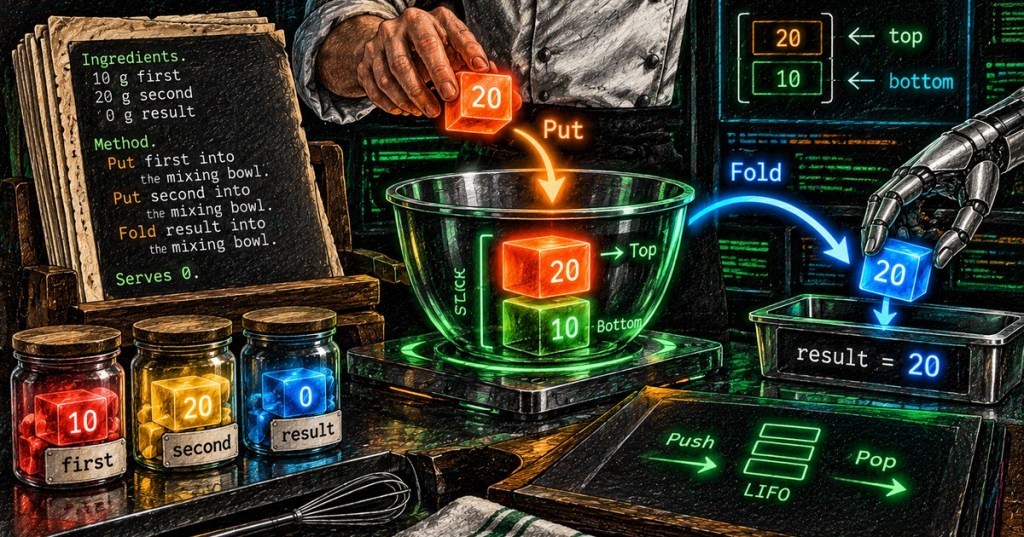
Chef’s mixing bowl is a real stack data structure hidden behind recipe language. In OSChef.001, ingredients stored numeric values and the bowl stored copies of those values. This lesson focuses on the two basic movement instructions: Put pushes an ingredient value onto the bowl, while Fold removes the top value and writes it back into an ingredient. David Morgan-Mar’s Chef specification defines those exact behaviors.
Put Is Chef’s Push Operation
Put ingredient into the mixing bowl. copies the current value of that ingredient onto the top of the selected bowl. The ingredient itself keeps its value. If first = 10 and second = 20, putting first and then second produces a bowl whose top value is 20 and whose next value is 10. That is ordinary last-in, first-out behavior—the same basic push/pop idea used throughout computer science, including stack-based scripting systems.
Fold Pops the Top Value Into an Ingredient
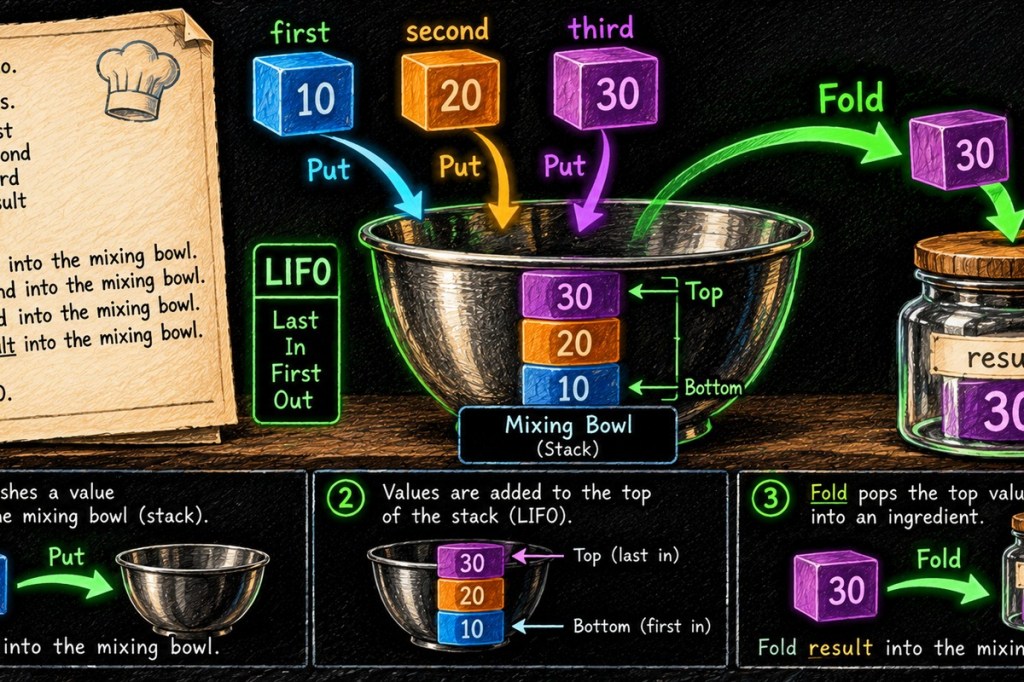
Fold result into the mixing bowl. does the reverse kind of movement. Chef removes the bowl’s current top value and stores that value in result. If the bowl contains 10 on the bottom, 20 above it, and 30 on top, folding into result sets result = 30 and leaves 20 as the new top. The bowl changes and the destination ingredient changes at the same time.
Worked Example
Stack Demo.

Ingredients.
10 g first
20 g second
30 g third
0 g result

Method.
Put first into the mixing bowl.
Put second into the mixing bowl.
Put third into the mixing bowl.
Fold result into the mixing bowl.

Serves 0.
Execution is straightforward: 10 is pushed first, then 20, then 30. Because the bowl is LIFO, 30 is the first value Fold can remove. After the Fold statement, result is 30 and the bowl still contains 10 and 20. This is why stack order matters: changing the order of the Put statements changes which value Fold receives.
Exercises
- Push 4, then 9, then 2. What value will Fold remove first?
- Change the worked example so
third = 99. Predictresult. - Remove the third Put statement. What value does Fold return now?
- Explain why Put does not erase the source ingredient.
- Explain why Fold changes both the bowl and the destination ingredient.
Knowledge Check + Answers
- What does Put do? It copies an ingredient’s current value onto the top of a mixing bowl.
- What does Fold do? It removes the top value from a mixing bowl and stores it in an ingredient.
- What does LIFO mean? Last In, First Out.
- If values 10, 20, 30 are pushed in that order, which comes out first? 30.
- Does Put clear the source ingredient? No.
Elementary Review
Remember the translation: Put = push, Fold = pop into an ingredient, mixing bowl = stack. Once those three ideas are clear, Chef’s recipe metaphor becomes much easier to read as programming. The next lesson adds arithmetic to the value already sitting on top of the bowl.
BitcoinVersus.Tech content is provided for informational and educational purposes.


Leave a comment