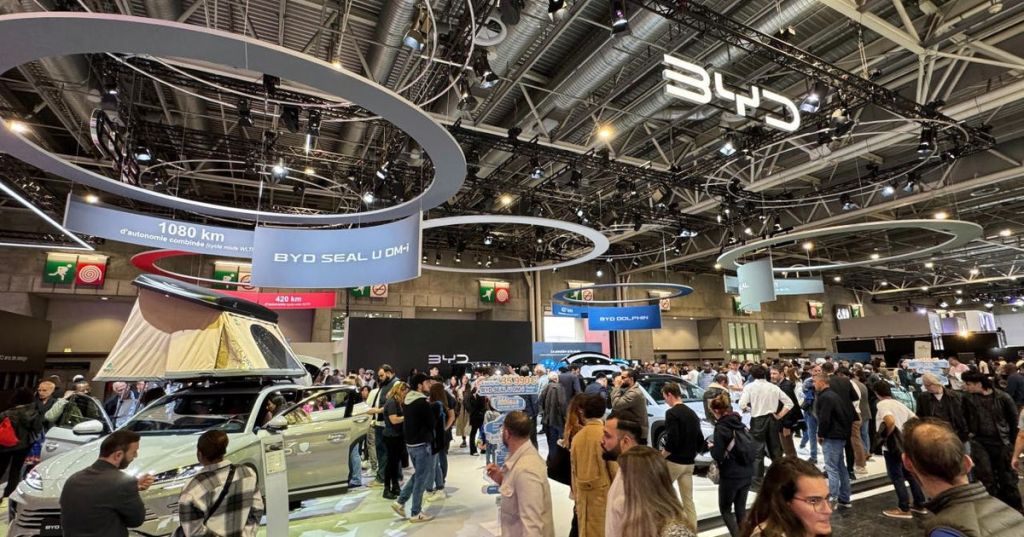
The 2026 Paris Motor Show is becoming a snapshot of how quickly the balance of the global auto industry is changing. A record 20 Chinese car brands are expected at the show, roughly double the Chinese presence in 2024, as manufacturers including BYD, Chery, Aito and Avatr push deeper into Europe with electric cars, plug-in hybrids and increasingly Europe-specific products.
Reuters reports that Chinese automakers now account for about 10.7% of the European car market, while their share of Europe’s plug-in-hybrid segment has climbed above 26%. The expansion is unfolding while European manufacturers wrestle with weak demand, expensive electrification programs, restructuring and pressure to launch lower-cost electric vehicles of their own.
The Paris show runs October 12–18 at Paris Expo Porte de Versailles. The scale of China’s presence is notable because the European Union has already imposed additional duties on Chinese-built battery-electric vehicles. Chinese groups are responding with a broader product mix, more plug-in hybrids, local production plans and partnerships designed to make their European businesses harder to treat as simple import operations.
Paris is no longer just a showcase—it is a market-share battle
Auto shows used to be dominated by domestic and established global brands showing concept cars and future design language. Paris 2026 looks more like a competitive map. Chinese manufacturers are arriving with production-ready vehicles across compact cars, SUVs, pickups, luxury models and hybrids, while European companies are being forced to answer on price, range, software and battery technology.
The shift follows years of trade friction. BitcoinVersus previously covered EU-China talks over tariffs on Chinese electric vehicles. Those tariffs did not stop the expansion. Instead, manufacturers increasingly diversified into plug-in hybrids and began planning more local assembly and manufacturing inside Europe.
Reuters says that strategy is already visible in the numbers: Chinese brands have gained a particularly large position in plug-in hybrids, a category that is not treated exactly the same way as fully electric imports under the EU’s current tariff structure.
BYD is bringing products built specifically for Europe
BYD’s Paris plan shows how much its European strategy has matured. The company says its Hall 6 stand will include all-electric models, its Super Hybrid plug-in-hybrid range, second-generation Blade Battery technology and energy-storage systems.
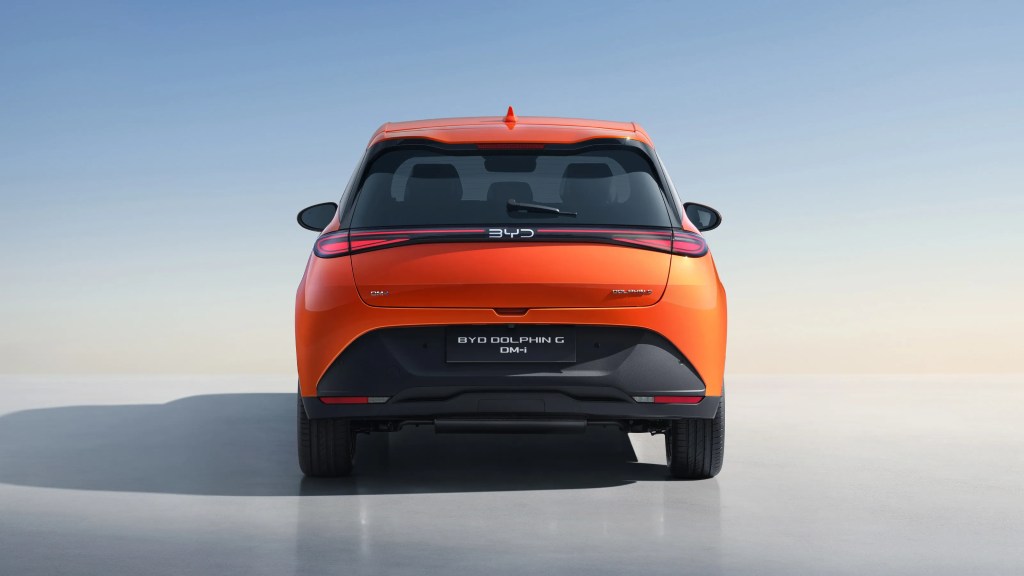
The DOLPHIN G DM-i is especially important because BYD describes it as the first model it designed and developed specifically for Europe. The compact plug-in hybrid can provide up to 105 km of electric-only WLTP range and up to 1,040 km of combined range. BYD quotes weighted fuel consumption as low as 1.4 L/100 km for the larger-battery versions.
The product strategy is easy to see: give European buyers enough battery range for many daily trips while retaining a gasoline engine for long-distance travel. That approach targets customers who like electric driving but are not ready to depend entirely on public charging.
BYD is also bringing an electrified pickup
At the other end of the lineup is the BYD SHARK, the company’s first pickup planned for the European market. Its plug-in-hybrid all-wheel-drive system is rated at 436 PS and 650 Nm of torque, with up to 90 km of electric range and 675 km of combined WLTP range.
BYD also quotes a 2,500 kg towing capacity, payload up to 790 kg and a 1,200-liter cargo bed. The important competitive point is not that every European buyer needs a pickup. It is that Chinese manufacturers are no longer entering Europe with only a handful of inexpensive compact EVs—they are filling out entire product portfolios.
Premium Chinese brands are arriving too
BYD’s premium DENZA brand will occupy a separate Paris stand with the Z9GT, D9, BAO 5 and the electric DENZA Z in Coupé, Spider and Racing forms. The stand will also demonstrate BYD Group’s FLASH ultra-fast charging technology.
That matters because Chinese automakers are increasingly competing above the entry-level market. European companies cannot assume their strongest defense will always be premium branding, driving dynamics or luxury technology while China owns the low-cost end.
Europe is responding with cheaper EVs and industrial policy
European automakers are not standing still. Volkswagen, BMW, Renault, Stellantis and others are pushing new lower-cost EVs, software platforms and manufacturing strategies. Reuters also reports that the EU is developing rules that could tie some subsidies to local-content requirements, an attempt to make European public support reinforce European production rather than simply increase imported vehicle sales.
The result is a more complicated competition than a simple “China versus Europe” tariff story. Chinese automakers can localize production. European automakers can partner with Chinese technology companies. Battery supply chains can cross borders even when final assembly is local. The car itself is increasingly the visible end product of a much larger contest over batteries, software, manufacturing scale and energy efficiency.
Plug-in hybrids are becoming a strategic bridge
The strong Chinese position in European plug-in hybrids is one of the most important parts of the story. Battery-electric vehicles receive most of the attention, but plug-in hybrids let manufacturers sell electrified drivetrains to buyers who still worry about charging access, apartment living or long-distance travel.
They also give manufacturers another route into markets where policy has become more hostile toward imported battery-electric vehicles. That does not guarantee long-term success—hybrid policy can change too—but it shows how quickly manufacturers adapt when regulation changes the economics of one drivetrain.
Paris 2026 is a preview of the next phase of the auto industry
The record Chinese turnout at Paris is less important as a one-week event than as evidence of where the industry is going. China’s automakers are exporting more, designing vehicles specifically for overseas buyers and moving into segments that once seemed protected by local brand loyalty.
Europe still has enormous strengths in automotive engineering, premium brands, manufacturing expertise and supplier networks. But the competitive gap is now measured in battery cost, software, model-development speed and product breadth as much as engine engineering and brand history.
The 20-brand Chinese presence in Paris makes the message difficult to miss: Europe is no longer deciding whether Chinese automakers will enter its market. It is deciding how its own manufacturers will compete now that they are already there.
Editor’s note: Market-share figures are based on Reuters reporting published October 9, 2026. Vehicle specifications are manufacturer figures from BYD and may vary by market or trim.
Disclaimer: BitcoinVersus.Tech publishes technology and industry news for informational purposes.


Leave a Reply