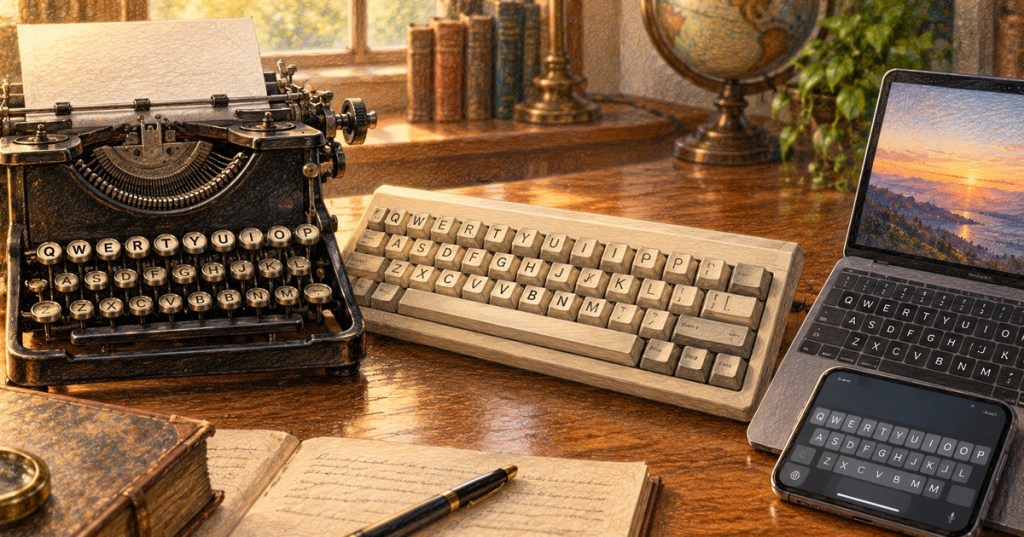
The QWERTY keyboard is a 19th-century solution that survived every major computing revolution. The letters on your laptop, desktop keyboard and phone are still arranged around a pattern developed for early mechanical typewriters more than 150 years ago.
That persistence is remarkable. The typebars that once struck inked ribbon are gone. Modern keyboards use switches, membranes, capacitive sensors or touchscreens. Yet the same familiar top row still begins Q-W-E-R-T-Y. The reason is not that QWERTY is obviously perfect. It is that a technology can become so widely taught, manufactured and expected that replacing it becomes harder than keeping it.
QWERTY began with the typewriter, not the computer
The layout traces back to the work of Christopher Latham Sholes and his collaborators in the late 1860s and early 1870s. Their writing machine eventually reached E. Remington & Sons, which manufactured the first commercially successful Sholes and Glidden Type-Writer. The Library of Congress notes that production began in 1873 and that the Remington machine helped popularize the QWERTY layout still used today.
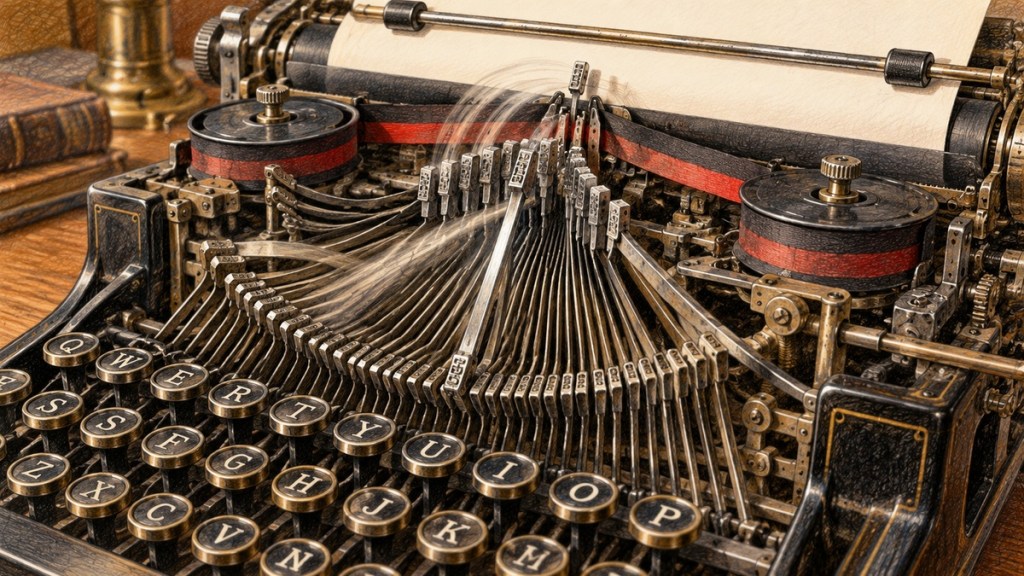
The original machines were not electronic input devices. Pressing a key moved a mechanical linkage connected to a typebar. That typebar swung toward the paper and struck an inked ribbon, leaving a character behind. Every key position therefore had mechanical consequences inside the machine.
The famous “QWERTY was made to slow people down” story is too simple
The most common explanation says QWERTY was deliberately designed to slow typists so nearby typebars would not collide. There is a real mechanical issue behind the story: early machines could jam when multiple typebars moved into the printing area too quickly.
But historians do not agree that “slowing typists down” was the actual design goal. The Smithsonian’s history of QWERTY notes that the exact reason for the final arrangement remains disputed. Some accounts emphasize separating common letter combinations to reduce clashes. Other research argues that telegraph operators helped shape the layout so they could transcribe Morse code more efficiently.
That distinction matters. A keyboard can be rearranged to reduce mechanical conflicts without being intentionally designed to make a person type slowly. And if telegraph operators were part of the design feedback loop, speed would have been valuable rather than undesirable.
QWERTY was still evolving when Remington adopted it
Early prototypes did not immediately appear with the exact modern arrangement. Sholes and his collaborators tried several layouts while refining the machine. By the time Remington commercialized the Type-Writer in the 1870s, however, the familiar QWERTY pattern had become part of the product.
The Smithsonian’s National Museum of American History preserves a Sholes and Glidden machine and notes that Remington placed the first model on the market in 1874. The machine typed only capital letters. A later 1878 model added upper- and lowercase capability, but the basic QWERTY arrangement endured.
Vox traces how QWERTY moved from early typewriters into typing schools, offices and eventually computer keyboards.
The bigger reason QWERTY survived was standardization
Once many people learn a keyboard layout, changing it creates a coordination problem. A manufacturer can introduce a theoretically better arrangement, but users have to relearn where every letter is. Schools need new training materials. Employers need compatible equipment. Typists moving between offices need the same arrangement. Repair shops, manufacturers and software developers benefit from common expectations.
By the late 19th century, Remington and other major manufacturers helped make QWERTY the de facto standard. Typing schools trained people on it. Businesses bought machines that matched the skills workers already had. Workers then had an incentive to learn the layout employers were buying. The standard reinforced itself.
This is an example of path dependence: an early technical choice shapes later decisions because switching becomes expensive. The layout does not have to be globally optimal. It only has to become common enough that everyone else benefits from compatibility.
Typing became a professional skill
The typewriter transformed offices because it made documents faster to produce, easier to read and more standardized. As corporations expanded in the late 19th and early 20th centuries, typing became a major occupational skill and an entire training industry formed around it.
Once millions of people could touch-type on QWERTY without looking at their hands, the layout became more than hardware. It became learned muscle memory. That human investment proved more durable than the mechanical problem that originally helped shape the keyboard.
Shakespeare’s Globe and Twitter once built a modern “Twitter typewriter” installation—a good illustration of how the typewriter remains embedded in technology culture long after offices moved to computers.
Alternative layouts did appear
QWERTY has never been the only possible keyboard. August Dvorak and William Dealey developed the Dvorak Simplified Keyboard in the 1930s, arranging common letters so more typing could occur on the home row and reducing some finger movement. Colemak arrived much later with another attempt to improve efficiency while preserving several familiar QWERTY shortcuts and key positions.
These layouts have dedicated users, and modern operating systems make switching relatively easy. But technical availability is not the same as social adoption. Most schools teach QWERTY. Most public computers use QWERTY. Most physical keyboards print QWERTY legends on the keycaps. Most people who sit at a borrowed computer expect QWERTY.
Changing one person’s layout is easy. Changing a civilization’s shared muscle memory is difficult.
Computers removed the mechanical reason—but kept the layout
Electronic computers do not have metal typebars that crash into one another. A modern keyboard is simply one of many computer peripherals that turns human actions into electrical signals a computer can interpret.
Pressing a key closes or changes an electrical switch in a keyboard matrix. A keyboard controller identifies the key position and sends a code to the computer. The operating system translates that event according to the active keyboard layout. At that point, QWERTY is largely a software convention layered on top of hardware.
Inside the computer, the motherboard, USB controller and operating system handle the incoming data. The processor may be alerted through the same broader event-driven mechanisms described in our explainer on hardware interrupts. The physical key no longer needs a mechanical relationship to the letter it produces.
Touchscreens made QWERTY even stranger
A smartphone has no mechanical key mechanism at all. Its keyboard is an image on a touchscreen. Software could rearrange the letters instantly, resize keys dynamically or choose completely different layouts for different tasks.
Yet most English-language phones still display QWERTY because users already know it. Prediction, autocorrect and gesture typing compensate for the fact that the layout was never designed for two thumbs on glass. The old standard survives because familiarity itself has become a feature.
This is similar to many other computing conventions: the technology underneath changes dramatically while the interface remains stable so people do not have to relearn everything at once. Even a modern web browser still accepts keyboard input through layers of software while doing far more behind the scenes, as our explainer on what happens when you type a website into your browser shows.
Was QWERTY actually worse?
Claims that another layout is dramatically faster should be treated carefully. Typing speed depends on training, language, ergonomics, text being entered and the individual typist. Dvorak and other layouts can reduce some finger travel or concentrate work differently, but demonstrating a universal real-world speed advantage is harder than comparing theoretical key movement.
The more important historical point is that QWERTY did not need to prove it was the fastest possible arrangement. Once it became the shared standard, compatibility and training effects gave it an enormous advantage over alternatives.
Why QWERTY still matters as a technology lesson
QWERTY is a reminder that technologies are shaped by more than pure engineering efficiency. Manufacturing, education, business strategy, worker training, habits and compatibility can determine which design survives.
- Technical constraints matter: early typewriters had real mechanical limitations.
- History matters: the exact origin of the final layout is more complicated than one popular myth.
- Standards matter: once manufacturers and schools converge on one system, alternatives face a huge adoption barrier.
- Human learning matters: muscle memory is an installed base just as real as hardware.
- Compatibility can beat optimization: a familiar system may survive even after the original engineering constraint disappears.
The takeaway
The keyboard is QWERTY because a layout developed during the mechanical typewriter era became commercially successful, widely taught and deeply standardized. The original design was shaped by practical problems and real users, but its long-term survival came from something even more powerful: everyone learned it.
That is why QWERTY remained when typebars disappeared, when electric typewriters arrived, when personal computers replaced typewriters and when physical keys turned into pixels on a phone. The machines changed. The shared human habit did not.


Leave a Reply