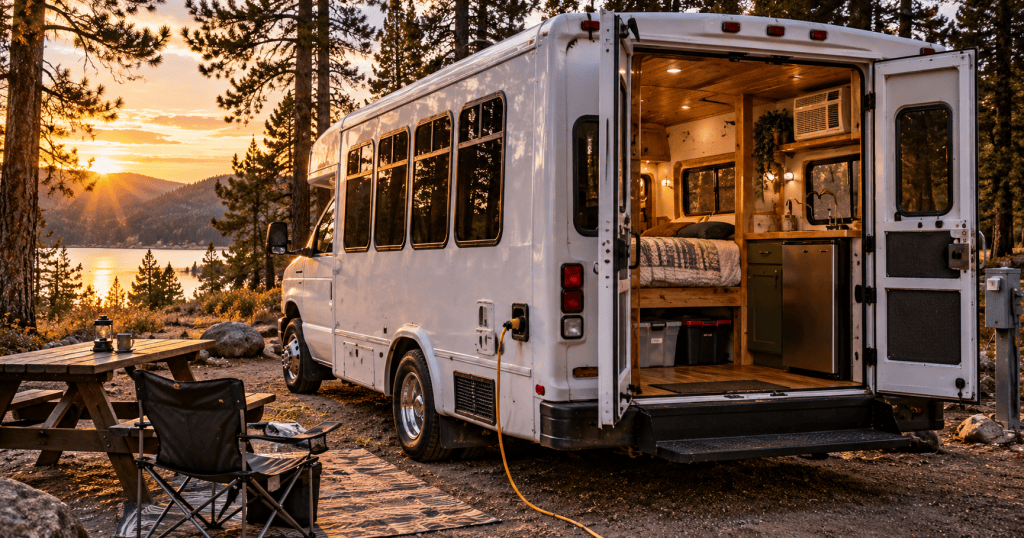
A 78-year-old retired military veteran named Bill turned a 2015 Chevrolet Express 3500 shuttle bus into a simple camper home built around reliability, state-park travel, and systems he can actually repair and understand.
The build was featured by New Jersey Outdoor Adventures in a September 2026 YouTube tour. Instead of copying the increasingly common van-build formula of huge lithium banks, large solar arrays, complicated plumbing, and expensive integrated electronics, Bill designed the bus around the way he actually travels.
The Bus Started As A Chevrolet Express 3500
The base vehicle is a 2015 Chevrolet Express 3500 shuttle bus with a 6.0-liter Vortec V8. That platform gives the build a heavy-duty commercial chassis, dual rear wheels, tall standing room, and a boxier interior than a normal cargo van.

The extra interior height was one of the biggest advantages. The finished space provides more than 6 feet 2 inches of standing room, which changes how practical the vehicle feels compared with a low-roof van where almost every activity happens sitting down or crouched over.
Mechanical Reliability Came Before Interior Features
One of the smartest parts of the build is the order of priorities. Bill spent money making sure the drivetrain, brakes, tires, and basic vehicle systems were dependable before treating the bus like a tiny house.
That sounds obvious, but camper conversions can reverse that logic. It is easy to spend thousands on cabinets, batteries, lighting, and appliances while the vehicle carrying all of it still has deferred mechanical work. Bill’s approach treats the camper as a vehicle first and a room second.
The Electrical System Is Deliberately Simple
The bus uses a 30-amp shore-power connection when campground electricity is available. A converter supplies 12-volt DC power from the 120-volt AC source, while a portable Jackery power station provides another compact source of stored electricity.
There is still an inverter in the system, but the build does not revolve around a giant permanently installed lithium bank. That matches Bill’s travel pattern because state parks and campgrounds often provide electrical hookups. Designing around available infrastructure keeps the system smaller and easier to troubleshoot.
The same conversion principle appears at much larger scales in solar inverter systems: different parts of an electrical system often operate at different voltages or forms of power, so converters and inverters sit between them and make the loads usable.
Air Conditioning Does Not Need A Custom Roof System
Instead of installing an expensive rooftop RV air conditioner, Bill uses a removable window-style AC arrangement. It is a good example of solving the actual problem rather than automatically choosing the most specialized RV component.
The tradeoff is obvious: a removable system takes setup and is less integrated. The benefit is that the hardware is common, replaceable, inexpensive compared with many RV-specific systems, and easy to understand.
Water Storage Is Kept Basic Too
The camper uses a straightforward fresh-water setup instead of a large pressurized plumbing network with an indoor shower and multiple permanent tanks. Bill expects to use campground facilities when they are available.
That removes pumps, long pipe runs, extra fittings, leak points, winterization problems, and a large gray-water system. Again, the design follows the use case rather than trying to make the vehicle completely independent of outside infrastructure.
The Interior Uses Small Mechanical Solutions Everywhere
The most interesting parts of the camper are often the smallest. Bill made custom cabinet and refrigerator latches with a scroll saw, uses magnetic blackout shades over the windows, and installed a marine-style pedestal table that can be moved or removed when the space needs to change.
The cabinets are shaped to reduce the chance of hitting your head while moving through the narrow interior. Swivel chairs add seating without requiring a permanent built-in dinette, and heavy-duty tie-down points keep furniture secure while the vehicle is moving.
The Bed Was Treated Like A Real Bed
Bill devoted a large amount of interior volume to a 16-inch residential pillow-top mattress. That choice says a lot about the build philosophy. A camper can be mechanically impressive and still be miserable to use if the sleeping setup is treated like an afterthought.
For long trips, comfort is not decorative. Sleep quality directly affects driving safety, recovery, and whether someone actually enjoys using the vehicle for more than a weekend.
The Build Stayed Under Roughly $20,000
The video places the total vehicle-and-build budget below roughly $20,000, with the bus itself purchased for about $10,000. That figure is useful because the project is not presented as a six-figure luxury van disguised as DIY engineering.
The more important lesson is where the money went. Reliability, brakes, tires, sleeping comfort, functional storage, shore power, basic climate control, and usable standing room received priority over complicated automation or oversized off-grid systems.
This Is A Better Way To Think About DIY Builds
A good build is not the one with the most components. It is the one where every component supports the owner’s actual use case.
Bill already had experience with teardrop trailers, travel trailers, and a Class C motorhome. That experience appears throughout the shuttle bus: he knew which features mattered to him and which expensive systems he could leave out.
That is why build videos are useful technical sources when treated carefully. They show the engineering tradeoffs that product pages and specification sheets often hide: what broke, what was simplified, what was left out, what had to be fabricated, and what the builder would actually trust on the road.
Why BitcoinVersus.Tech Is Covering Builds Like This
Engineering is not limited to laboratories, fabs, data centers, or robotics companies. A well-designed camper conversion combines electrical distribution, AC/DC conversion, HVAC, water systems, mechanical reliability, load restraint, materials, cabinetry, thermal management, and human factors inside one moving platform.
That makes high-quality maker videos a useful addition to the normal BitcoinVersus.Tech rotation. The goal is not to repost lifestyle content. It is to extract the engineering decisions that make a real build work.
Editor’s Note
The featured image is original photorealistic editorial artwork created specifically for this story and is not reused in the body. The body image is a separate still from the New Jersey Outdoor Adventures video. The full build tour is embedded as a responsive native Gutenberg YouTube player, and the related Chevy Express shuttle-conversion discussion is embedded directly from Reddit. No normal story text is placed inside cards, panels, callouts, or text boxes.
BitcoinVersus.Tech content is provided for informational and educational purposes.


Leave a Reply