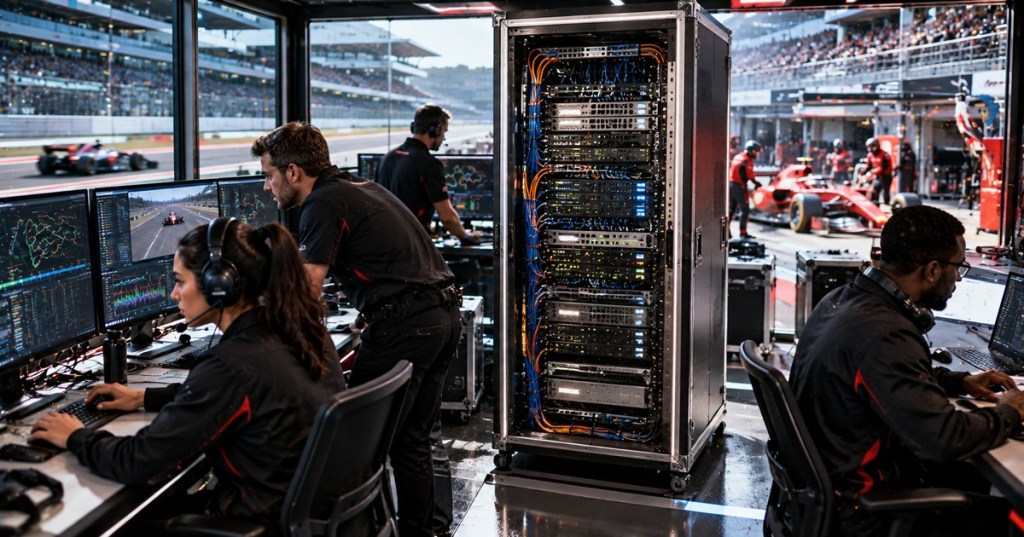
Formula 1 has reduced the travelling data-center footprint it takes to each Grand Prix from three racks of IT equipment to one while moving more telemetry processing back to the circuit.
The system is called the Event Technical Centre, or ETC. It travels with Formula 1 from race to race and acts as the trackside technology hub for timing, telemetry, camera feeds, team radio, audio, and other data that has to move between the circuit and Formula 1’s permanent Media & Technology Centre in Biggin Hill, UK.
Computer Weekly reported October 11 that the ETC has now been consolidated from three racks to one. Formula 1 also moved telemetry processing that previously depended more heavily on its UK facility back to the track itself.
One rack is doing more work than before
The smaller hardware footprint does not mean Formula 1 is collecting less information. The opposite is happening.
In Lenovo’s May 2026 telemetry-platform announcement, the company said every Formula 1 car produces about 1.1 million data points per second from more than 300 sensors.
The data includes information such as engine performance, suspension status, gearbox behavior, fuel, G-forces, and driver-control inputs.
Formula 1 now processes and deduplicates roughly 8 TB of telemetry per race weekend directly at the circuit using Lenovo ThinkSystem SR650 V3 and DE4000F infrastructure in the ETC.
Moving processing to the track cuts latency
Previously, telemetry collected at the track could make a round trip between the circuit and Formula 1’s Media & Technology Centre before reaching the teams and other stakeholders.
Lenovo says moving more of that processing directly into the ETC can reduce telemetry delivery latency by as much as 0.3 seconds at the most geographically distant races.
Three-tenths of a second sounds small in normal IT operations. In Formula 1, where race strategy can depend on real-time tire, power-unit, weather, and traffic data, it is meaningful.
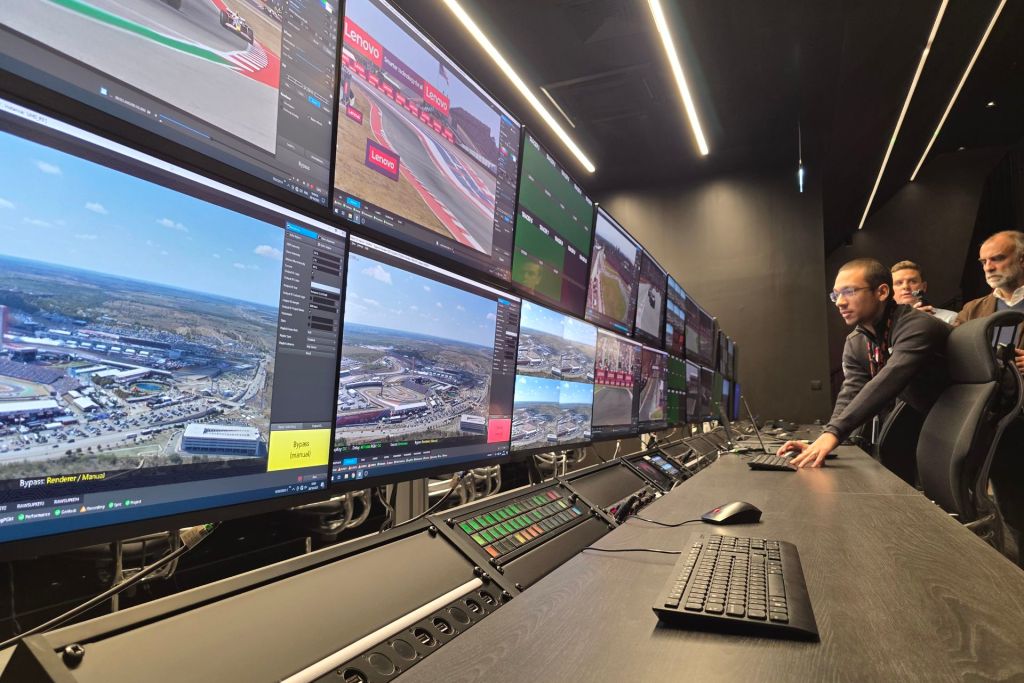
The one-rack ETC is only one part of a much larger system
The trackside rack should not be confused with Formula 1’s entire computing environment.
Lenovo says roughly 600 TB of live data can move between the ETC and the Media & Technology Centre during a typical race weekend when timing, telemetry, tire data, team radio, camera feeds, and audio are counted together.
The permanent Biggin Hill facility runs more than 180 bespoke software systems containing more than four million lines of code, according to Lenovo.
So the technical change is not “Formula 1 now runs on one server rack.” It is that the portable trackside portion of the infrastructure has become denser while accepting more local processing responsibility.
Virtualization is doing much of the consolidation work
The ETC uses Lenovo servers as a virtualization platform. Instead of dedicating a physical server to every individual application, multiple isolated workloads can share the same underlying compute hardware.
This is a standard data-center efficiency technique, but Formula 1 has an unusual constraint: the infrastructure has to be packed, shipped, installed, tested, operated under race-weekend pressure, and then moved again.
Every rack removed reduces equipment volume, cabling, weight, power requirements, cooling demand, deployment work, and the number of physical components that can fail during transport.
BitcoinVersus examined the same broader principle in our 2024 guide to improving data-center efficiency: increasing useful IT work per unit of infrastructure can matter as much as raw compute performance.
It is effectively an edge data center
Formula 1’s ETC is a strong real-world example of edge computing.
The permanent facility in the UK still performs enormous amounts of processing, but latency-sensitive telemetry work is being moved physically closer to the source of the data—the race circuit.
That same architecture appears in factories, telecom networks, autonomous systems, retail, energy infrastructure, and industrial automation. Some workloads belong in large centralized data centers. Others become more useful when they are processed close to the equipment generating the data.
Networking is as important as the servers
Processing telemetry locally only helps if the networking layer can move the right data to the right systems reliably.
The ETC has to support real-time feeds while maintaining connectivity back to Biggin Hill and distributing results to Formula 1, the FIA, teams, broadcasters, and other authorized systems.
This is where basic networking concepts become operational engineering. Our 2025 network-port overview explains the transport and service layer underneath the applications that depend on Ethernet and IP connectivity.
The permanent data center is moving toward liquid cooling
The trackside ETC is becoming smaller, while Formula 1’s permanent compute environment is becoming denser.
In January, Formula 1 and Lenovo announced deployment of Lenovo Neptune liquid cooling inside the Biggin Hill facility. The system uses direct warm-water cooling around high-density Lenovo ThinkSystem servers supporting HPC and AI workloads.
That follows the same density problem confronting AI data centers: once more compute is packed into less floor space, heat removal becomes one of the limiting factors.
BitcoinVersus covered that transition in our 2025 comparison of air, water, and immersion data-center cooling.
Smaller does not mean simpler
Consolidating three racks into one can actually increase the importance of reliability engineering.
When workloads become physically denser, individual hardware failures can affect a larger share of the system. Power, cooling, storage, network redundancy, spare parts, monitoring, backups, and failover therefore become even more important.
Formula 1’s requirement is unusually strict because a race cannot simply stop for an IT maintenance window while millions of viewers wait.
Bottom line
Formula 1’s travelling data center has become physically smaller while taking on more local compute work.
The ETC has moved from three racks to one, while Lenovo’s 2026 telemetry architecture brings roughly 8 TB of race-weekend telemetry processing to the circuit and can reduce delivery latency by up to 0.3 seconds.
The change is a good example of where modern infrastructure is heading: denser servers, more virtualization, more edge processing, faster networks, and liquid cooling where central compute density becomes high enough to demand it.
BitcoinVersus.Tech Editor’s Note: The one-rack figure refers to Formula 1’s travelling Event Technical Centre, not its entire race-technology infrastructure. Formula 1 continues to rely on its larger Media & Technology Centre in Biggin Hill and extensive networking between both locations.
Follow BitcoinVersus.Tech for data centers, Formula 1 technology, networking, cooling, AI infrastructure, robotics, and emerging computing systems.
Support independent technology reporting: Bitcoin donations help fund BitcoinVersus.Tech research and publishing.
Disclaimer: BitcoinVersus.Tech provides technology news and analysis for informational purposes only.


Leave a Reply