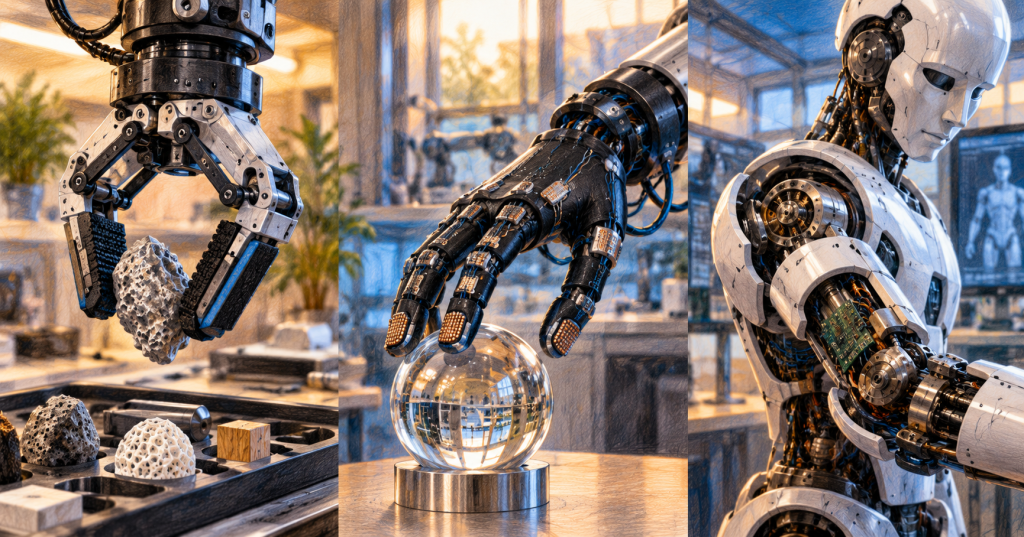
October 20, 2026 — Robotics / Semiconductors. Infineon announced the winners of its 2026 humanoid robotics startup challenge on October 19. The competition highlights three practical engineering needs: reliably gripping objects, sensing contact and controlling actuators efficiently.
Key Takeaways
- Italy’s AdapTronics won first place for adaptive gripping technology.
- South Korea’s COSMOKE placed second with magnetic tactile sensing.
- Germany’s TECHiFAB finished third with in-memory computing for motor control.
- More than 100 startups from 29 countries participated, according to Infineon.
AdapTronics Takes First Place
AdapTronics develops gripping technology intended to handle different objects without relying on conventional suction cups or mechanical grippers. Its potential uses include logistics and packaging. Winning the competition does not itself establish performance in large-scale commercial deployments; those results require independent testing.
COSMOKE Adds a Sense of Touch
COSMOKE’s COSKIN uses flexible magnetic tactile sensing to measure physical interaction. Touch feedback can help a robot determine whether an object is slipping or whether a grasp applies too much force. Reliable manipulation depends on sensing as well as movement.
TECHiFAB Targets Actuator Efficiency
TECHiFAB’s in-memory computing approach aims to process information closer to where it is stored for real-time motor control. The company proposes that this could improve actuator response and energy efficiency. Comparative performance and power savings were not quantified in Infineon’s announcement, so these remain engineering objectives rather than independently demonstrated universal gains.
Why These Three Technologies Matter Together
A humanoid hand must first perceive contact, then calculate an appropriate response and finally move its actuators while limiting force and energy consumption. Better gripping, tactile sensing and motor control address different parts of that same feedback loop. The technologies may also benefit industrial robots that are not humanoid.
Video and Community Context
The following video discusses Infineon’s 2026 humanoid robotics startup challenge. It predates the final results and should be viewed as background rather than footage confirming the winners.
Watch the original video on YouTube.
A separate robotics community discussion addresses the practical difficulties of humanoid manipulation, sensing and reliable deployment. It is contextual commentary, not an official Infineon announcement.
Humanoids Were Everywhere at Automate 2026, But So Was the Skepticism — r/robotics
Read the original Reddit discussion.
What Comes Next
Infineon says AdapTronics will enter its Startup Co-Innovation Program, with collaboration expected to begin in November. Whether the winning systems achieve broad deployment will depend on repeatable performance, integration cost, safety testing and manufacturability.
Sources
Infineon: Official October 19 competition results; Infineon: Humanoid Robotics Startup Challenge.
BitcoinVersus.Tech Editor’s Note: We volunteer daily to ensure the credibility of the information on this platform is Verifiably True. If you would like to support to help further secure the integrity of our research initiatives, please donate using the QR code provided

For best QR-code scanning results, please scan this donation code from a desktop or larger screen. Mobile screens may prevent camera recognition.


Leave a Reply