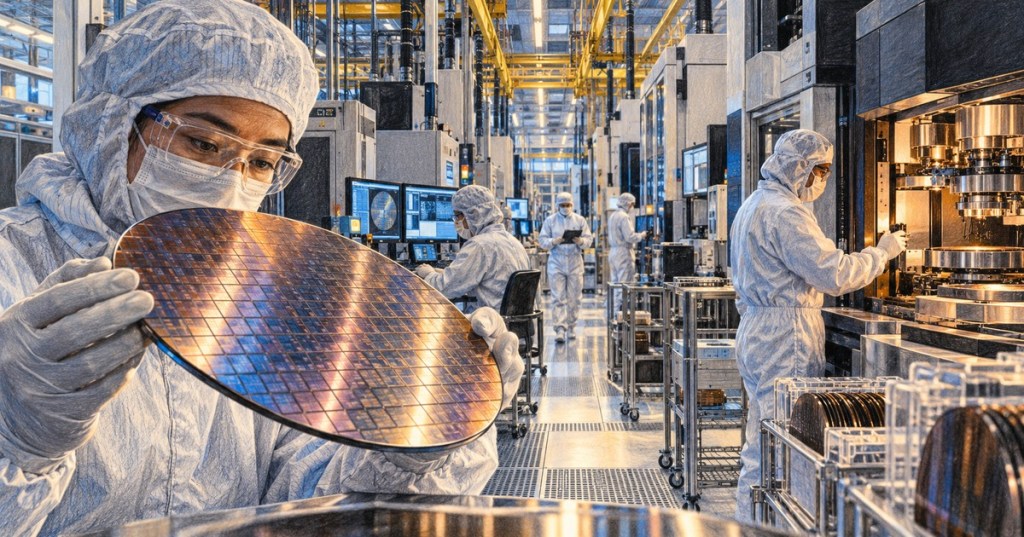
October 21, 2026 — Texas, United States. SpaceX and Tesla have given their ambitious Terafab semiconductor project two concrete but provisional milestones: a first functional test chip in May or June 2027 and a hoped-for start of volume manufacturing in the third quarter of 2028. Elon Musk disclosed the targets during SpaceX’s October 20 earnings call, cautioning that the factory schedule remains uncertain. The dates are planning objectives, not evidence that advanced chips have already been successfully manufactured.
Key Takeaways
- The Austin research fab aims to produce a functional SRAM test chip by mid-2027, a step toward qualifying the fabrication process rather than a commercial AI processor launch.
- The main Terafab operation in Grimes County, Texas, is aiming for volume production in Q3 2028; Musk also described Q4 2028 as within the possible range.
- Equipment availability, especially advanced lithography systems, facility readiness and acceptable wafer yields remain critical challenges.
- The proposed 1-terawatt annual compute-capacity goal is a long-term production ambition, not current output or a demonstrated chip-performance measurement.
What Musk Said About The Schedule
In response to a question on the SpaceX earnings call, Musk described internal expectations for an SRAM-based process-validation chip at the Austin research fab in approximately May or June 2027. He said the larger Terafab plant at Gibbons Creek in Grimes County could potentially achieve volume production around Q3 or Q4 2028. He emphasized the large uncertainty surrounding both milestones. The October 20 call recording and transcript provide the underlying remarks; Reuters separately reported the timeline.
The distinction between a test chip and manufacturing scale is central. Static random-access memory (SRAM) test structures are useful for checking whether a semiconductor process can produce functioning transistors and repeated circuit cells. They can inform assessments of defects, electrical behavior and process stability. A working SRAM test chip would be meaningful progress; it would not by itself establish commercially viable yields, acceptable costs or production readiness for complex AI accelerators.
What Terafab Is Building In Texas
SpaceX’s August 6 project announcement named Grimes County as the location for the main plant, while the research fab was already under development at Giga Texas near Austin. Its stated ambition is to integrate advanced logic manufacturing, memory, packaging and testing, shortening the distance between design changes and finished silicon. SpaceX said the initial project phase was estimated at about $16.8 billion and could support at least 3,000 jobs. Those commitments describe a proposed development, not completed spending or a fully staffed factory.
This builds on BitcoinVersus.Tech’s earlier reporting on Musk’s discussions involving TSMC and Terafab and our October 15 follow-up on TSMC’s Texas assessment. The new development is the explicit manufacturing timetable, not a new confirmation of TSMC production commitments.
The Manufacturing Bottlenecks
Advanced semiconductor fabrication requires more than a completed building. A fab must install and calibrate lithography, deposition, etching, metrology and inspection tools; establish reliable chemical, gas, water, power and cleanroom systems; then tune manufacturing recipes across many process steps. New process nodes also require extensive yield learning and repeatability testing before economical high-volume output is possible.
Extreme-ultraviolet (EUV) lithography equipment from ASML is an especially important constraint for leading-edge chips. Asked on the earnings call whether Terafab had ordered the necessary machines, Musk did not directly confirm a specific order. He thanked ASML and other suppliers for moving equipment deliveries forward. That should not be rewritten as proof of an installed EUV production line. Industry reports have offered slower independent ramp forecasts, underscoring how much remains to be demonstrated.
How To Interpret The One-Terawatt Goal
Terafab’s vision has been described as producing chips representing about 1 TW of computing electrical-power capacity per year. This is an aspiration for the aggregate capacity of chips manufactured, not a single chip delivering a terawatt, not proof that the factory consumes a terawatt, and not a measured rate of computation in FLOPS. Chip efficiency, rated power and the number of finished devices would have to be specified before making a rigorous performance comparison. The broader demand case spans Tesla vehicles and Optimus robots as well as SpaceX’s proposed space-based computing systems.
Tesla previously summarized the factory announcement on X. Its post is included as the company’s original social statement about the Grimes County site, not as an announcement of the October 2028 production target.
The following Reddit discussion links to the original SpaceX release and includes technical debate about tooling and manufacturing scale. Community comments are opinions and are not independent validation of the timeline.
What To Watch Next
The strongest evidence of progress will be a disclosed functional test wafer, independently documented process characteristics, confirmed lithography tool installation, meaningful yields and a defined production run rate. The Q3 2028 objective is a substantial manufacturing challenge; it is neither impossible by definition nor established by an earnings-call projection. For now, Terafab has a clearer set of dates against which its execution can be measured.
Primary sources: SpaceX Q3 2026 earnings-call recording and transcript (October 20); SpaceX, Breaking Ground on Terafab in Texas (August 6); Texas Governor’s office, project and capital announcement.
BitcoinVersus.Tech Editor’s Note: We volunteer daily to ensure the credibility of the information on this platform is Verifiably True. If you would like to support to help further secure the integrity of our research initiatives, please donate using the QR code provided

For best QR-code scanning results, please scan this donation code from a desktop or larger screen. Mobile screens may prevent camera recognition.


Leave a Reply